49 works in this view — arrow keys or swipe to move between them.
Dance in Art
Espagne, Espana, Danse, Danza
Unknown artist
- Collection:
- Prints depicting dance
- Source:
- New York Public Library
- Rights:
- Public domain — free to use, share and adapt.
- Recorded as:
- Public Domain
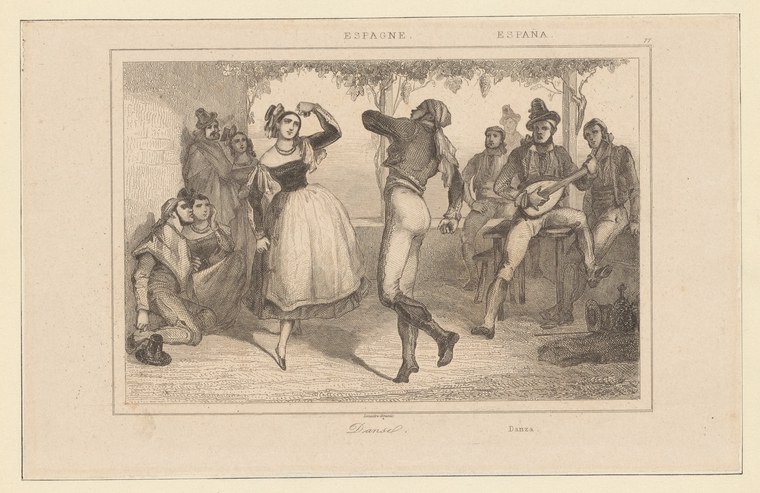
This print is an early visual record of Spanish folk dance in circulation before flamenco and regional Spanish dances became standardized for theatrical performance. For dancers and historians, it documents the social context in which these dances lived—as community events, not performances—and captures the body language and energy of vernacular practice as a 19th-century artist understood it. It is also a rare surviving image of a woman dancer in a non-elite setting, active and energetic, at a moment when such representations were still relatively uncommon.
What you are looking at
A woman in a white dress dances energetically before a gathered crowd in what appears to be a rural or village setting, with trees visible overhead. She is captured mid-movement, her body in a lively pose with one arm raised. Around her stand approximately a dozen figures in period dress—men in hats and jackets, women in long skirts and bonnets—arranged as spectators. The mood is convivial and festive, suggesting a folk celebration or community gathering. The composition is crowded and informal, with figures clustered around the central dancer, some seated on benches, others standing. The print is executed in a soft gray tone typical of 19th-century engraving or lithography, with careful attention to the textures of fabric and the play of light on the figures beneath overhanging foliage.
The dancing
The central dancer stands in an open, exuberant stance with her weight shifted dynamically, one leg bent and her skirt lifted and flaring outward, the other arm raised above her head in a gesture of abandon. Her posture suggests rapid movement—a turn or a vigorous step—captured mid-phrase. The spectators are rendered with varied attitudes: some lean forward in attention, others sit relaxed, their body language reading as amusement and interest rather than formality. The dancer's isolation in the center and the ringside arrangement of onlookers is characteristic of social dance documentation from this period.
The dance depicted
This is almost certainly a representation of Spanish regional or folk dance, as indicated by the title 'Espagne/Espana' and 'Danse/Danza'. The woman's raised arm, the dynamic hip and leg action, the lifted skirt, and the exuberant abandon of the pose suggest one of the popular Spanish dances of the 19th century—possibly a fandango, seguidilla, or a regional variant. The outdoor setting, the informal gathering of rural or village people, and the celebratory tone all point to folk dance rather than theatrical or court dance. Spanish regional dances of this era were characterized by energetic footwork, dynamic hip movement, and a sense of playful flirtation or joy, all of which the artist has captured here.
How it was made
This is an engraving or lithograph, likely from the mid-19th century, executed in tonal black and gray. The soft, graduated tones and the even texture suggest lithography rather than the sharper lines of wood or steel engraving, though the catalogue does not specify. The technique allowed for subtle modeling of light and shadow across fabrics and skin, and the soft gray palette creates an intimate, genre-scene quality. Such prints were produced for publication and circulation among a bourgeois readership interested in ethnographic or picturesque scenes of regional life.
About this work
This is a 19th-century print documenting a Spanish folk dance as it would have been performed in a village or rural setting. The work sits at the intersection of two 19th-century interests: the ethnographic fascination with regional and 'national' dances, and the Romantic valorization of folk culture and rural life as expressions of authentic human joy and community. It belongs in a dance gallery as evidence of how Spanish regional dance was understood, represented, and circulated in European visual culture during a period when such dances were becoming subjects of artistic interest and, eventually, theatrical adaptation.
The work is part of a larger body of 19th-century prints documenting dance across Europe and the Mediterranean, created both by artists with direct knowledge of the dance traditions and by those working from secondhand description or imagination. Its value lies not in documentary accuracy—which cannot be assumed—but in what it reveals about how dance was seen, composed, and valued during its period.
How to look at it
Note the artist's choice of moment: the dancer captured mid-turn or mid-leap, with the skirt lifted and the body in full exuberance. This is not a posed, balanced moment but an active one, suggesting movement and joy. Observe the contrast between the central figure's dynamic energy and the seated, attentive spectators arranged around her—a compositional device that emphasizes the dance as a social event, a performance for a community rather than an exhibition for a distant audience. The informal gathering, the outdoor setting, and the lack of stage or formality all speak to a different understanding of dance than the theatrical tradition of the period.
The period
This print was made during the 19th century, a period of intense European interest in regional, 'national,' and non-elite dance traditions. The Romantic movement had turned attention toward folk culture as an authentic expression of national character, and artists and collectors began documenting regional dances across Europe as ethnographic specimens. Spanish dance held particular fascination for Northern European artists and audiences, associated with passion, spontaneity, and the exotic Mediterranean. At the same time, Spanish regional dances were beginning to be adapted and regularized for the theatrical stage—a process that would accelerate throughout the late 19th and early 20th centuries, eventually producing the formalized flamenco and regional styles familiar today.
Where it lives
The work is held in the New York Public Library's collection of prints depicting dance. It is catalogued as a print (likely engraved or lithographed) but without specific information on medium, artist, or date. Such prints were typically produced for publication and circulation in illustrated books, journals, or as separate popular prints.
Dance in this work
Questions about this work
Is this a real dance or an artist's invention?
The print is titled as Spanish dance, and the dynamic pose, the outdoor setting, and the social context all align with documented Spanish regional folk dances of the 19th century. However, without attribution or documentation, it is impossible to say whether the artist had direct knowledge of the dance or was working from secondhand sources, description, or imagination. The print should be read as a 19th-century interpretation of Spanish dance, not as an ethnographic document.
What is the woman's dress telling us?
The white dress and the way it moves suggest a light cotton or linen garment suitable for active movement and warm weather—consistent with 19th-century Spanish regional dress for women. The skirt's ease of movement and its lifting in the dance suggest it was designed or chosen to be danced in, not merely worn. The informality of the dress (no corset visible, no elaborate trimming) marks this as folk dress rather than elite fashion.
Who are the onlookers?
They appear to be villagers or rural people—men in work jackets and hats, women in long skirts and bonnets. Their presence suggests this is a community event, not a formal performance or a staged attraction. The ringside arrangement is characteristic of how folk dances were socialized: a spontaneous or semi-organized gathering of the community watching one or more dancers.
More dance artwork





