49 works in this view — arrow keys or swipe to move between them.
Dance in Art
The polka on 19th-century music covers
Unknown artist
- Collection:
- Prints depicting dance
- Source:
- New York Public Library
- Rights:
- Public domain — free to use, share and adapt.
- Recorded as:
- Public Domain
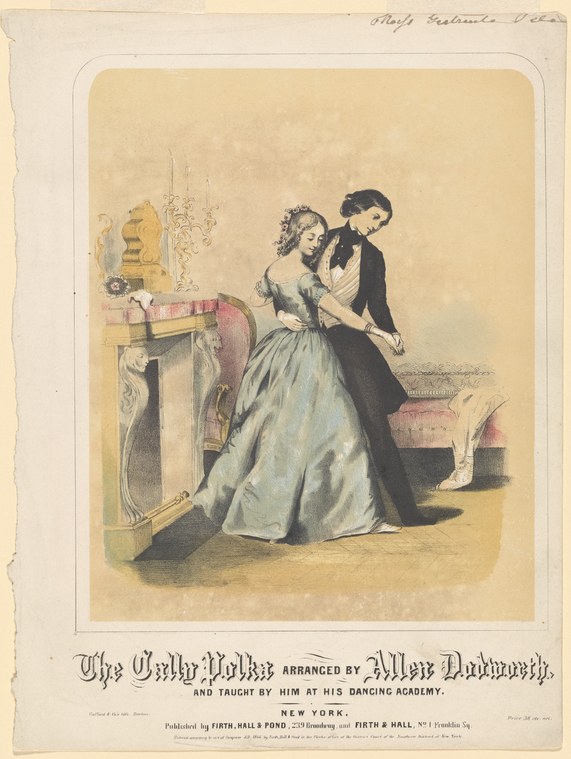
The Polka was the first truly international popular dance, spreading from Central Europe to ballrooms across the Atlantic within a decade. This print documents how a New York dancing master used the new technology of hand-colored lithography to market and teach it. For dance historians, it shows the actual positioning, dress, and ballroom setting of the dance in its moment of peak popularity.
What you are looking at
A man in dark formal dress—tailcoat, bow tie, and trousers—dances with a woman in a pale ball gown with full skirt and fitted bodice. The woman leans back into the man's supporting arm in a characteristic Romantic-era embrace, her body angled away from his while remaining in close contact. The setting is a grand interior with classical architectural details: a marble-topped side table in the foreground holds a decorative urn and flowers, a potted plant sits to the right, and the background suggests a ballroom with draped fabric or wallpaper. The lighting is warm and diffused, creating soft shadows that model the figures' forms. The moment captured shows the man guiding the woman through what appears to be a turning or pivoting motion, her skirt billowing with the movement. The hand-colored lithograph uses pale washes of blue, pink, and ochre against a cream ground, with black outlines defining the figures and furniture with precision.
The dancing
The couple holds in what is recognizably the Polka embrace: the man's right hand at the woman's waist, his left hand extended at approximately shoulder height, the woman's right arm raised to meet his. The woman's left hand rests on his shoulder or upper arm. Her body is lifted and turned, creating the characteristic sway and lean of the Polka, with her weight appearing to be on the balls of her feet in readiness for quick pivoting steps. The man's posture is upright and supportive, anchoring the turn. The positioning and the woman's animated posture—neither stiff nor relaxed—are consistent with the sprightly, rotational character of the Polka.
The dance depicted
This depicts the Polka, a couple dance that emerged in Bohemia around 1830 and became the dominant ballroom sensation of the 1840s–1860s. The title confirms it: 'The Polka.' The dance is recognized by the closed-position hold, the woman's backward lean, and the rotational motion implied by the woman's lifted skirt and the angled positioning of both bodies. The Polka was taught by professional dancing masters and performed at formal balls by upper-class couples, as the costume and setting here attest. The image captures the moment of rotation—the 'turn' that gave the Polka much of its character and appeal.
How it was made
This is a hand-colored lithograph, a reproductive technique that allowed rapid, economical circulation of popular imagery. The image was printed from stone and then individually colored by hand, a practice that made images like this affordable for music sheets, gift albums, and popular prints. The soft tones and fine linework typical of lithography suited the delicate rendering of fashionable dress and the graceful postures the Polka required. The medium's suitability for quick production is relevant: this print is explicitly a teaching aid and marketing image for 'The Polka,' 'arranged by Alfred Dodworth and taught by him at his dancing academy,' as the inscription states.
About this work
This is one of a series of mid-nineteenth-century instructional prints depicting the fashionable dances of the moment. The Polka was the defining dance of its era—a commercial and social phenomenon that spawned sheet music, print series, and professional instruction. Dodworth's name on this print anchors it to the largest dancing academy in New York City, which produced and sold such imagery to genteel families learning the latest steps. The print served multiple purposes: as a souvenir of instruction, as a model for practice at home, and as a status marker—aspiring to ballroom competence. It represents the moment when commercial dance instruction and lithographic mass production converged to create the modern market for dance imagery.
How to look at it
Observe the woman's relationship to gravity: she is not falling back passively, but actively lifted and supported, her weight centered through the couple's shared frame. This is not a static pose but a captured moment of rotation—the skirt's angle and the twist of the torso suggest the quick spinning motion the Polka required. The precision of the linework around the hand positions and the woman's arm shows the lithographer's understanding of the specific hold required; this is not a generic 'couple dancing' but a document of a particular embrace. Notice also the interior setting: the potted plant and marble table place this in a genteel ballroom, not a street or tavern—the Polka, by the 1850s, was firmly an upper-class ballroom dance in America.
The artist
Alfred Dodworth (1801–1876) was the most prominent ballroom dancing master in mid-nineteenth-century New York, operating a prestigious academy on Broadway. He was known for rapid adoption of new dances and for using print and instruction manuals to extend his reach beyond his physical academy. Dodworth's 'Dancing as a Fine Art' and his instructional print series made him a major figure in codifying and popularizing ballroom dance in America. The inscription crediting him as arranger and teacher is consistent with his brand: he positioned himself as both innovator and authority.
The period
The Polka emerged in Prague in the early 1830s and reached Paris by 1840, London by 1843, and New York shortly after. By the 1850s it had eclipsed earlier dances like the Quadrille and Waltz in popularity. The dance coincided with a surge in commercial dance instruction and the rise of lithography as a mass medium for popular entertainment. Dodworth's academy opened in 1834 and thrived during this period, training thousands of New York's prosperous families. Print series like this one were a standard way of spreading knowledge of new dances and advertising the dancing master's credentials and taste.
Where it lives
The print is held in the New York Public Library's collection of prints depicting dance. It is part of a series of instructional and promotional lithographs issued by Dodworth's academy or by music publishers in collaboration with him. The text at the bottom indicates it was published by Firth, Hall & Pond, a major New York music publisher, placing it among the commercial ephemera of popular culture.
Dance in this work
Questions about this work
Who was Alfred Dodworth and why is his name on a dance print?
Alfred Dodworth was the proprietor of the largest and most prestigious ballroom dancing academy in New York City during the mid-nineteenth century. His academy was known for teaching the latest fashionable dances to wealthy families. Dodworth used his name and reputation to market instructional prints like this one, which served both as souvenirs of lessons and as marketing for his academy. The print combines Dodworth's brand authority with the publisher's reach to reach customers who might never attend his academy in person.
What was the Polka and why was it so popular?
The Polka was a couple dance in 2/4 time that originated in Bohemia around 1830. It was characterized by a quick rotational step, a close couple position, and an energetic, almost athletic quality that contrasted with the stately Waltz and the formal Quadrille. It spread rapidly across Europe and America in the 1840s–1850s, becoming a symbol of modernity and cosmopolitan sophistication. Every ballroom and dancing academy taught it, and print series like this one fed demand for instruction and images.
How was this print made and who would have owned it?
This is a hand-colored lithograph: an image drawn on a stone block, printed in black ink, and then individually colored by hand with watercolor or gouache. This method was economical and fast, allowing publishers to produce prints cheaply and in quantity. Someone who had taken lessons at Dodworth's academy, or who aspired to learn the Polka at home, might purchase this print as a reference. It would have cost a few cents—affordable for a middle-class or prosperous family.
More dance artwork





