49 works in this view — arrow keys or swipe to move between them.
Dance in Art
Portefeuille historique de l'ornement
Unknown artist
- Collection:
- Prints depicting dance
- Source:
- New York Public Library
- Rights:
- Public domain — free to use, share and adapt.
- Recorded as:
- Public Domain
This work is significant as historical evidence of how the human figure—including childhood and allegorical bodies—was integrated into the visual and material culture of the 18th-century interior. For dance historians, it documents the visual language within which choreography and courtly movement existed, showing how bodies were rendered in the decorative schemes that framed aristocratic and elite domestic space.
What you are looking at
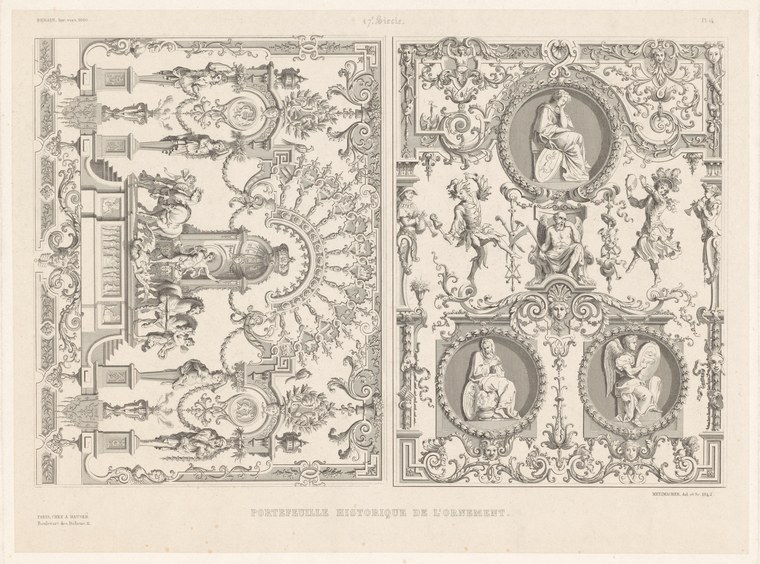
This is a decorative ornament design presented in two facing pages, likely from a printed portfolio or pattern book. The left page shows a symmetrical architectural layout with paired grotesque figures, urns, and classical ornamental scrollwork arranged around a central vertical axis. The right page displays a different composition with three oval portrait medallions—one at top center and two below—surrounded by elaborate acanthus leaves, putti, swags, and flowing rococo ornament. Both pages are framed with decorative borders. The engravings are finely detailed in the neoclassical to rococo style, rendered in black line on cream paper. The figures throughout are small and integrated into the ornamental scheme rather than portrayed as primary subjects; they serve as decorative elements within an overall design for architectural or interior embellishment.
The dancing
The human figures are consistently small, stylized, and incorporated into ornamental passages rather than depicted as active dancers. Several appear in poses suggesting classical ease—reclining, seated, or standing in contrapposto—but they function as decorative motifs. The putti (cherubs) scattered throughout are rendered in the rococo manner, some appearing to float or recline among scrollwork. No clear dance holds or frames are evident; the figural poses appear to reference classical statuary and allegorical convention rather than choreographic practice.
The dance depicted
While this portfolio contains human figures in various attitudes, it does not depict dance. The figures are ornamental elements serving the neoclassical and rococo design vocabulary of the period. They are arranged to complement architectural and decorative schemes rather than to illustrate movement or choreography. Any motion implied is decorative and allegorical rather than choreographic.
How it was made
This is an engraving, identifiable by the fine parallel lines (hatching and cross-hatching) used to create shadow and modeling, and the precise, controlled line work characteristic of intaglio printing. The even tone and technical precision suggest a professional hand, likely created for reproduction and circulation within design circles—as a reference book for decorators, architects, and ornament designers. Such portfolios were distributed to craftspeople and artists as sources for ornamental motifs.
About this work
This plate belongs to a European ornamental design portfolio, likely 18th-century French or Italian in origin (though unattributed in the record). It exemplifies the neoclassical-rococo transition in decorative arts, combining classical architectural elements with flowing rococo vegetation and figural ornament. The human and putti figures are component parts of an overall design system rather than subjects in their own right. While the catalogue places this in a dance collection, the work does not depict dance; it is instead a design resource for architectural and interior embellishment, in which figurative motifs appear as one element among many.
How to look at it
Attend to the systematic organization of the ornament: how the eye is guided through symmetry, repetition, and hierarchy. Notice how figures are scaled and positioned within the overall composition—they are never the dominant element. The engravings are meant to be studied closely and repeatedly referenced; look at how individual motifs (a single scroll, a putto, a classical urn) could be extracted and adapted. The quality of line work reveals the skill required in this professional craft.
The artist
The artist is unrecorded in the catalogue. Based on style and technique, this is a professional engraver working in the rococo tradition, likely French or Italian, with access to classical sources and working knowledge of architectural ornament. The quality of execution and the systematic organization of the portfolio suggest a trained hand, possibly working within a larger commercial or court-sponsored publishing enterprise.
The period
This portfolio dates to the 18th century, an era of intense engagement with classical revival and rococo ornament across Europe. Ornament books and design portfolios were circulated widely among architects, decorators, and artists as reference materials. Dance during this period was primarily courtly and aristocratic; the interior spaces shown here would have housed dancing and music-making. The inclusion of figural ornament—putti, allegorical figures, and classical poses—reflects the period's conflation of visual beauty, moral allegory, and refined taste.
Where it lives
This engraving is held in the New York Public Library's collection of prints depicting dance. It is catalogued as part of a portfolio titled *Portefeuille historique de l'ornement* (Historical Portfolio of Ornament), with no recorded artist, date, or medium beyond the holding description.
Questions about this work
Is this actually a dance image?
No. While it contains human figures and putti, they are ornamental elements serving a decorative design system, not choreographic subjects. It was likely catalogued here as part of a larger collection of prints that also includes actual dance scenes, or because the collection focuses on visual culture in which dance occurred. The figures are static, allegorical, and architectural in purpose.
What was a portefeuille historique?
A portfolio of designs, engravings, or prints distributed as a reference resource for professionals—in this case, architects, interior designers, and decorators. These were working documents, consulted repeatedly to adapt and combine motifs into new schemes. They were commercial products, circulated widely across Europe.
Who would have used this?
Decorators, architects, stucco-workers, furniture makers, and pattern designers working for elite and aristocratic households. A designer tasked with creating ornament for a ballroom or salon would have consulted such portfolios to select, combine, and adapt motifs.
Why is it in a dance collection?
Likely because it is part of a larger printed collection encompassing visual culture of the 18th century, or because it was shelved with other ornament prints that document the spaces in which dance occurred. Dance historians study not only choreography and performance, but also the material and visual contexts in which dancing took place.
More dance artwork





