49 works in this view — arrow keys or swipe to move between them.
Dance in Art
Rope dancing
Unknown artist
- Collection:
- Prints depicting dance
- Source:
- New York Public Library
- Rights:
- Public domain — free to use, share and adapt.
- Recorded as:
- Public Domain
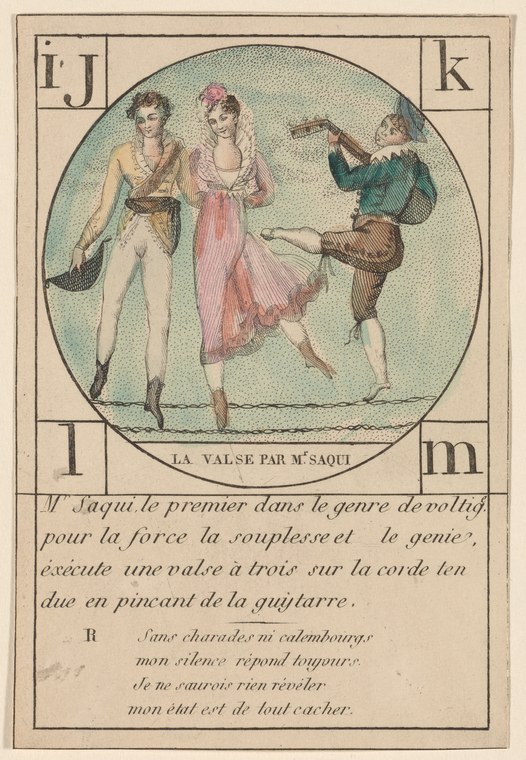
The waltz arrived in European ballrooms in the 1770s–1780s and became explosive—celebrated by some as the height of grace and condemned by others as scandalous for its close partner contact. This print documents the dance not as a folk or social form but as a theatrical achievement worthy of being credited to a named artist. It shows us how waltzes looked when they were still a novelty, when practitioners trained in classical dance technique applied that training to turning in three-time.
What you are looking at
A hand-colored engraving depicts a waltz in the late 18th century, framed within a circular composition bordered by letters J, K, L, M (a common convention for print cataloguing). The scene unfolds on a stage or performance space with a pale blue-green ground. At center, a woman in a flowing pink gown with white plumage in her hair dances in the arms of a man in dark coat and breeches. To the left stands a second male figure in tan breeches and dark jacket, gesturing toward the dancing pair. The composition is shallow and intimate, focusing entirely on the three figures against a neutral background. The title below reads "LA VALSE PAR M'SAQUI" (The Waltz by M. Saqui), and a verse in French below the image praises the performers' grace and genius. The engraving is finely detailed with delicate crosshatching defining form and drapery.
The dancing
The dancing pair occupy the center with the woman's body angled away from her partner in a characteristic waltz frame, her right arm raised and left arm extended toward him. The man steadies her with a firm hold at her waist and hand-clasp. Her weight appears shifted onto one leg with the other leg extended, suggesting active turning in mid-motion. The gesture of the watching man—one arm raised in admiration or instruction—suggests this is a performance moment being narrated or judged. The woman's pose is balletic and elevated; her posture speaks of trained, theatrical movement rather than social dance.
The dance depicted
This depicts the waltz, the dominant social and theatrical dance of the late 18th and early 19th centuries. The inscription credits M. Saqui (likely a dancer or choreographer of the period), suggesting this is a celebrated performer or a famous version of the dance. The three-figure composition—two dancing and one observing or presenting—is typical of prints illustrating dance instruction or celebrated performances. The woman's extended line, the man's supporting frame, and the turning motion all accord with the waltz as it was performed in Regency and post-Regency contexts, where it had recently been adopted into ballrooms and theaters. The theatrical setting and formal dress indicate this is theatrical rather than social performance.
How it was made
This is a hand-colored engraving, likely French or German, dating to the early 19th century based on costume and printing technique. Engravings of this size and style were mass-produced for the print market and circulated widely among dance enthusiasts, students, and the educated public. The engraver used fine parallel lines (crosshatching) to build form and shadow, and the hand-coloring was applied afterward—visible in the delicate watercolor wash of the background and the selective tinting of clothing. This technique allowed for widespread distribution and affordability compared to oil painting, making dance imagery accessible to a large audience interested in ballroom culture and theatrical performance.
About this work
This is a theatrical representation of the waltz at the moment of its ascendancy in European dance culture. Inscribed to M. Saqui, it records either a famous performer or an idealized version of how the dance was executed on stage. The engraving belongs to a rich tradition of dance prints—instructional, documentary, and celebratory—that flourished in the early 19th century as the waltz sparked both enthusiasm and moral anxiety across society. The work captures the dance at a specific historical moment: when it was still relatively novel, when it was still a courtship and theatrical spectacle rather than an established ballroom norm, and when its practitioners were celebrated as artists worthy of commemoration in print.
For dancers and historians, this print offers a window into how the waltz looked, how it was taught, and how it was valued. It shows the pose and frame expected of performers, the theatrical context in which it thrived, and the cultural moment that made a three-minute dance the subject of public debate and artistic representation.
How to look at it
Observe the woman's frame and line: her body is extended and lifted, her arm position balletic, suggesting that theatrical waltz incorporated the posture and training of classical dance. Notice the man's supporting role—he is positioned slightly behind and below her visual center, allowing the woman to dominate the composition. The raised arm of the observing figure draws the eye and suggests this is not casual social dancing but a performance being watched and judged. The artist has chosen the moment of turning, with the woman's weight shifted and one leg extended, emphasizing the rotatory motion that made the waltz notorious and exciting.
The artist
The engraver is not recorded in the catalogue. French and German printsellers were prolific producers of dance imagery during this period, often working from the sketches of theatrical designers or choreographers. The naming of M. Saqui suggests this may have been a commissioned print celebrating a real dancer or choreographer—a common practice for establishing reputation and reaching potential students or audiences.
The period
The waltz emerged in Vienna and Munich in the 1770s and swept into Paris and London in the 1800s, where it provoked intense cultural debate. Conservative critics condemned its intimacy and rotatory motion; dancers and musicians embraced it as a vehicle for virtuosity and expression. By the 1810s–1820s, when this print was likely made, the waltz was the dominant novelty in European ballrooms and a staple of theatrical dance. Prints of famous dancers performing waltzes were common merchandise, serving as both instruction aids and celebrity endorsements. The engraving technique allowed these images to circulate far beyond the capitals where the dances were performed, spreading knowledge of technique and style across the continent.
Where it lives
This is a hand-colored engraving held in the New York Public Library's collection of prints depicting dance. It belongs to a large corpus of early-19th-century dance ephemera—instructional images, celebrity portraits, and scene documentation—that circulated as affordable prints in Europe and America.
Dance in this work
Questions about this work
Who was M. Saqui?
The catalogue does not identify M. Saqui. The name appears in the title as the credited performer or choreographer of this waltz. Research in 19th-century dance records or French theater archives might identify this figure, but from the print alone we know only that Saqui was celebrated enough to be credited in an engraving intended for public sale.
Was the waltz always danced this way?
No. Waltz technique and style evolved significantly across the 19th century. This image shows how it was executed in a theatrical context in the early 1800s—with balletic posture and a close partner hold. Social waltzes could be less formal; rural or folk versions differed substantially. What you see here is a trained performer's idealized version.
Why is this engraving useful for dance history?
Engravings like this are primary documents of how dancers understood and performed the waltz at a specific historical moment. They show pose, frame, and stage presence. Unlike written descriptions, which can be vague or polemical, an image gives you direct visual evidence of execution and costume.
How common were these prints?
Hand-colored dance engravings were a significant part of the print market in the early 1800s, especially in France and Germany. They were affordable compared to paintings, and circulated widely in ballrooms, drawing rooms, and among dance students. They were both instructional and decorative.
More dance artwork





