49 works in this view — arrow keys or swipe to move between them.
Dance in Art
Rope dancing
Unknown artist
- Collection:
- Prints depicting dance
- Source:
- New York Public Library
- Rights:
- Public domain — free to use, share and adapt.
- Recorded as:
- Public Domain
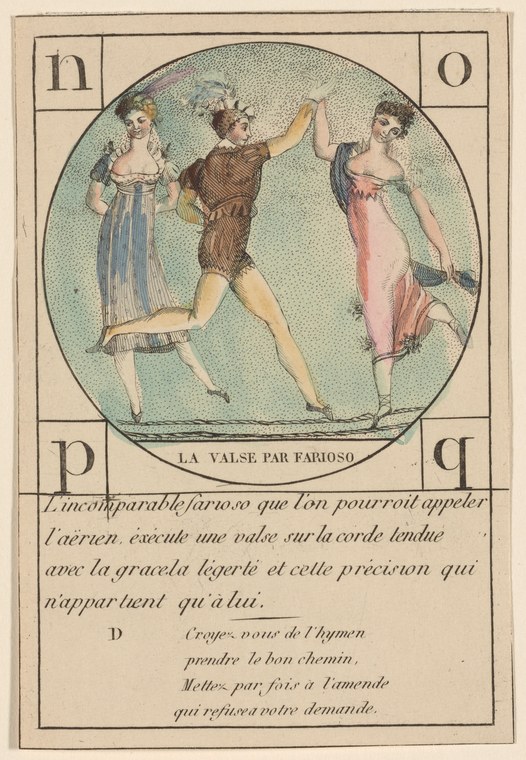
This image documents a hybrid performance form—the rope waltz—that bridged social ballroom dance and physical spectacle, and it preserves the name of a performer (Farioso) otherwise lost to history. It offers precise visual evidence of early 19th-century waltz posture, arm position, and the cultural prestige attached to the dance during a period of significant social controversy over its morality and propriety.
What you are looking at
This hand-colored engraving depicts three figures in Enlightenment dress performing a waltz on a rope. The composition is circular, framed within an ornate oval border with letters n, o, p, q at the cardinal points. Two women in high-waisted neoclassical gowns—one in blue-grey, one in pink—flank a central male figure in brown breeches and a short tunic. All three are shown mid-movement, their bodies in balletic attitudes of grace and lightness. The male dancer's raised arm and the women's extended limbs create diagonal lines of motion across the composition. The figures appear to float or glide across a taut rope depicted as a thin line at the base of the oval, their feet barely touching it. The background is a soft green-grey wash, giving the scene an ethereal quality. Below the engraving, French text identifies this as "La Valse par Farioso" (The Waltz by Farioso) with a passage describing an incomparable waltz performed with grace and precision.
The dancing
The three dancers occupy distinct positions: the central male figure strides forward with his right arm raised high and his torso twisted in a contrapposto stance characteristic of neoclassical art. His left leg extends behind him in a balletic line. The woman on the left stands with arms extended in a geometric, controlled frame; the woman on the right mirrors a similar pose but with her body turned in the opposite direction. All three figures maintain the upright carriage, narrow silhouette, and restrained arm positions typical of early 19th-century ballroom decorum. The feet are drawn with delicate precision, suggesting an art historical understanding of dance as a refined, aristocratic practice rather than folk movement.
The dance depicted
This is a waltz, as stated in the caption 'La Valse par Farioso,' performed on a rope (corde tendue). The waltz emerged as a fashionable social dance in the late 18th century, and by the 1800s had become the dominant European ballroom form, though initially controversial for its close partner hold and rotational movement. The image shows a theatrical or spectacular variant—the rope waltz—which was likely a novelty entertainment demonstrating the dance's elegance and the dancer's balance and skill. The inscription attributes the performance to 'Farioso,' suggesting this was a known performer or choreographer. The three-figure composition is unusual for a waltz, which typically involves couples; this may represent a solo male dancer with two female attendants, or an emblematic rather than literal representation of the dance.
How it was made
This is a hand-colored engraving, identifiable by its fine parallel hatching lines and precise linear definition. The coloring is applied in translucent washes—pale greens and blues dominate, with selective use of pink and brown—suggesting it was produced as a commercial print, likely colored by hand after printing in limited editions. Engravings of this type circulated among educated European audiences in the early 19th century, often as illustrations in dance manuals, theatrical prints, or popular scientific or artistic publications. The oval format and decorative border treatment suggest this may have been part of a series or an allegorical scheme.
About this work
This is an engraved and hand-colored print from the early 19th century depicting three elegantly dressed figures performing a waltz on a taut rope, an act attributed to a performer named Farioso. The work combines the conventions of ballroom dance imagery—the neoclassical dress, the upright posture, the refined gesture—with the theatrical spectacle of rope dancing, a feat of balance and control that was popular in circus and stage entertainments. The French caption and artistic execution suggest it was created for a cultivated audience interested in both dance instruction and fashionable amusement. It represents a moment when the waltz was at the height of its popularity in European society, and when the boundaries between social dance and theatrical or acrobatic performance were fluid and permeable.
How to look at it
Attend first to the rope depicted at the base of the composition—it is rendered as a single delicate line, and the dancers' feet are drawn touching or hovering just above it, creating the illusion of weightlessness and balance. Notice the symmetry of the composition: the two women mirror each other's poses on either side of the central male figure, creating a balanced, allegorical quality despite the claim of depicting a specific performance. Observe the precision of the line work and the restraint of the coloring; these conventions reinforce the image's claim to represent a dance of refinement and elegance rather than exertion or spectacle. The oval frame isolates the dancers from any earthly setting, presenting the waltz as an abstraction—an ideal rather than a documentary record.
The period
The waltz emerged from the folk dances of the Alpine regions in the late 18th century and rapidly ascended to dominance in European ballrooms during the Napoleonic era and Restoration period. By the 1810s–1830s, it had become the defining dance of the social season, despite fierce opposition from conservative moralists who objected to the close embrace, rapid rotation, and the physical intimacy it required between partners. Concurrently, circus and theatrical entertainments were increasingly professionalized and codified; rope dancing, tumbling, and other feats of agility were established attractions in amphitheatres and stages across Europe. The fusion of these two worlds in the 'rope waltz' reflects the period's fascination with demonstrating that aristocratic refinement and physical prowess could coexist, and that fashionable dance could be rendered spectacular through technical difficulty.
Where it lives
This print is held in the New York Public Library's collection of prints depicting dance. It is a commercial engraving from the early 19th century, hand-colored after printing, intended for circulation among educated European audiences with interest in dance, theatre, or fashionable entertainments.
Dance in this work
Questions about this work
What is a rope waltz?
A rope waltz was a theatrical entertainment in which trained dancers performed the waltz—a fashionable ballroom dance—while balancing on or moving across a taut rope. This combined the technical difficulty and spectacle of rope dancing (a circus or stage art) with the refined gesture and music of ballroom dance. It was a novelty attraction designed to astonish audiences with the dancer's skill and to elevate the waltz to the status of high art.
Who was Farioso?
Farioso is identified in the inscription as the performer of this dance, but little else is known. The attribution suggests he was a known entertainer or choreographer in early 19th-century Europe, but no other records of him survive in standard dance histories or theatrical archives. This print may be one of the only surviving documents of his work.
Why is there a male dancer in the center?
The composition is unusual for a waltz, which typically pairs one man and one woman. The central male figure with two female attendants may represent either a specific performance structure (in which a male performer danced with two partners, or was framed by two female attendants as part of the spectacle) or an allegorical or emblematic treatment of the dance, emphasizing balance and symmetry rather than literal documentary representation.
When was this made?
The style of dress, the neoclassical aesthetic, the waltz itself, and the technique of hand-colored engraving all point to the early 19th century, likely the 1810s–1830s, though the catalogue record does not provide a specific date. The height of the waltz's popularity and controversy coincides with this period.
More dance artwork





