49 works in this view — arrow keys or swipe to move between them.
Dance in Art
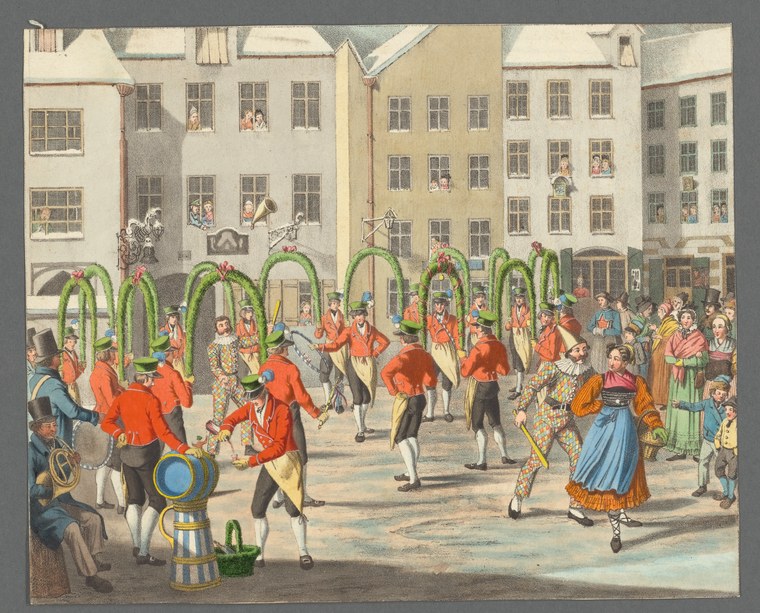
La fête des tonneliers de Munich [title penciled on verso]
Unknown artist
- Collection:
- Prints depicting dance
- Source:
- New York Public Library
- Rights:
- Public domain — free to use, share and adapt.
- Recorded as:
- Public Domain
This print is important because it preserves the visual appearance of a specific folk festival and the kinds of movement and gathering practices associated with it—details that would otherwise be lost. For historians of dance and community life, it shows that jumping, skipping, and celebratory movement were central to folk festivals, and that these were mixed-age, mixed-gender social events rather than formal performances. The image also documents the material culture of festival—the decorated spaces, the costumes, the presence of musicians—as a context for understanding how dance functioned in historic community life.
What you are looking at
A large courtyard or plaza surrounded by four-story residential buildings fills the composition. The scene depicts a festival or celebration, with dozens of figures in bright costume distributed across the space. The most striking elements are seven large, woven green structures resembling arches or tunnels, positioned in a loose line through the center of the square. Around and beneath these structures, figures in red and orange clothing—some standing, some moving—create clusters of activity. On the right, women in long skirts of yellow, blue, and green stand among children; on the left, seated musicians with instruments occupy the foreground. The light is even and bright, suggesting daytime. The entire scene has the character of a folk festival or fair, with the green structures as the focal point around which the community has organized itself.
The dancing
The figures vary in their positions and orientations, but most are depicted in standing or walking poses rather than a coordinated dance formation. Those in red and orange clothing appear to be moving through or beneath the green structures with raised arms and bent legs, suggesting jumping, skipping, or celebratory movement. The women and children on the periphery stand as spectators or participants at rest. No closed partnerships or strict frame is evident; the movement appears social and informal rather than choreographed in the ballroom sense. The distribution of figures is loose and crowded rather than organized into lines or sets.
The dance depicted
This depicts a folk festival or community celebration, most likely a German cooper's (barrel-maker's) festival, as the title suggests. The green structures appear to be decorative installations—possibly made of greenery or woven branches—rather than dance formations, yet the joyful movement of figures through and around them indicates that dancing or celebratory jumping is taking place. The style is consistent with German folk or peasant celebrations of the 18th or 19th century, where communities gathered for seasonal festivals. The jumping and skipping movements and the mixed-age participation suggest a folk dance tradition rather than formal ballroom or theatrical dance, though the specific style cannot be determined from the image alone.
How it was made
This is a hand-colored engraving or etching, executed with fine linear detail for architectural and figural outlines and then tinted with watercolor or hand-applied pigment. The print medium allowed for wide distribution and reproduction, making it suited for documenting folk customs and festivals for a broad audience. The hand-coloring—applied after printing—gives the image its bright reds, oranges, yellows, and greens. The precision of the architectural setting and the narrative detail of the composition suggest this was a commercial or documentary print, likely made for popular consumption in German-speaking regions.
About this work
This hand-colored engraving documents a festival gathering in Munich, identified by the penciled title as the coopers' (tonneliers') celebration. The image captures a moment of community celebration centered on large green structures that serve as focal points for jumping, skipping, and informal joyful movement among men, women, and children. Rather than a codified dance style, it records the festive movement and gathering practices of a specific trade guild or regional community, making it a visual document of folk custom and social celebration in historic Germany. The work belongs to a tradition of documentary prints that captured the visual character of regional festivals and celebrations for circulation among educated audiences.
How to look at it
Attend first to the relationship between the figures and the green structures: the jumping, raised-arm movement, and clustering of red-clad figures around and beneath the arches are the key to understanding the event. Notice how the movement is distributed and informal rather than organized into lines or couples. Look at the architecture of the square and the detail of the buildings to understand the civic or residential setting. The presence of musicians on the left and spectators on the right shows how the festival was organized as a social gathering with both performers and observers. The bright colors—the oranges and reds of the dancers against the green structures—suggest the artist's interest in capturing the visual spectacle and joy of the occasion.
The period
This print was likely made in the 18th or early 19th century, when German and European print culture was rich in documentary and satirical images of folk life and regional customs. The engraving tradition allowed artists and publishers to circulate images of festivals, celebrations, and folk practices to a growing audience of educated viewers interested in ethnographic detail. Such prints often served both documentary and entertainment purposes—preserving a record of how different communities celebrated while also offering urban audiences a view of rural or working-class festivity. The bright hand-coloring and narrative detail suggest this was a popular commercial print rather than a rare or elite production.
Where it lives
This print is held in the New York Public Library as part of a collection of prints depicting dance. The penciled title on the verso identifies it as 'La fête des tonneliers de Munich' (The Festival of the Coopers of Munich), suggesting it may have been part of a larger portfolio or series of festival scenes, possibly compiled or annotated by a later collector.
Dance in this work
Questions about this work
What are the green structures in the center?
They appear to be decorative installations made of greenery or woven branches, typical of festival decoration in German folk celebrations. They serve as focal points and gathering structures around which the celebratory movement and jumping take place.
Is this a depiction of a specific dance style?
No—this documents a folk festival and the celebratory jumping and movement associated with it rather than a codified dance style. The movement is informal, mixed-age, and social rather than choreographed in the manner of ballroom or theatrical dance.
Why focus on coopers specifically?
Trade guilds and craft professions held seasonal festivals and celebrations as part of their social and economic life. The coopers' festival may have been a well-known annual event that the print artist chose to document and distribute to interested audiences.
When and where was this print made?
The exact date and publisher are not recorded, but the style and hand-coloring suggest an 18th or early 19th-century commercial print, likely made in Munich or another German city for circulation among educated urban viewers interested in folk customs.
More dance artwork





