49 works in this view — arrow keys or swipe to move between them.
Dance in Art
Dancing girls
Unknown artist
- Collection:
- Prints depicting dance
- Source:
- New York Public Library
- Rights:
- Public domain — free to use, share and adapt.
- Recorded as:
- Public Domain
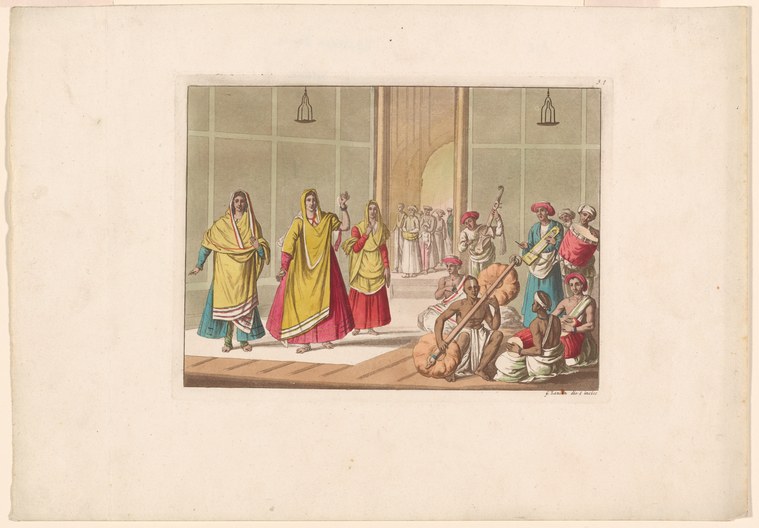
This image is a rare visual record of courtly dance practice in South Asian or Middle Eastern courts during a period when such performances were being documented for European audiences and collections. It preserves information about the formal dress, spatial arrangement, and social context of court performance that written sources alone cannot convey, making it valuable for understanding how dance functioned in elite contexts beyond Western Europe.
What you are looking at
A formal interior space with tall windows and hanging lamps frames this scene of dancers and attendants. Three women in elaborate dress occupy the foreground left: the nearest wears a yellow robe with a blue-green undergarment and a draped yellow head-covering; the second wears a deep red or crimson gown also with yellow drapery; the third is similarly dressed. To their right, a group of figures in lighter dress—some seated, some standing or kneeling—occupies the middle ground. The seated figures appear to be attendants or musicians; some wear what may be turbans or ornate headgear. In the background, a procession or gathered crowd of figures in various colored garments fills the deep space of the hall, suggesting a court scene or formal ceremony. The floor is rendered in perspective lines. The palette throughout uses warm yellows, reds, and earth tones against cooler greens and blues.
The dancing
The three foreground women face toward the gathered crowd in relaxed, upright postures; their bodies are not in a tight or partnered hold but rather stand independently, suggesting either a formal processional stance or a moment of presentation rather than active dancing. The figures to the right are predominantly seated or in low positions, their bodies angled toward the standing women. One kneeling figure appears to be gesturing or reaching toward the dancers. Arm positions are not raised or extended in the sharp angles of a choreographed movement but rather fall naturally or in gentle curves, consistent with courtly bearing.
The dance depicted
This appears to be a scene of courtly dancing or entertainment in a palace or formal court setting, most likely South Asian (Indian) or Middle Eastern based on the architectural elements, dress, headgear, and the composition of seated attendants around standing performers. The women's postures and the formal arrangement suggest this may document a presentation or performance style rather than social partner dancing. The identity of the specific dance form cannot be established from the image alone, but the seated attendants, the formal interior, and the presence of what may be musicians suggest this is a court entertainment scene, possibly depicting Mughal or later Indian court dance practices. The style of the women's dress and the architectural setting point to a period when such court performances were documented in illustrated manuscripts or prints.
How it was made
This is a hand-colored engraving or etching, identifiable by the fine line work visible in the architectural details, the clothing folds, and the background figures, combined with the application of watercolor or gouache for the flat, bright color fields. The technique allowed for the dissemination of images across print collections and albums; the careful architectural setting and the legible detail suggest this was intended as a documentary or ethnographic record for a European audience. The print has been mounted on a larger sheet of laid paper, typical of albums and reference collections from the 18th or early 19th century.
About this work
This engraving documents a formal courtly dance scene set in an architectural interior. Three elegantly dressed women stand before a gathered court or audience, with musicians and attendants positioned in the middle ground and background. The work appears to record actual dance practice from an Indian or Middle Eastern court tradition, captured in a format designed for European circulation and study. It belongs in this gallery because it preserves a specific moment of dance performance in a non-Western tradition, rendered through the conventions of European print-making and documentary practice.
How to look at it
Attend to the positioning of the three dancing women: they stand upright and still, not mid-movement, suggesting either a moment of formal presentation or a pause in performance. Note the careful arrangement of the attendants around them—seated, attentive, some with instruments or objects in hand—which frames the dancers as the focal point of attention. The artist has chosen to render this as a moment of formal display rather than dynamic motion, which tells us something about how this performance was meant to be understood: as a structured, courtly presentation governed by protocol and precedent rather than improvisation or passionate expression.
The period
During the 18th and 19th centuries, European interest in non-Western cultures led to the production of numerous prints and engravings documenting customs, dress, and entertainments from colonized or newly opened territories. Such prints were often based on observations, travel accounts, or earlier illustrated manuscripts, and served both documentary and commercial purposes—they circulated through albums, reference collections, and the cabinets of curious collectors. In the context of dance documentation, such images preserve performance styles and court practices that were not consistently recorded in written form in European sources, offering a window into performance traditions as they were perceived and represented for Western audiences.
Where it lives
The work comes from the New York Public Library's collection of prints depicting dance. It is a hand-colored engraving or etching of unknown date and maker, mounted as part of a collected volume or album. The collection from which it derives suggests it was preserved as part of a systematic attempt to document global dance practices through prints and illustrations.
Questions about this work
What country or region does this depict?
The architecture, dress style, headgear, and arrangement of attendants all point toward a South Asian (Indian) or possibly Middle Eastern court tradition, most likely dating to the Mughal period or its aftermath. The specific court or region cannot be determined without additional documentation or inscription on the print itself.
Are these women actually dancing, or are they posing?
They appear to be posed or in a formal moment of presentation rather than mid-movement. Their upright, still postures and the careful arrangement of the scene suggest this documents a courtly ceremony or formal entertainment moment rather than capturing dynamic dance motion.
What do the objects the attendants are holding represent?
Some appear to be holding what might be musical instruments, fans, or ceremonial objects typical of court service. Their exact identity cannot be determined with certainty from the image, but their presence suggests this is a formal, attended performance where musicians and servants played an active role.
More dance artwork





