49 works in this view — arrow keys or swipe to move between them.
Dance in Art
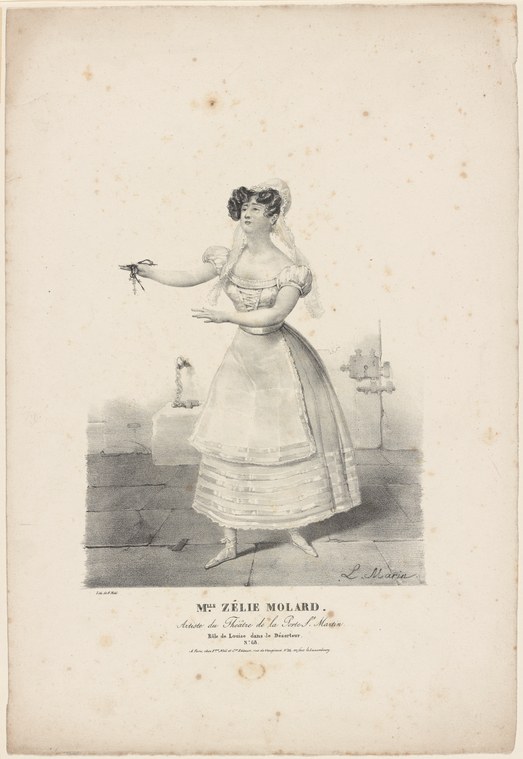
Mlle. Zélie Molard: Artiste du Théâtre de la Porte St. Martin. Rôle de Louise dans Le déserteur
Unknown artist
- Collection:
- Prints depicting dance
- Source:
- New York Public Library
- Rights:
- Public domain — free to use, share and adapt.
- Recorded as:
- Public Domain
The image documents the visual and gestural language of early 19th-century popular theater at a precise historical moment, before the standardization of ballet technique and when theatrical performance drew on pantomime, dramatic gesture, and social movement equally. It records a named performer at a named venue at a specific moment in theatrical history, making it a rare document of the non-ballet theatrical landscape from which modern performance emerged.
What you are looking at
A young woman in early 19th-century stage costume stands alone against a neutral background, positioned in a graceful contrapposto stance. She wears a white muslin empire-waist dress with horizontal pleating at the hem, typical of Romantic-era theatrical dress, and a white bonnet or headdress adorned with feathers or plumes. Her right arm extends outward with her hand open in a gestural pose, while her left arm rests at her side. She holds what appears to be a small bouquet or nosegay in her extended hand. Her posture is upright and dignified, with her weight settled on one leg in a pose of gentle repose. The background suggests a theatrical setting with what may be architecture or a landscape element rendered in light wash. The overall composition is a formal theatrical portrait print, likely a promotional image for a specific performance.
The dancing
A single female dancer is depicted in a controlled standing position with an open, presentational frame. Her right arm is extended at approximately shoulder height with a relaxed hand, suggesting a gentle gestural vocabulary rather than dynamic movement. Her torso remains quiet and upright, with no apparent twist or tilt; the weight appears centered and settled rather than suspended or in motion. The pose suggests a moment of stillness within a performance—a tableau or a transitional moment between movements—rather than the climax of an action. Her feet are positioned in what appears to be a basic stance without marked turnout.
The dance depicted
This is a theatrical portrait of an actress-dancer in a romantic dramatic role, not a choreographic study. The inscription identifies her as performing the role of Louise in *Le Déserteur*, a French play-opera first performed in 1769 and frequently revived. The pose and costume place her in the early 19th century, when such roles were performed with a controlled theatrical presence rather than trained ballet technique. The gesture and costume vocabulary align with the pantomime and dramatic movement of the period's popular theater, where narrative and character took precedence over formal dance technique. This is a record of theatrical celebrity and costume rather than a document of codified dance.
How it was made
This is a steel or copper engraving, identifiable by the fine line work, the subtle tonal gradations achieved through hatching, and the careful modeling of form and fabric. The print shows the crisp detail and high finish characteristic of early 19th-century theatrical engravings. Such prints were produced in significant numbers and distributed to theaters, sold to print collectors, and posted as advertisements—they were a primary medium for theatrical celebrity and fashion documentation of the period. The process allowed for relatively economical mass production, making such images widely accessible to a theater-going public.
About this work
This is a French theatrical engraving from the early 19th century recording the actress and dancer Zélie Molard in a named role—Louise in the melodrama *Le Déserteur*—at the Théâtre de la Porte Saint-Martin in Paris. It documents not a formal dance work but a theatrical character portrayed through costume, gesture, and pose. The image is a celebrity portrait in the form of a stage print, part of a now-vast archive of such promotional materials that recorded how professional theaters shaped and marketed public taste. It belongs in a dance archive as a record of how theatrical movement, costume, and character were conceived and circulated in the era when Romantic ballet was beginning to crystallize, and when actresses and performers often moved fluidly between spoken drama, pantomime, and dance.
How to look at it
Observe the careful attention to the fabric—the pleating, the fall of the muslin, the texture of the bonnet. The artist has chosen to depict the figure in stillness and repose rather than in motion, a choice that emphasizes the costume and the character's emotional or dramatic state rather than physical virtuosity. The extended arm and gentle gesture suggest a moment of farewell, entreaty, or emotional address to another character—a key dramatic moment frozen for the print. The formal portrait mode elevates the performer as a public figure and celebrity, not merely as an exemplar of movement.
The artist
The engraver is not recorded in the catalogue. The signature on the print reads indistinctly and would require verification in the original or in theatrical print archives. Early 19th-century theatrical portrait engravings were a specialized commercial genre, often produced by workshops rather than signed artists, and distributed through theaters and print sellers across Europe. Such prints typically recorded the costume and pose as accurately as possible while idealizing the face and figure.
The period
This print dates to the early 19th century, a period when theatrical fashion and performance were among the most visible and widely circulated forms of public culture. The Théâtre de la Porte Saint-Martin, founded in 1802, became famous for melodrama and popular spectacle. The costume and style place the image in the 1810s–1820s, just as Romantic ballet was establishing itself in Paris. However, the majority of theatrical performance outside of the Opéra remained rooted in pantomime and dramatic acting, and such performances drew and entertained massive audiences. This print records that larger theatrical ecosystem, in which named performers like Molard built careers and celebrity.
Where it lives
The print is held in the New York Public Library's collection of prints depicting dance, a broad collecting category that includes theatrical portraiture, choreographic documentation, and performance records from the 15th century to the present. As part of NYPL's collection, it is catalogued and digitized but remains minimally described in its metadata.
Questions about this work
Was Zélie Molard a professional dancer?
The record describes her as an artist (artiste) at the Théâtre de la Porte Saint-Martin, a venue known for melodrama and popular theatrical spectacle. She would have been trained in theatrical movement, gesture, and pantomime as practiced in early 19th-century popular theater rather than in formal ballet technique. The boundary between actress, dancer, and performer was fluid in this period, and a theater artist might perform across multiple modes.
What is *Le Déserteur*?
*Le Déserteur* is a French play-opera first performed in 1769, with music by Pierre-Alexandre Monsigny and a libretto by Michel-Jean Sedaine. It tells the story of a soldier who deserts the army and is ultimately pardoned; Louise is the female lead role, a character central to the emotional and dramatic arc. The work was frequently revived throughout the 19th century and was part of the popular theatrical repertory.
How do I know this is an engraving and not a lithograph or other print?
The fine, controlled line work and the tonal gradations achieved through precise hatching are characteristic of copper or steel engraving. The clarity of detail in the drapery and the subtle modeling of form also point to engraving rather than lithography, which would show different mark-making properties. The technique suggests a work made for wide circulation among collectors and theater patrons.
Why is this in a dance archive?
Theatrical performance in the early 19th century was understood as a unified practice encompassing acting, gesture, pantomime, and dance. This print documents how a professional performer at a major Parisian theater moved, stood, and presented herself in character. It is a record of theatrical movement practice at a moment when ballet was becoming codified as a separate discipline.
More dance artwork





