49 works in this view — arrow keys or swipe to move between them.
Dance in Art
Historical and ethnic costumes
Unknown artist
- Collection:
- Prints depicting dance
- Source:
- New York Public Library
- Rights:
- Public domain — free to use, share and adapt.
- Recorded as:
- Public Domain
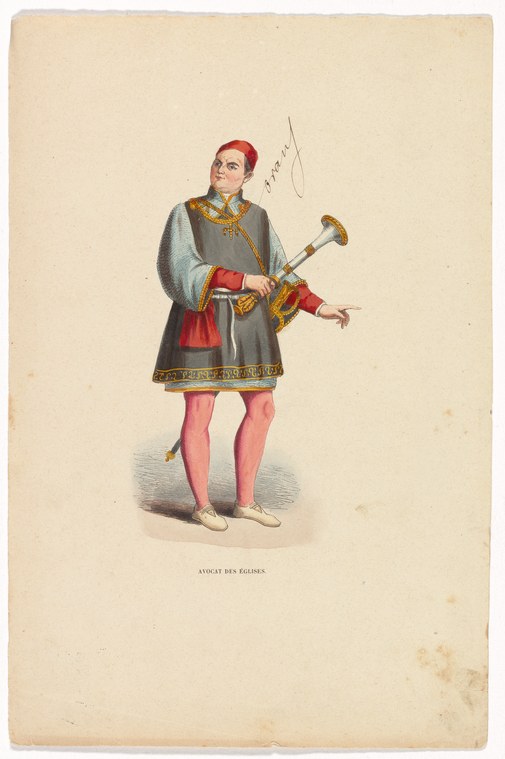
This work is a primary document of Renaissance court dress and the formal presentation of the noble body. For historians of dance and performance, it reveals how the body was framed, constrained, and presented in official contexts—the posture, the proportions of the garments, and the accessories of authority all shaped how court dances and ceremonies were executed. The careful rendering of the hose and the stance shows how the leg was displayed and supported in period dress.
What you are looking at
A single male figure stands against a plain cream background, presented in three-quarter view facing left. He wears Renaissance or early Tudor court dress: a short tunic or doublet of grey-blue wool with a decorative gold collar and gold trim at the hem, over bright pink-red hose that reach mid-thigh. The costume is completed with soft shoes or slippers. He holds a long ornamental staff or scepter in his right hand, with a distinctive curved or hooked head, and his left arm extends outward in a gesture of presentation or display. His red hair is close-cropped in a period style. The figure is rendered in hand-colored engraving or woodcut, with careful attention to fabric texture and the subtle modeling of the legs. This is a costume study or figure of nobility, not a narrative scene—the pose is frontal and didactic, as if presenting the garment itself for examination.
The dancing
A single standing figure in a relaxed contrapposto stance, weight distributed evenly. The left arm extends away from the body with an open palm, a gesture of presentation rather than active movement. The right hand grasps an ornamental staff, held vertically. The posture is upright and dignified but static—there is no indication of weight shift, no turned-out turnout, no active use of the feet. The body is framed to display the costume elements rather than to show movement or dance technique.
The dance depicted
This is not a depiction of active dance. The figure is posed as a static costume study, likely representing a court attendant, nobleman, or ceremonial figure from Renaissance or early Tudor England. The staff or scepter suggests authority or an official role. The presentation is documentary rather than kinetic—the artist is recording the cut and color of the garments rather than capturing the body in motion. No specific dance style is evident.
How it was made
This appears to be a hand-colored engraving or possibly a woodcut, executed in the 16th or early 17th century style. The line work is fine and precise, with careful cross-hatching used to model the legs and create shadow and volume. Hand coloring in watercolor or gouache has been applied afterward, visible in the uniform cream background, the bright pink hose, and the gold trim details. This technique was standard for costume documentation and manuscript illumination of the period, allowing for wide circulation through prints and broad dissemination of court fashion and protocol.
About this work
This is a costume study or official dress figure from the Renaissance or early Tudor period, rendered as a hand-colored engraving. It is not a narrative dance scene but rather a documentary image of court dress and protocol. The figure is presented frontally and statically, holding an ornamental staff that denotes rank or ceremonial office. Such prints served as records of court fashion, heraldry, and social hierarchy, circulating among the nobility and those employed in court service.
While the work appears in a collection labeled "prints depicting dance," it does not depict dance in the active sense. It is included here likely because it documents the costume, bearing, and formal presentation conventions of Renaissance court culture, which were intimately tied to the dances, processions, and ceremonial performances of that world. To understand how people moved and dressed in formal Renaissance settings, such costume studies are invaluable documentary evidence—they show us the garment that constrained and shaped the body, and the official posture with which authority was embodied.
How to look at it
Attend to the precise rendering of the hose and the controlled posture—note how the fabric falls and how the leg is positioned to display the line. Observe the ornamental staff and the formal presentation of the gesture; this is the body as emblem or symbol rather than as a moving thing. The slight turn of the head and the extension of the arm create a sense of formal address or display, as if the figure is being presented to the viewer for scrutiny and approval. This is the visual language of authority and officialdom in Renaissance court culture.
The period
This image dates to the 16th or early 17th century, a period of intense interest in recording and codifying court fashion, heraldry, and social protocol. Renaissance courts, particularly in England under the Tudors, were centers of elaborate ceremony and performance. Court dances—such as the pavane, galliard, and almain—required specific bearing and costume; costume studies like this one document the visual and material context in which those dances took place. Hand-colored engravings were a primary medium for the dissemination of court fashion and protocol across Europe, allowing courtiers and officials to reference approved dress and deportment.
The work belongs to a rich tradition of Renaissance costume books and heraldic studies, exemplified by works such as Albrecht Dürer's costume studies and the elaborate pattern books of the period. Such images were both practical (documenting what one should wear) and ideological (displaying the hierarchy, dignity, and power of the court through the formality and richness of dress).
Where it lives
From the New York Public Library, held within a collection of prints depicting dance. The work is catalogued as "Historical and ethnic costumes" but is attributed to an unknown artist and lacks a recorded date, medium, or acquisition number.
Questions about this work
Is this actually a dance?
No—this is a static costume study, not a depiction of active dance. However, it documents the dress, bearing, and formal presentation conventions of Renaissance court culture, which were inseparable from the dances and ceremonies of that world. It shows us how the body was constrained and displayed in official contexts.
What is the staff he is holding?
The ornamental staff with a curved or hooked head is likely a symbol of office or rank, used in court ceremonies and processions. Such staffs were carried by officials, heralds, and noblemen as badges of authority and were part of the formal presentation of the body in Renaissance court ritual.
Why are the hose so bright pink?
The vivid color was likely expensive and rare in the 16th century, signaling wealth and rank. The hand-coloring process allowed for bright pigments and was often applied to costume studies to emphasize the visual impact of the garment. The vividness also served a documentary purpose—it showed the actual or intended color of the cloth.
What is the medium?
This appears to be a hand-colored engraving or woodcut from the 16th or early 17th century. The fine line work and careful modeling are typical of Renaissance engraving. Hand coloring in watercolor or gouache was applied afterward, a common practice for costume studies and official documents of the period.
More dance artwork





