49 works in this view — arrow keys or swipe to move between them.
Dance in Art
Historical and ethnic costumes
Unknown artist
- Collection:
- Prints depicting dance
- Source:
- New York Public Library
- Rights:
- Public domain — free to use, share and adapt.
- Recorded as:
- Public Domain
For historians of dance and material culture, this work documents the formal costume, posture, and social presentation expected of courtiers and performers in Renaissance and Early Modern courts. The image shows how individual male nobility or dancers were expected to stand, gesture, and present themselves in formal settings—knowledge valuable for understanding the embodied culture of courts and the visual training in deportment that preceded and accompanied dance practice.
What you are looking at
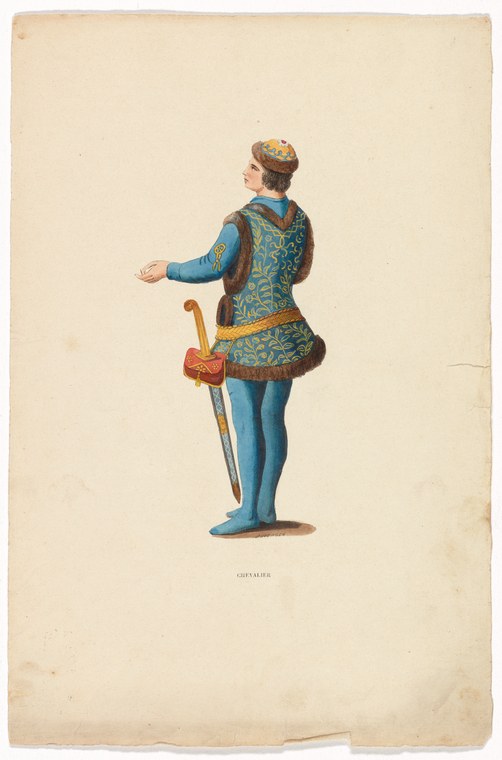
A single male figure stands in profile against a plain cream ground, positioned slightly left of center. He wears an ornate Renaissance or Early Modern court costume: a blue doublet with gold embroidered decoration across the chest and sleeves, paired with a short matching tunic or skirt that falls to mid-thigh and is trimmed with gold braid at the hem. His legs are clothed in blue hose. He wears a soft hat or cap with decorative band. His right arm is extended outward in a gesture of presentation or address, the palm open in an inviting or explanatory pose. His left hand rests on the hilt of a sword or decorated hanger. His posture is upright and formal, his gaze directed toward the middle distance. The figure is rendered in hand-colored engraving or print technique, with careful attention to textile pattern and metallic detail. Below the figure is a single word caption in serif type.
The dancing
The single standing figure is presented in a formal pose rather than an active dance position. The extended right arm and open palm suggest declamation or demonstration rather than the symmetrical frame or closed hold of partnered dance. The weight appears evenly distributed, the body upright and static; there is no suggestion of rise, pivot, or traveling action. The figure is viewed in complete profile, a convention of court portraiture rather than dance documentation.
The dance depicted
This is not a depiction of dance in action. The figure is posed in the formal stance of a court performer or nobility in dress, a convention used in Renaissance and Early Modern court culture where dance was sometimes documented through single-figure studies in costume. The gesture suggests theatrical or ceremonial presentation rather than choreographed movement. If this forms part of a series on historical and ethnic costumes, it may represent a dancer in court dress, but the image itself shows a static figure in a pose of address, not the body in motion through space.
How it was made
This is a hand-colored engraving or print, executed with fine lines defining costume detail and subtle shading to suggest form and textile. The technique allowed for reproducible documentation and wide circulation in printed books and collections—the practice of costume documentation for court, noble, and theatrical figures was widespread in the 16th and 17th centuries. The neat serif caption and regular composition suggest this was part of a didactic or historical compendium, likely issued in multiple copies.
About this work
This is a costume study of a male figure in ornate court dress, likely from a printed series documenting historical garment and presentation conventions. The figure wears Renaissance or Early Modern formal attire rendered in meticulous hand-colored engraving. The work belongs to a tradition of costume documentation rather than dance action proper; the pose and gesture are theatrical and formal rather than choreographic. It serves as evidence of how court dress, posture, and bearing were represented and circulated in visual form across the early modern period.
How to look at it
Attend to the precision of the engraved detail: the geometric patterns of the embroidery, the fold and drape of the hose, the decorative sword hanger, the style of the hat. These specifics date the work and identify the rank and probable context of the figure. Note also the carefully studied pose—the arm extension and open palm represent a formal gesture vocabulary expected of courtiers, distinct from the relaxed or engaged postures of actual dance. The profile view is a deliberate choice to display the garment's cut and the figure's bearing.
The artist
The artist is not recorded. The work appears to be part of a commercial or institutional print series documenting historical and ethnic costume—a common genre of the 16th–18th centuries, produced by printing houses in major European centers. Such series were often compilations rather than works by a single author, and attribution was frequently omitted in favor of the publisher's name or the collector's identity.
The period
Costume documentation was a major genre of Renaissance and Early Modern prints, particularly in the 16th and 17th centuries. Publishers like Cesare Vecellio, Hans Burgkmair, and Wenceslas Hollar produced influential collections of costume studies serving both artistic reference and ethnographic interest. These works circulated widely and were consulted by painters, embroiderers, and performers. They represent the period's growing interest in recording and classifying human dress and social presentation across regions and ranks.
Where it lives
The work is held by the New York Public Library as part of a prints collection labeled 'Prints depicting dance.' This cataloguing suggests it was selected for a dance-related collection, though the image itself shows static presentation rather than dance action. The work's original publication and circulation context cannot be confirmed from the record.
Questions about this work
Is this a depiction of a dance?
Not in the sense of showing a figure executing choreographed movement. This is a static pose of formal presentation in court dress. However, it may document the posture, costume, and bearing expected of dancers or courtiers in the Renaissance or Early Modern period, and it was likely collected as part of a historical record relevant to performance and dance culture.
What is the figure holding and what does it signify?
He wears a decorated sword or hanger at his left side, a sign of rank and status in court dress. The right arm extended with open palm is a formal gesture of address, declamation, or invitation—a learned pose reflecting courtly manners and social presentation rather than a dance movement.
Why is only one figure shown?
This is part of a costume documentation series, which typically presented individual figures in different garments and poses. Single-figure studies allowed for clear rendering of textile detail and formal bearing, and were compiled in albums or printed books for reference by artists, performers, and collectors.
What is the blue fabric and the gold decoration?
The doublet and tunic are typical of Renaissance court dress, rendered here in blue wool or silk with gold embroidered ornament—materials and techniques that signify wealth and status. The engraver rendered the pattern in careful detail to document the style of the period.
More dance artwork





