49 works in this view — arrow keys or swipe to move between them.
Dance in Art
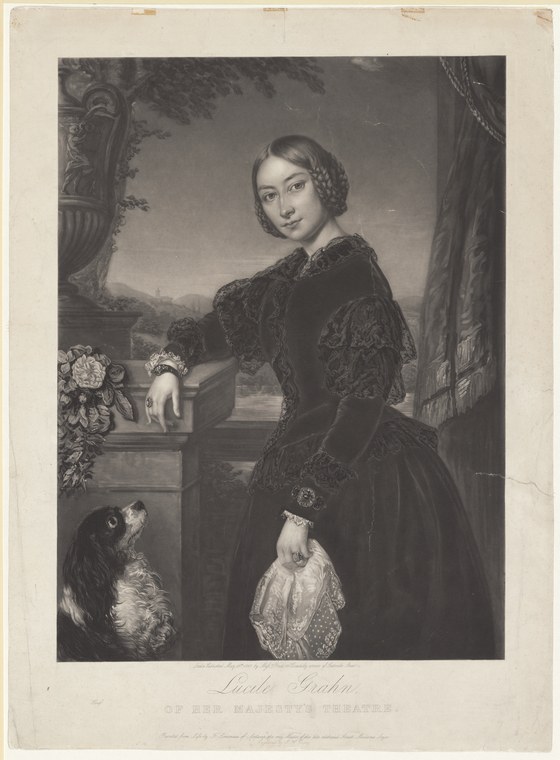
Lucile Grahn, of Her Majesty's Theatre
Unknown artist
- Collection:
- Prints depicting dance
- Source:
- New York Public Library
- Rights:
- Public domain — free to use, share and adapt.
- Recorded as:
- Public Domain
Lucile Grahn was one of the four great ballerinas of the Romantic era, creator of roles in some of the most celebrated works of the time, yet portraiture and prints were often the only way most people encountered her likeness. This engraving is evidence of how dancers of international reputation were marketed and consumed as cultural celebrities, circulated through the same print culture that made fashionable society itself visible.
What you are looking at
A three-quarter-length portrait of a young woman in an elegant dark velvet gown with intricate lace detailing at the sleeves and bodice, set within a luxurious interior. She stands beside a marble or stone balustrade, turning toward the viewer with a composed, direct gaze. A small King Charles spaniel sits at her feet to the left, and on the balustrade beside her rests a potted flowering plant—roses in cream and white. The background opens onto a distant landscape visible through draped curtains; the lighting is soft and even, characteristic of aristocratic portraiture of the mid-nineteenth century. The composition emphasizes refinement and status through the quality of the furnishings, the woman's fashionable dress, and the inclusion of a pet—all markers of wealth and social position.
The dancing
The subject stands upright in a relaxed contrapposto stance, her weight shifted slightly to one side, one hand holding a delicate lace handkerchief. Her posture is open and assured, with her shoulders back and her head held high. The positioning is entirely static and formal—there is no suggestion of movement or the body's engagement with physical exertion. This is a portrait of stillness and composed elegance, not of active dancing.
The dance depicted
The image does not depict dance. The figure is posed for a formal portrait in the conventions of mid-nineteenth-century society portraiture. The title identifies the subject as Lucile Grahn, a celebrated Romantic ballet dancer, but the image records her in street dress and indoor setting, not in performance costume or mid-performance. It is a portrait of a dancer as a fashionable woman of her era, not a representation of dance itself.
How it was made
This is a steel engraving, a reproductive print technique that dominated the mid-nineteenth century. The fine linear hatching, the precise tonal modeling, and the formal composition are all characteristic of commercial engraving. Steel engraving allowed for large print runs and wide distribution, making such portraits affordable for a middle-class audience. The skill of the engraver is evident in the rendering of fabric texture—the contrast between the dense velvet and the delicate lace—and the subtle modeling of the face. Works of this kind were often published as standalone prints and collected in albums; they served to circulate the likenesses of celebrated public figures.
About this work
This is a mid-nineteenth-century engraved portrait of Lucile Grahn, one of the most celebrated ballet dancers of the Romantic era. Though the subject is known to history as a dancer, the image presents her according to the conventions of fashionable female portraiture: elegantly dressed, posed in a domestic or semi-public interior, attended by a lapdog and flowers. The print represents the way in which a dancer's public identity extended beyond the theatre into the visual culture of genteel society. It is a record not of performance but of the dancer as a figure of social status and refinement—how she wished to be known to her public.
How to look at it
This portrait belongs to the tradition of genteel female portraiture in which the subject is posed without action, the emphasis falling on dress, bearing, and the markers of wealth and taste surrounding her. Notice the care taken to render different textures—the soft pile of the velvet against the intricate pattern of the lace, the delicate curl of the handkerchief, the gloss of the spaniel's coat. The artist is not asking you to imagine the subject in motion; instead, the portrait asks you to recognize the dancer as a woman of fashion and refinement, someone whose life extended well beyond the stage.
The artist
The engraver is not recorded in the catalogue. The work is published anonymously, which was common practice for reproductive prints of this period. The engraver's task was to translate a painted or drawn original (likely a portrait miniature or oil painting) into a print suitable for mass circulation. The quality of the execution suggests a skilled professional working in the commercial engraving trade in London or another major publishing centre.
The period
The 1840s and 1850s were the height of the Romantic ballet era. Lucile Grahn performed with the greatest dancers of the time—Marie Taglioni, Carlotta Grisi, Fanny Cerrito—in works that emphasized ethereal beauty, pointe work, and narratives of tragic love. At the same time, the commercial print trade was booming. Engraved portraits of opera singers, actors, and dancers were among the most popular subjects for print publishers, eagerly collected by an expanding middle-class audience. The dancer's celebrity was new; ballet had become a major public entertainment, and dancers were public figures whose images had market value. Grahn herself was a Dane who became an international star; her portrait in fashionable dress was a marker of her status and cosmopolitan fame.
Where it lives
This engraving is held in the New York Public Library's collection of prints depicting dance. It is a commercial reproductive print, likely published in London or another major centre in the mid-nineteenth century. The work is one of many such portraits made to capitalize on the fame of celebrated dancers and to satisfy the appetite of print collectors.
Questions about this work
Who was Lucile Grahn?
Lucile Grahn (1819–1907) was a Danish-Swedish ballet dancer who was one of the greatest stars of the Romantic era. She created roles in several major ballets and performed across Europe and in Russia. She was famous for her technical skill, her beauty, and her dramatic presence. She danced alongside Marie Taglioni and other legendary performers of the time.
Is this a picture of her dancing?
No. This is a formal society portrait in street dress, not a representation of dance. It shows how Grahn was represented to the public outside the theatre—as a fashionable woman of status and refinement. Dancers' portraits from this period rarely showed them in performance.
What does 'of Her Majesty's Theatre' mean in the title?
Her Majesty's Theatre in London was one of the principal venues for opera and ballet in the 19th century. The inscription indicates that Grahn performed there, positioning her as a star of the London stage. Many such portraits included the theatre as part of the subject's professional identity.
What is an engraving and why was it used for portraits?
An engraving is a print made by carving into a metal plate, which is then inked and printed. Steel engravings, used here, could be printed many times without wearing out. This made them much cheaper than paintings, allowing publishers to produce affordable portraits of famous people for a mass audience.
More dance artwork





