49 works in this view — arrow keys or swipe to move between them.
Dance in Art
Historical and ethnic costumes
Unknown artist
- Collection:
- Prints depicting dance
- Source:
- New York Public Library
- Rights:
- Public domain — free to use, share and adapt.
- Recorded as:
- Public Domain
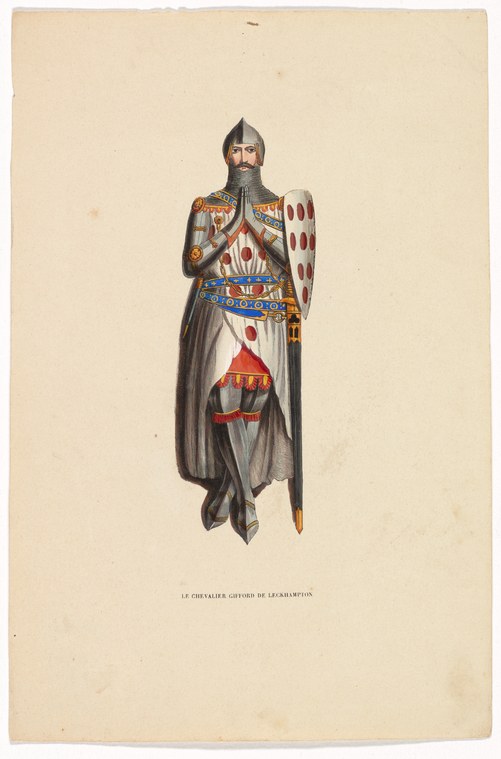
This work should not appear in a dance collection. It is a military or heraldic portrait with no dance content, and its presence in the 'Prints depicting dance' collection at the New York Public Library appears to be a cataloguing error.
What you are looking at
A single male figure stands in formal military dress against a plain cream background. He wears a dark tunic or jacket with ornate gold embroidery and braiding across the chest, paired with a tall pointed helmet and a full-length grey cloak fastened at the shoulders with decorative clasps. His legs are clad in white or light-colored breeches and dark boots. He holds a long spear or lance in his right hand, which rests against his body. The figure is depicted in a strict frontal stance with arms positioned formally at his sides. At the base of the image, a caption in French reads "LE CHEVALIER GOYDN DE LE-CHAMP-ION," suggesting this is a portrait of a historical military or noble figure. The image appears to be a hand-colored print or engraving, with careful attention to the heraldic and military details of the costume.
The dancing
The single figure stands in a rigid, formal military posture with no suggestion of movement or dance. His weight is evenly distributed, his arms hang straight, and there is no bend in the knees or any indication of weight transfer or momentum. The costume is ceremonial rather than functional for dancing—the heavy cloak, ornate armor details, and formal helmet all suggest a state or parade occasion rather than active movement.
The dance depicted
This is not a depiction of dance. The figure stands in a formal military or heraldic stance used for portraiture and ceremonial presentation. There is no gesture, footwork, body relationship, or any other element of choreography or movement practice visible.
How it was made
This is a hand-colored engraving or print, evident from the fine linear detail in the costume ornamentation, the controlled shading, and the caption. The technique allows for precise rendering of heraldic and military detail, suggesting this is a historical or antiquarian print meant for documentation or display. The hand coloring indicates a relatively high-status object, as colored prints were more expensive than plain ones.
About this work
This is a heraldic or military portrait print, not a dance image. It depicts a single figure in formal medieval or Renaissance military costume and posture, with no choreographic content. The inscription identifies the subject as 'Le Chevalier Goydn de Le-Champ-ion,' suggesting a historical or legendary military figure. The work belongs to a tradition of costume documentation or heraldic portraiture rather than to the history of dance representation.
How to look at it
Observe the precise rendering of the costume details—the braiding, the helmet shape, the cloak fastenings—which are the focus of the artist's attention. The rigid frontality and lack of any bodily ease or movement are deliberate: this is heraldic presentation, not dance. The formal stance is typical of military or noble portraiture of the period.
The period
The costume style—the pointed helmet, the cloak, the ornate military dress—suggests a print from the 19th century documenting medieval or Renaissance military history. The caption in French and the hand-coloring technique are consistent with 19th-century antiquarian or historical publishing practices. Such prints were often issued as series of historical costumes or military uniforms.
Where it lives
This print is held in the New York Public Library's collection labeled 'Prints depicting dance,' but the catalogue record is sparse and the subject matter does not support the classification.
Questions about this work
Is this a dance image?
No. This is a military or heraldic portrait print, depicting a single figure in formal historical costume standing in a rigid posture with no choreographic content or indication of movement.
What does the caption say?
The French caption reads 'LE CHEVALIER GOYDN DE LE-CHAMP-ION,' identifying the figure as a knight or military nobleman. The exact historical reference is unclear without further documentation.
Why is this in a dance collection?
The presence of this work in the NYPL's 'Prints depicting dance' collection appears to be a cataloguing error. The image contains no dance content.
More dance artwork





