49 works in this view — arrow keys or swipe to move between them.
Dance in Art
Historical and ethnic costumes
Unknown artist
- Collection:
- Prints depicting dance
- Source:
- New York Public Library
- Rights:
- Public domain — free to use, share and adapt.
- Recorded as:
- Public Domain
While not itself a depiction of dance, costume studies like this one are essential primary sources for understanding how dancers actually moved in historical dress. The volume of the robe, the weight of the mantle, the restricted arm position, and the formal frontality all shaped the movement vocabulary of early modern court dance, and no reconstruction of historic dances can proceed without reference to how these garments fell and functioned on the body.
What you are looking at
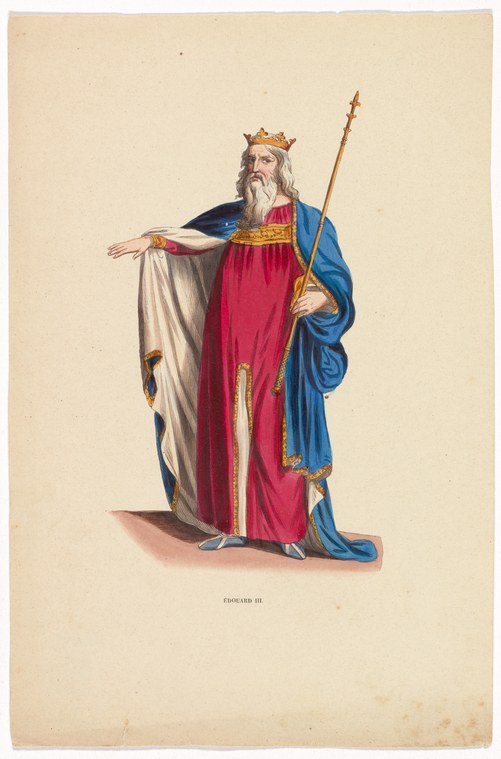
A single figure stands in formal, frontal pose against a neutral ground. The man wears a long, flowing robe of deep red over a white undergarment, with a blue mantle draped over his shoulders. A jeweled belt cinches the waist; a crown sits on his head. He holds a staff or scepter topped with a cross in his right hand, and extends his left arm in a gesture of address or blessing. His long, grey beard and dignified bearing suggest royal or ecclesiastical authority. The figure is rendered with careful attention to the weight and drape of the fabrics, which fall in elegant folds. This is a costume study rather than a narrative scene—the figure is presented as a type or exemplum, not in action.
The dancing
A single standing male figure in complete stillness and formal frontality. The left arm extends outward at roughly shoulder height, palm open in what reads as a gesture of address, declaration, or benediction. The right arm hangs at the side, gripping the staff. The weight appears evenly distributed on both feet. There is no suggestion of motion, balance-challenge, or dynamic weight shift. The body is presented as a stationary display of costume and authority rather than as a moving or dancing form.
The dance depicted
This image does not depict dance. The figure is a costume study—a type of historical documentation showing the formal dress and insignia of a crowned ruler or high ecclesiastical dignitary. The gesture, though formal and deliberate, is one of address or blessing, not a movement from a recognized dance vocabulary. The stance is static and heraldic, designed to display regalia rather than to show kinetic action.
How it was made
Hand-colored engraving or lithograph, rendered with fine detail. The costume is meticulously rendered through careful line work and selective hand coloring applied to show the rich textures of textile, metal, and fur. The technique—outline enhanced by color wash—was standard for historical costume documentation in the 18th and 19th centuries. This method allowed for clear legibility and was well suited to reproduction and circulation in illustrated books and portfolio collections of national or historical dress.
About this work
This is a costume study documenting the formal regalia of a European monarch or high-ranking ecclesiastical figure. It belongs to the tradition of historical dress illustration rather than to a dance context per se. However, such images circulated widely in collections of 'historical and ethnic costumes' and were used as reference material by dancers, theatrical designers, and historians studying period movement. The work records not a moment of dancing but the material culture within which formal court dances were performed, and may have served as a visual reference for understanding the weight, volume, and aesthetic of garments worn during Baroque or early-modern court dance.
How to look at it
Attend to the silhouette and the drape of the fabrics. Note how the robe stands away from the body due to its weight and construction, and how the mantle's volume would have constrained the arm's range of motion. The formal frontality is characteristic of heraldic and documentary display. The gesture, though stylized, shows the kind of formal arm position that would have been standard in court ceremony and formal court dance. This is a costume as object to be examined, not as the skin of moving action.
The period
The collection of historical and ethnic costume studies was a major artistic and documentary project of the 18th and 19th centuries, serving encyclopedic, theatrical, and antiquarian interests. Such works often appeared in multi-volume compilations that circulated among the educated classes, costume designers, and performers. The formal frontality and heraldic presentation follow conventions of royal portraiture and historical documentation. By the 19th century, dance historians and theater practitioners actively collected such costume studies to inform their work—particularly important given the Romantic ballet's preoccupation with national and historical authenticity.
Where it lives
This work is from a collection of prints depicting dance held at the New York Public Library. It is catalogued as part of 'Historical and ethnic costumes,' a typical rubric for 18th- and 19th-century illustrated compilations of dress from different periods and nations.
Questions about this work
Is this a dancer?
No. This is a costume study showing the formal dress of a crowned ruler or high dignitary, not a depiction of a person in motion. The figure is presented as a static exemplum of regalia and formal attire.
Why is this in a dance collection?
Historical costume studies were essential reference materials for dancers and theater practitioners reconstructing period dances. Understanding how garments draped and moved on the body is crucial to understanding how court and formal dances were actually performed.
What does the staff and crown signify?
These are the insignia of royal or ecclesiastical authority. They identify the wearer as a figure of rank and power, and together with the formal robes, document the visual language of formal European court authority in the early modern or early modern period.
More dance artwork





