49 works in this view — arrow keys or swipe to move between them.
Dance in Art
Historical and ethnic costumes
Unknown artist
- Collection:
- Prints depicting dance
- Source:
- New York Public Library
- Rights:
- Public domain — free to use, share and adapt.
- Recorded as:
- Public Domain
For historians of medieval and Renaissance dance, costume studies like this are crucial evidence of what performers wore and how rank was signaled through dress. Though the figure does not dance, understanding the weight and drape of such garments—the stiffness of the mitre, the swing of the lined cloak, the pointed shoes—is essential to reconstructing how bodies moved within such clothing and what dance in such regalia would have looked like.
What you are looking at
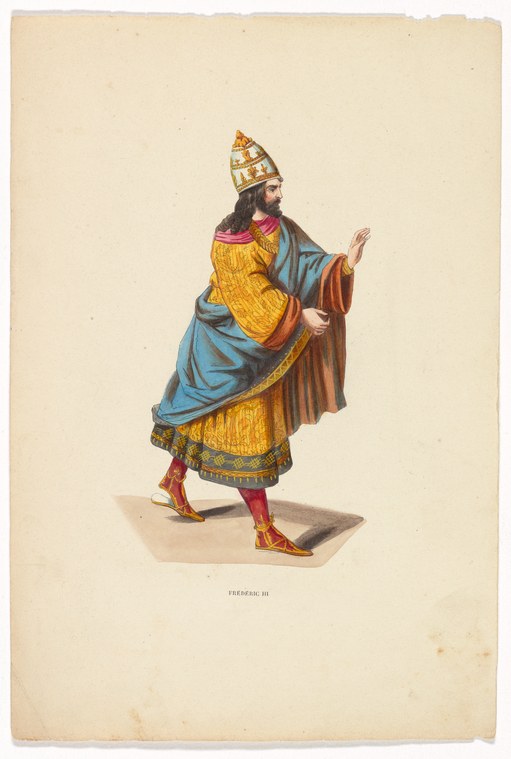
A single figure stands in profile against a pale ground, dressed in the formal regalia of a medieval or Renaissance-period ecclesiastical or noble authority. The figure wears a long golden-yellow tunic or undergarment, over which falls a blue cloak or mantle lined in red or rust tones. The head is crowned with an ornate white and gold mitre or tall peaked headdress bearing geometric patterning and a cross. The figure has a dark beard and appears bearded and mature. The right arm is raised in a gesture of address or blessing, while the left hangs at the side. The feet wear pointed red shoes or hose. The figure is rendered in hand-colored engraving or print technique, with delicate stippling and line work creating volume in the drapery and subtle modeling of the face. The composition is a formal figure study of the type used for historical costume documentation.
The dancing
A single standing figure in a three-quarter or profile stance, weight evenly distributed on both feet. The raised right arm extends at roughly shoulder height with the hand open in a palm-forward gesture suggestive of blessing, proclamation, or benediction. The left arm hangs naturally. The posture is upright and dignified, with no suggestion of movement or dance position. This is a static pose typical of heraldic or ceremonial portraiture rather than the dynamic frame of stage dance.
The dance depicted
This image does not depict dance. It is a figure study in historical costume, presenting a single ecclesiastical or noble personage in formal dress from the medieval or early modern period. The raised arm and frontal presentation suggest authority or ceremonial rank rather than choreographed movement. There is no indication of musical accompaniment, partner work, spatial patterning, or any of the markers that would identify this as dance imagery.
How it was made
This is a hand-colored engraving or woodcut of the type produced in Northern Europe during the 16th to 18th century, likely as part of a larger series on historical costume or ecclesiastical vestments. The fine line work and careful stippling suggest engraving rather than woodcut. The hand coloring—applied after printing in tempera, watercolor, or oil pigments—shows the warm gold and blue palette typical of such antiquarian documentation. Such prints were produced in series for collectors, scholars, and artists seeking visual reference to historical dress, and circulated widely among an educated public.
About this work
This is a historical costume study rather than a dance image. It presents a single figure of ecclesiastical or noble rank in formal medieval or early modern dress, rendered as a hand-colored engraving in the antiquarian documentary tradition. The work belongs to a widespread early modern practice of visual record-keeping through costume plates, used by antiquarians, scholars, and artists as reference material. While it depicts no movement or dance, it is included here because such costume documentation often appears in collections labeled as dance-related, and because understanding the dress and social rank of performers is essential context for reconstructing historical dance. The raised gesture and formal authority suggested by the figure's dress and pose place this within the world of courtly ceremony and ritual rather than theatrical or social dance.
How to look at it
Attend to the carefully rendered details of dress: the construction of the mitre, the layering and lining of the cloak, the style and color of the hose and shoes. These details—which would be invisible in a written description—are what the print was designed to preserve. The static pose and formal frontality are not artistic limitations but deliberate choices: costume studies were meant to display the complete figure and all its elements clearly, without distraction from movement or narrative action. The hand-coloring, applied individually after printing, was a labor-intensive luxury that signals the intended audience as educated collectors and professionals rather than a mass market.
The period
The 16th to 18th centuries saw sustained antiquarian interest in the dress and customs of preceding centuries, particularly in Northern Europe. Engraved costume plates like this one were produced in series by artists and printers to serve both scholarly and practical purposes: they provided historical reference for writers and artists seeking authenticity, but also supplied models for theatrical costume makers and embroiderers. This particular work sits within the tradition of historical documentation that preceded modern historical costume museums, reflecting an era when visual evidence was gathered through such prints rather than preserved garments.
Where it lives
This work belongs to the New York Public Library's collection of prints depicting dance and related ceremonial practices. It is catalogued as part of a larger series on historical and ethnic costumes, though the series itself lacks detailed attribution or dating in the record. The existence of such a series suggests this may be one plate from a numbered costume encyclopedia or antiquarian documentation project, likely European in origin.
Questions about this work
Is this a dance image?
No. This is a costume study—a single figure portrait in formal historical dress, not a depiction of dance or movement. It was made to document and preserve knowledge of how people of rank dressed in a particular historical period. However, such images are important to dance historians because they show what dancers and courtiers actually wore, and the weight and construction of such garments deeply affected how bodies could move.
What rank or office does this figure hold?
The mitre (the tall peaked crown), the formal gesture, and the ecclesiastical color scheme suggest this is a bishop, archbishop, or other high church official, or possibly a noble or sovereign with religious authority. The golden tunic and blue mantle are colors of rank and dignity. The exact identity cannot be determined from the costume alone, but the dress unmistakably signals authority, ceremony, and high status.
When and where was this made?
The catalogue record does not provide a date or artist attribution. Based on the engraving technique, hand-coloring method, and style of dress documentation, this was likely made in Northern Europe (possibly German, Dutch, or Flemish) sometime between the 16th and 18th centuries. The costume itself is meant to represent an earlier medieval or early Renaissance period.
Why is a costume study in a dance collection?
Dance collections often include costume documentation because understanding what performers wore is essential to understanding how dances were performed. The weight of fabric, the structure of headwear, the height of heels—all affect movement. Additionally, such prints were often circulated among theater makers and dance practitioners of the period who needed visual reference for historical authenticity.
More dance artwork





