49 works in this view — arrow keys or swipe to move between them.
Dance in Art
Historical and ethnic costumes
Unknown artist
- Collection:
- Prints depicting dance
- Source:
- New York Public Library
- Rights:
- Public domain — free to use, share and adapt.
- Recorded as:
- Public Domain
For historians of dance in religious contexts—ceremonial procession, liturgical gesture, and the training regimes of convents—this image is evidence of how formal habit constrained and shaped the moving body. The visual precision of institutional dress tells us how the dancer's frame and carriage were meant to be constructed in sacred settings.
What you are looking at
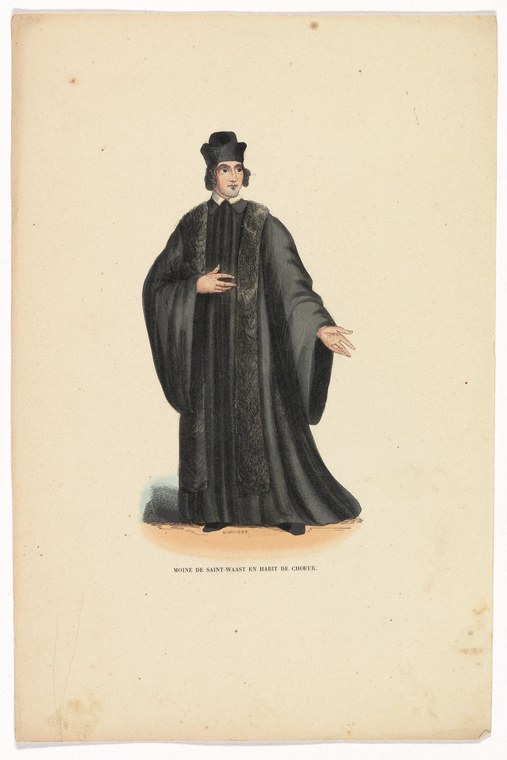
A single figure stands in three-quarter view against a pale ground, dressed in the full formal habit of a nun of the Order of Saint Mary. The figure wears a voluminous black woolen robe that falls to the ground, with a fitted bodice and long sleeves. A white linen collar frames the neck. Over the robe is draped a black cloak or mantle lined with lighter fabric, which falls from the shoulders and opens at the front, creating a formal silhouette. The head is covered with a black hood or coif, and the face is pale and serene, looking slightly to the side. The hands emerge from the sleeves in a gesture of presentation or benediction—the right hand raised at waist height, palm open and gesturing outward. The left hand hangs at the side. The figure's posture is upright and dignified, with the weight evenly distributed. The composition is frontal and hieratic, emphasizing the formal status of the wearer rather than capturing a moment of movement or prayer.
The dancing
A single standing figure in religious habit displays the formal deportment required of vowed religious. The open-palmed right hand and relaxed left hand suggest a pose of blessing or formal presentation rather than active gesture. The upright, centered stance and balanced weight distribution follow the conventions of devotional portraiture. There is no indication of dance movement; the figure is presented as a static emblem of religious identity and authority.
The dance depicted
This image does not depict dance. The figure is a nun in formal religious dress, presented in the manner of a devotional or institutional portrait. The caption identifies her as belonging to the Order of Saint Mary in the habit of the Church. While religious dance and ceremonial procession existed in the medieval and early modern periods, and some convents maintained traditions of liturgical movement, nothing in this image—the static pose, the formal portraiture convention, or the context—suggests dance rather than prayer, vocation, or institutional rank.
How it was made
This is a hand-colored engraving or lithograph, likely 19th-century, printed from a prepared plate and finished with watercolor or gouache. The technique allowed for precise rendering of fabric texture and fold, and the open, light ground suggests the work was intended for circulation as a print series—possibly documenting religious orders and their habits for educational or devotional purposes. The tinted background and careful articulation of the white linen collar and black wool demonstrate the engraver's attention to the visual grammar of religious dress.
About this work
This is a formal portrait print documenting the habit and rank of a nun of the Order of Saint Mary. It belongs in the Gallery's collection of dance-adjacent materials because religious orders and their ceremonial practices are material evidence of how bodies were trained, moved, and presented in institutional contexts—knowledge relevant to understanding dance history even when the image itself does not depict dance. The print is part of a visual archive of historical dress and devotional practice that shaped the possibilities of movement in European culture.
How to look at it
Attend to the precision with which the fabric has been rendered—the fall of the heavy wool, the crisp white collar, the placement of the cloak. These details are not ornamental; they constitute a visual code telling the viewer exactly how the wearer's body was meant to be positioned and moved. The frontal, centered pose follows the conventions of institutional and devotional portraiture, presenting the figure as a type or exemplar rather than as an individual. The open hand gesture, formalized and restrained, suggests the vocabulary of controlled, measured movement expected in religious life.
The period
The print belongs to the 19th-century tradition of ethnographic and religious costume documentation, when illustrated books and print series made visual records of historical dress, regional costume, and institutional habit. This was an era of historical enthusiasm and religious revival in Europe, and costume prints served both scholarly and devotional audiences. The style and technique suggest publication between 1820 and 1880, in a series intended to instruct readers in the visible markers of religious identity and historical practice.
Where it lives
The work is held in the New York Public Library's collection of prints depicting dance and related movement practices. It was catalogued under the broad heading 'Historical and ethnic costumes' and tagged as dance material, likely because costume history and the training of the moving body are understood as adjacent to dance studies.
Questions about this work
Why is a portrait of a nun in a dance archive?
Religious habit shaped how the body moved and could move. Understanding the constraints and conventions of institutional dress—how it was worn, what postures it enforced—is part of understanding the history of movement, posture, and ceremony. Dance historians study how clothing, ritual, and institutional practice shaped the body's possibilities.
What order is this nun from?
The caption identifies her as belonging to the Order of Saint Mary in the habit of the Church. The specific order and the date of the print are not recorded in the catalogue, making precise identification difficult without additional research.
Is this a portrait of a real person or a type?
The formal, centered composition and the generic presentation suggest this is a type—a visual codification of the habit and rank of the order—rather than a portrait of a named individual. The print was likely part of a series documenting different religious and secular orders.
More dance artwork





