49 works in this view — arrow keys or swipe to move between them.
Dance in Art
Historical and ethnic costumes
Unknown artist
- Collection:
- Prints depicting dance
- Source:
- New York Public Library
- Rights:
- Public domain — free to use, share and adapt.
- Recorded as:
- Public Domain
This work matters not as a depiction of dance but as evidence of the 19th-century appetite for cataloguing human types through costume—a practice that informed both ethnographic and theatrical documentation. It shows how folk and regional figures were made into standardized, collectible images, a process that shaped how dance traditions were later preserved and understood.
What you are looking at
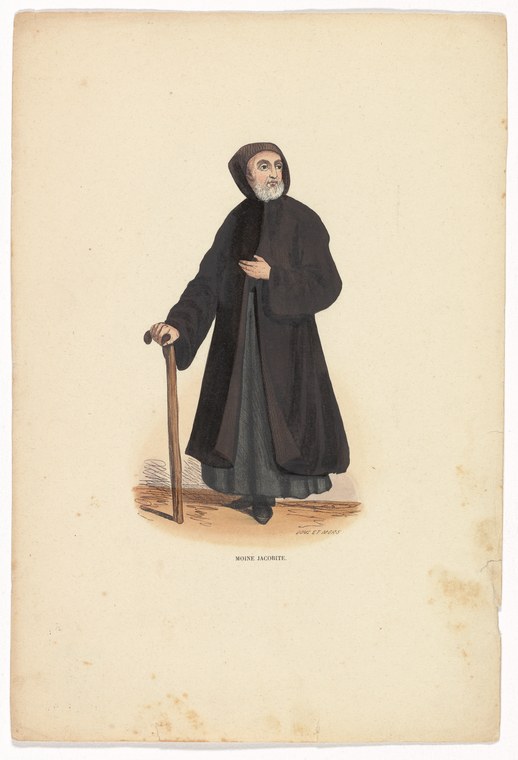
An elderly woman in austere black religious habit stands alone against a plain cream background. She wears a long black cloak or coat over a gray underdress, and a black bonnet frames her face. Her posture is upright but bent with age; she grips a wooden walking stick in her right hand, planted firmly on the ground beside her. Her left hand is drawn up slightly, as if holding the fabric of her cloak or steadying herself. The figure is rendered in hand-colored lithograph or engraving with careful attention to the texture of her clothing and the weathered quality of her aged face. The composition is a full-length portrait study of a single figure, with no setting beyond the neutral background. The inscription at the base reads "BONNE JACQUETTE"—likely a character type or named figure from popular imagery.
The dancing
The woman is stationary, weight settled firmly on her feet, gripping the walking stick for support rather than movement. Her frame is entirely closed and contracted—there is no extension, no dance frame, no suggestion of the lifted posture characteristic of dance training. Her gesture is one of age and infirmity: the stick is a necessity, not a prop. This is a figure at rest, not in motion.
The dance depicted
This image does not depict dance. The woman is a named character type—likely "Good Old Jacquette" or a similar figure from folk tradition, street theater, or popular prints—shown in her ordinary posture and dress. While the print belongs to a genre of costume studies that documented regional, occupational, and character types across Europe, including some used in folk performance and carnival, this particular figure is presented as a standing portrait, not as a performer captured mid-movement. The walking stick is an attribute of age and infirmity, not a dance prop or tool.
How it was made
This is a hand-colored lithograph or possibly a colored engraving, characteristic of the 19th-century illustrated costume books and popular prints that circulated widely in Europe. The technique allowed for rapid reproduction and coloring of figure studies, making them affordable and accessible to a broad audience—students, antiquarians, performers, and the general public. The careful delineation of fabric texture and the subtle hand-coloring suggest this was part of a professional series documenting European types and costumes, likely intended as both educational reference and commercial entertainment.
About this work
This is a character-type study from a 19th-century costume documentation series, presenting an identifiable folk or theatrical figure—"Bonne Jacquette"—in her everyday dress and stance. Though the series it belongs to may have included performers and folk types, this particular print shows the woman as a stationary figure, characterized by age, poverty, and dependence on a walking stick rather than by any gesture of dance or performance. It represents the archival impulse of the period to document and classify regional and social types through costume and posture, a practice that sometimes overlapped with dance history and ethnographic interest but is distinct from dance imagery proper.
How to look at it
Note the careful attention to the texture of worn fabric and the dignity given to an aged, humble figure. The artist has chosen a pose of rest and dependence—not a moment of performance or movement, but a standing portrait. The walking stick and the closed, contracted posture are the key indicators that this is a character defined by age and condition, not by action. Compare the still, upright stance here with the open, energetic frames found in actual dance imagery of the same period.
The artist
The work is part of a series titled "Historical and ethnic costumes" but no artist is recorded. Such costume studies were produced throughout 19th-century Europe by both established printmakers and commercial workshops, often in series that were sold in folios or separately as educational and popular entertainment. Attribution would require comparison with known series and mark identification.
The period
The 19th century saw a widespread European fascination with folk costume and regional type-figures, driven by Romanticism's interest in the authentic and the local. Lithography and colored prints made such imagery cheap and abundant. While some of these costume studies documented actual performers and dance traditions, many were idealized or theatrical interpretations created for urban audiences with little direct contact with rural life. This image belongs to that broader culture of classification and display.
Where it lives
The work is held in the New York Public Library's collection of prints depicting dance, though it is catalogued under the broader heading "Historical and ethnic costumes." Its inclusion in a dance collection likely reflects the series' association with folk types and regional performance traditions, even though this particular print is not itself a dance image.
Questions about this work
Is this woman dancing?
No. The print shows her standing still, leaning on a walking stick. Her posture is closed and settled, with no suggestion of the frame, extension, or lightness associated with dance. She is presented as a character type—identified by her costume and age—not as a performer in motion.
Why is this in a dance collection?
The series this print belongs to, 'Historical and ethnic costumes,' documented folk and regional types that sometimes participated in dance traditions. However, this particular figure is shown at rest, not dancing. The work's presence reflects the series' broader interest in folk and traditional culture, even though not all images in it are dance imagery.
Who was Bonne Jacquette?
The name likely refers to a stock character or folk type—'Good Old Jacquette'—recognizable to 19th-century audiences through folk tradition, street theater, or carnival performance. Without additional context, it is difficult to establish whether this was a named performer, a character from a play, or a generic folk type. The print documents her costume and bearing as they were understood by the artist's audience.
More dance artwork





