49 works in this view — arrow keys or swipe to move between them.
Dance in Art
Historical and ethnic costumes
Unknown artist
- Collection:
- Prints depicting dance
- Source:
- New York Public Library
- Rights:
- Public domain — free to use, share and adapt.
- Recorded as:
- Public Domain
The image is evidence of how closely dance and courtly deportment were linked in the early modern period. The same training in body control, gesture, and formal bearing that produced dancers also produced courtiers; this print teaches the still postures and hand positions that were as much a part of noble practice as any choreographed movement.
What you are looking at
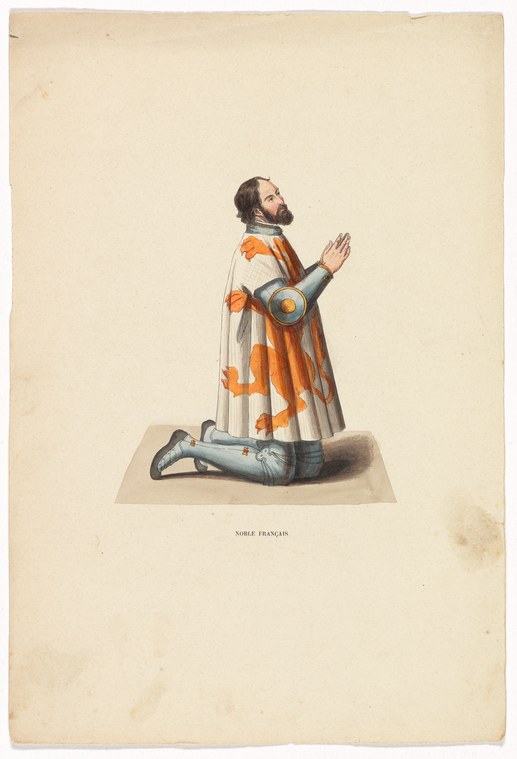
A man kneels in devotion on a rectangular platform against a plain ground. He wears the dress of a French noble of the sixteenth or seventeenth century: a long cloak or mantle of white linen decorated with golden-orange crosses or floral motifs, worn over a doublet. His dark hair and beard are styled in the fashion of the early modern period. His hands are raised in prayer or supplication, palms together at chest height, and his gaze is lifted upward. The figure is rendered in colored engraving or hand-colored print, with careful attention to the texture of fabric and the modeling of flesh. The work is titled simply "Noble Francais" (French Noble) in neat lettering beneath the figure.
The dancing
The body is arranged in a formal kneeling position: both knees planted firmly on the ground, the torso upright and dignified, the arms raised symmetrically to frame the face in an attitude of prayer or petition. The weight is distributed evenly across both knees; the posture conveys neither collapse nor tension, but rather composed reverence. The hands are shown with palms nearly touching, fingers extended upward. There is no dynamic movement; the figure is frozen in a moment of stillness and spiritual address.
The dance depicted
This is not a dance image. The figure is engaged in prayer or devotion, not any recognizable dance movement or style. The kneeling posture and raised hands belong to the language of religious supplication rather than dance. No musical accompaniment, dance partner, or choreographic intention is evident. While the gesture and costume are clearly those of the French noble class, and while the work appears in a collection labeled "Prints depicting dance," the image itself documents a non-dance moment of courtly or religious practice.
How it was made
This is a hand-colored engraving or print, likely from the sixteenth or seventeenth century. The technique allows for precise linear rendering of the figure's outline and features, with subsequent hand-coloring applied to give volume to the garments and flesh tones. The delicate cross-hatching visible in the darker areas suggests copperplate engraving. Such prints were produced in large editions and circulated widely among the educated classes as reference material for costume, deportment, and social practice. The careful execution and titled presentation suggest it was part of a didactic or documentary series on historical dress and comportment.
About this work
This hand-colored engraving documents the formal deportment of a French nobleman in an attitude of prayer or devotion. The work is a costume and posture study rather than a dance image, rendered in the exacting linear style of early modern engraving and hand-colored for circulation among a literate audience. It belongs to a tradition of prints that recorded the dress, bearing, and gestural vocabulary of the European nobility—visual instruction manuals for comportment and decorum. Its presence in a dance-focused collection reflects the historical overlap between dance and the broader study of courtly gesture and bodily discipline.
How to look at it
Attend to the symmetry and stillness of the pose. The figure is composed along a vertical axis, with the knees, torso, and raised hands all aligned. Notice how the engraver has rendered the weight of the heavy cloak and the texture of the linen through fine parallel lines and cross-hatching. Observe the hand position—palms nearly touching, fingers extended—which is characteristic of the devotional gesture across European art. The tilted head and upward gaze are conventions of religious submission that also appear in dance instruction, where the same elevated, dignified posture was required of courtiers and dancers alike.
The period
During the sixteenth and seventeenth centuries, the study of human gesture and costume became a major undertaking for artists and engravers across Europe. Works like Cesare Vecellio's *Habiti Antichi et Moderni* (1590) and similar compilations documented historical dress and deportment for reference and instruction. In France, the codification of courtly behavior was inseparable from the study of dance; etiquette manuals and dance instruction books often appeared together or cross-referenced one another. The precise rendering of fabric, fabric, and posture in such prints served both artistic and practical purposes—they were models to be studied and imitated. The nobiliaire tradition of the period placed enormous emphasis on the body as a text to be read: stance, gesture, and bearing communicated rank, virtue, and education.
Where it lives
The work is part of the New York Public Library's collection of prints depicting dance. It bears the simple caption "Noble Francais" and appears to be part of a broader series of costume or comportment studies. The collection is catalogued under the holding title "Prints depicting dance," suggesting it was acquired as evidence of the visual culture surrounding dance and courtly practice.
Questions about this work
Is this actually a dance image?
No. The figure is in an attitude of prayer or devotion, not performing any choreographed movement. It documents courtly deportment and dress rather than dance itself. However, it belongs in a dance archive because the bodily discipline and gestural vocabulary required for prayer and formal comportment were taught alongside dance in the courtly education of the period.
What does the title mean?
"Noble Francais" simply means "French Noble." It identifies the social rank and nationality of the figure, not a specific person. The print is part of a reference series documenting how members of the French nobility dressed and carried themselves.
When was this made?
The catalogue record gives no date, and the style of the engraving and the costume both suggest the sixteenth or seventeenth century. The hand-coloring and technique are consistent with prints made and distributed during that period.
More dance artwork





