49 works in this view — arrow keys or swipe to move between them.
Dance in Art
Historical and ethnic costumes
Unknown artist
- Collection:
- Prints depicting dance
- Source:
- New York Public Library
- Rights:
- Public domain — free to use, share and adapt.
- Recorded as:
- Public Domain
This print matters not as a dance document but as evidence of what informed historical imagination about courtly life. The formal dress and dignified bearing tell us what dancing bodies of the medieval court would have worn, even though these particular figures are not dancing. For historians of costume and court culture, it provides a direct reference point to understand the physical constraints and visual language of a period before dance notation existed.
What you are looking at
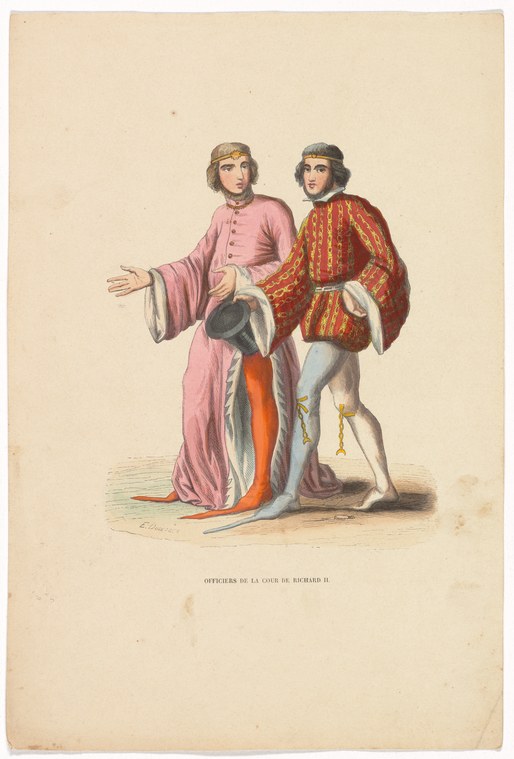
Two young men in courtly dress stand together against a plain background, the figure on the left wearing a long pink robe with wide sleeves and the figure on the right in a shorter red-orange tunic with dramatic billowing sleeves. Both wear close-fitting caps or hoods typical of 15th-century fashion. The man on the left gestures outward with his right hand in an open, expressive movement, while the man on the right stands beside him holding what appears to be a feathered fan or similar ornamental object. Their posture suggests a formal presentation or demonstration rather than active dance—they are posed for display rather than captured mid-movement. The engraving is hand-colored in muted tones, with careful attention to the texture and drape of expensive fabrics.
The dancing
Both figures maintain upright, dignified postures with no flexion or weight shift visible. The left figure's extended right arm and open palm suggest an instructional or presentational gesture—a moment of address or explanation rather than dance movement. The right figure's stance is static and observational. There is no evidence of partnered hold, synchronized footwork, or the body extension and line that would characterize formal dance of any era. The composition treats them as individual costume studies rather than as dancers engaged with each other.
The dance depicted
This print is titled as depicting officers of the court of Richard II (late 14th century), making it a historical costume document rather than a record of actual dance. While the figures wear the rich fabrics and formal dress of a period known for elaborate court ceremonies and courtly dances, nothing in their poses or gestures indicates active dancing. The left figure's gesture resembles the rhetorical or demonstrative poses common in courtly performances and processions, but without musical instruments, other dancers, or spatial staging, the work functions as fashion documentation rather than dance notation.
How it was made
This is a hand-colored engraving, likely 19th-century in origin despite its historical subject matter. The printing technique allowed for fine linear detail in the drapery and facial features, while hand-coloring added luxury and distinction to what would otherwise be a monochrome print. The scale and format suggest this was part of a larger series on historical costume and dress, intended for educated collectors and historical societies rather than for popular circulation. The careful archaeological attention to period detail indicates scholarly intent rather than imaginative reconstruction.
About this work
This engraving documents the courtly dress of 14th-century England rather than depicting dance itself. The two figures are presented as historical figures—officers of Richard II's court—rendered in meticulous period costume. While the work belongs to a tradition of courtly culture in which dance was central, the artist has chosen to present these figures in static, presentational poses that suggest courtly ceremony or formal address. The work is valuable as evidence of how 19th-century historical imagination visualized medieval court life, and for its attention to the material culture—fabrics, accessories, tailoring—that would have framed any dance activity of the period.
How to look at it
Notice the deliberate display of fabric and tailoring—the engraver has spent considerable effort rendering the texture of the wide sleeves and the fitted structure of the robes. This is not incidental detail but the whole point of the composition. The figures' posture and gesture are formal and presentational; this is how courtiers carried themselves in ceremonial contexts, whether dancing or receiving honors. The empty background isolates the figures for study, making them fashion plates rather than scene-paintings. The hand-coloring, applied after printing, highlights the luxurious materials that would have signaled rank and wealth in a real court.
The period
This work was produced in the 19th century, when historical costume became a popular subject for engravers and illustrators. The Victorian era developed a strong antiquarian interest in medieval and Renaissance material culture, partly as a response to industrialization and partly through the Gothic Revival in architecture and design. Historical accuracy in costume was valued, though often imperfect; these prints served as visual reference for historians, novelists, and theatrical designers seeking to reconstruct the appearance of earlier periods. The work reflects the assumption that studying dress was a path to understanding historical life.
Where it lives
This print belongs to the New York Public Library's collection of prints depicting dance, though it is better understood as a historical costume document. It is one of many such engravings produced in the 19th century to illustrate the material culture of earlier European periods.
Questions about this work
Is this a dance scene?
No. While the figures wear the formal dress of a court culture in which dance was important, their poses are static and presentational. The left figure's gesture suggests courtly address or instruction rather than dance movement. The work is a historical costume study rather than a record or illustration of dance.
What period is depicted?
The print depicts the court dress of Richard II (reigned 1377–99), based on the title. However, the engraving itself dates to the 19th century, when historical costume became a popular subject for illustrated books and reference collections.
Why is this in a dance collection?
Medieval and Renaissance courts were centers of dance culture, and understanding the costume and material culture of the period provides context for how dancers dressed and moved. Even non-dancing figures in courtly dress help historians reconstruct the visual world in which dance took place.
More dance artwork





