49 works in this view — arrow keys or swipe to move between them.
Dance in Art
Princess Eglantine
Unknown artist
- Collection:
- Prints depicting dance
- Source:
- New York Public Library
- Rights:
- Public domain — free to use, share and adapt.
- Recorded as:
- Public Domain
This print documents the aesthetics and costume conventions of romantic-era theatrical performance, a period when dance, opera, and theatrical spectacle were deeply intertwined. As a commercial theatrical print issued by a major London publisher, it offers evidence of how performers and costumes were marketed and remembered by the contemporary public.
What you are looking at
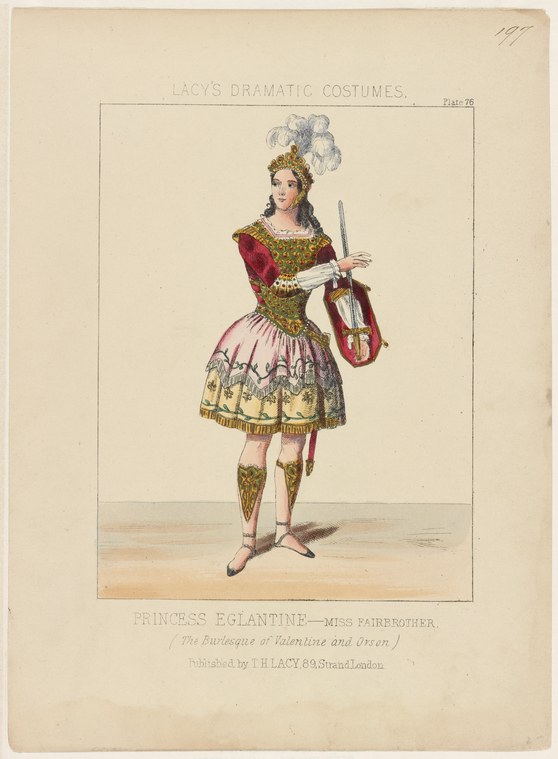
A young woman in theatrical costume stands alone against a neutral background, holding a lute or similar stringed instrument. She wears an elaborate ensemble: a close-fitting olive-green bodice embroidered with gold thread and edged with red velvet at the shoulders, a voluminous pink skirt decorated with a gold-bordered band of narrative or ornamental imagery around the hem, and cream-colored stockings. Her hair is styled up and crowned with an elaborate white plume or feathered headdress. She stands in a relaxed three-quarter pose, weight on one leg, regarding the viewer with a composed expression. The figure is rendered in hand-colored engraving, with careful attention to textile detail and the play of light on fabric. The print is titled *Princess Eglantine—Miss Fairbrother* and credited to T. Lacy, suggesting a connection to theatrical publication and performance.
The dancing
The single figure stands with her weight slightly shifted, one leg bearing load while the other leg appears relaxed—a pose associated with rest rather than active movement. Her arms hold the lute naturally before her. There is no suggestion of partnering or ensemble formation. The posture is upright and dignified, with the torso aligned and the head held high, consistent with courtly bearing rather than vigorous dance action. No foot position or step is distinctly legible.
The dance depicted
The image identifies this as a character from theatrical performance—specifically Miss Fairbrother as Princess Eglantine. The costume, hairstyle, and lute suggest a figure from romantic theatrical spectacle or comic opera of the 19th century rather than a professional dancer executing a defined dance technique. The lute-holding pose suggests her character may have been involved in musical or courtship scenes rather than pure dance. Without additional context on the play or opera this character inhabited, the specific dance content cannot be established, though the overall aesthetic suggests the romantic ballet era and its theatrical conventions.
How it was made
This is a hand-colored engraving, typical of theatrical illustration and costume documentation in the 19th century. The technique allowed for fine detail in rendering textiles, embroidery, and facial features, and the hand-coloring was applied afterwards with watercolor or similar pigment. T. Lacy was a major London printer and publisher of theatrical and musical works, and this print belongs to their commercial practice of documenting stage costumes and performers for the print-buying public. Such works circulated widely and served as both marketing for productions and records for historians and fellow performers.
About this work
This is a theatrical costume print documenting a named performer, Miss Fairbrother, in the role of Princess Eglantine. The image belongs to 19th-century theatrical culture and the commercial documentation of stage performance through engraved prints. While the figure is not actively dancing, she is a product of the romantic theatrical aesthetic that shaped dance practice and costume of the period, and her presence in a dance archive reflects the overlap between theatrical performance, spectacle, and choreography in that era. The work records both a specific historical performer and the broader visual language of romantic-era theater.
How to look at it
Attend first to the costume itself—the embroidery, the structured bodice, the lavish skirt decoration—as these elements are rendered with great precision and were essential to the character's identity on stage. The pose is deliberately composed and static, chosen to display the costume fully rather than to capture movement; this reflects the theatrical print tradition, which prioritized legibility and splendor over the energy of performance. The lute marks this character as romantic or musical, a detail that would have signaled her role in the narrative to a contemporary viewer familiar with the piece.
The artist
T. Lacy (Thomas Hailes Lacy, 1809–1873) was a prolific London printer, publisher, and theatrical entrepreneur. His publishing house was known for issuing plays, operas, and theatrical instruction manuals, and for producing illustrated costume and character prints of popular performers. These prints were significant cultural commodities, distributed to theater-goers, collectors, and other performers. Lacy's practice was commercial and documentary; his prints record the visual life of London theater and the stars who inhabited it.
The period
This print dates from the romantic era of theater and ballet, roughly the 1830s–1860s, when both forms celebrated spectacle, picturesque costume, and the allure of named performers. The romantic ballet—with works like *La Sylphide* and *Giselle*—established conventions of ethereal female beauty, elaborate tutus, and European or exotic characters that influenced all theatrical performance. Theatrical prints like this one were a major form of visual culture, allowing audiences to own and study images of favorite performers in their celebrated roles. The character name Princess Eglantine suggests a fairy-tale or romantic comedy context.
Where it lives
This print is held in the New York Public Library's collection of theatrical prints and ephemera. It is one of many such character and costume prints issued by T. Lacy's publishing house and circulated to the theater-going public of 19th-century Britain.
Questions about this work
Who was Miss Fairbrother?
The print identifies her only by her stage name and character. Without access to playbills or theatrical directories of the period, further biographical details cannot be established from the image alone. Theater historians may recognize the name; the NYPL collection may hold additional documentation.
What play or opera is this from?
The title gives the character name—Princess Eglantine—but not the title of the work itself. The romantic costume and the reference to Miss Fairbrother suggest this was likely a popular comedic opera or fairy-tale play of the mid-19th century, but the specific title would require reference to theater histories and Lacy's catalog.
Why is this in a dance archive if she's not dancing?
Romantic-era theater, dance, and opera were deeply interconnected. Performers often sang, danced, and acted in the same production. This print documents the visual and performative culture of the period and the conventions of costume and character that shaped choreography and movement.
What is the lute doing in her hands?
The lute identifies her character as musical or romantic—possibly a shepherdess, an enchantress, or a comic character associated with song and courtship. It is part of her costume identity and would have signaled her role to audiences.
More dance artwork





