49 works in this view — arrow keys or swipe to move between them.
Dance in Art
Historical and ethnic costumes
Unknown artist
- Collection:
- Prints depicting dance
- Source:
- New York Public Library
- Rights:
- Public domain — free to use, share and adapt.
- Recorded as:
- Public Domain
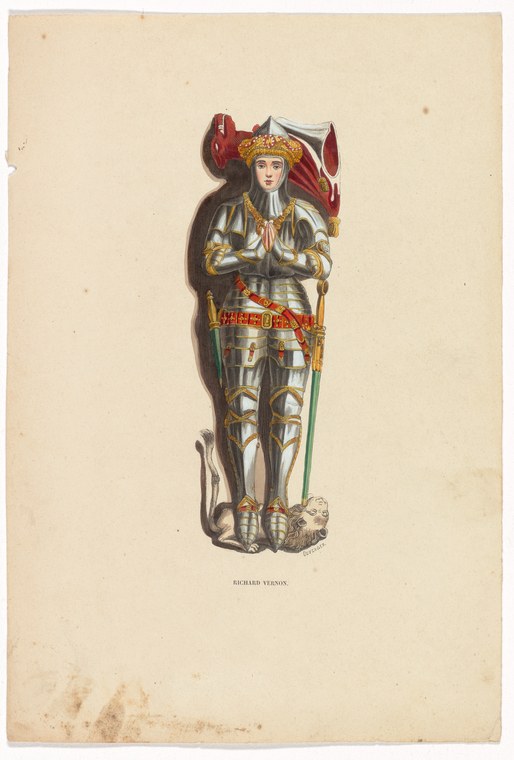
This work is a record of how armor and heraldic dress were imagined and disseminated in print culture, and of the visual conventions used to present historical and legendary figures to a popular audience. For dance historians, it documents the visual language of formality and rank that informs our understanding of ceremonial and court contexts in which dance occurred—but the image itself shows no evidence that dance is its subject.
What you are looking at
A solitary armored figure stands against a pale background, presented frontally in formal heraldic pose. The figure wears full plate armor rendered in silver and steel tones, with articulated joints at shoulders, elbows, knees, and ankles carefully delineated. The armor is embellished with gold detailing at the chest and along the breastplate. Above the suit, the figure's head wears a golden crown or circlet, and the face is pale and idealized—classical rather than naturalistic. Behind the figure rises a heraldic banner or standard in deep red and burgundy, held upright as a symbol of rank or authority. The composition is strictly symmetrical and vertical, emphasizing the figure's stillness and formal authority rather than any moment of motion. The hand position appears ceremonial: one arm is raised to hold or gesture toward the banner, the other rests at the side. There is no architectural setting, no ground line, no narrative context—only the figure isolated against the void.
The dancing
The single figure has no organic weight or counterbalance; the stance is parade-ground stiff, the arms positioned to display rather than move. The armored body appears as a symbol or diagram rather than as a dancing or moving being. The head is small relative to the massive breastplate, and the overall composition reads as monumental and heraldic rather than kinetic. No evidence of flexed knees, weight shift, or any of the physical negotiation of balance and momentum that characterizes dance.
The dance depicted
This is not a representation of dance. While the figure is formally positioned and the composition is ceremonial, there is no indication of movement, rhythm, musical context, or the engagement of the body in dance. This appears to be a heraldic or ceremonial portrait—possibly of a historical figure or personification of martial virtue—presented in the formal visual language of blazon and rank rather than dance imagery.
How it was made
This is a colored engraving or hand-colored print, identifiable from the fine linear hatching visible in the armor, the precise contour lines, and the limited palette applied in clear color washes. The inscription at the bottom ('RICHARD VICONT' or similar—partially legible) suggests this is one of a series documenting historical or legendary figures. The technique allows for mass reproduction and circulation, indicating this was likely a popular educational or heraldic broadside, part of a larger costume or genealogical compilation.
About this work
This is a heraldic or historical portrait rendered in the convention of a formal engraving, not a dance image. The figure—possibly Richard the Lionheart or a similar historical personage—is presented in full armor as a symbol of chivalric virtue and authority. While the image sits within a broader category of 'historical and ethnic costumes' (as the catalogue record suggests), it depicts costume and heraldry as static display rather than as worn by a moving body. It belongs in a gallery of dance in art only if that gallery includes the borderline case of ceremonial or processional dress recorded without movement.
How to look at it
Attend to the complete lack of movement: the symmetry, the still posture, the ceremonial frontality. Note how the armor is presented as a diagram or emblem rather than as a garment that clothes a body in motion. The heraldic banner and the formal positioning mark this as a display of status and symbol rather than a captured moment of dance or physical action.
The artist
Unknown. The style and technique suggest a Northern European engraver working in the 16th or 17th century, likely producing costume or heraldic series for popular or educational distribution. The inscription indicates this was one of a documented set.
The period
This engraving belongs to a period of intense interest in historical costume and heraldry, particularly in German-speaking lands and the Low Countries. Such prints often accompanied genealogies, histories, or costume compendia, and were used to educate the public about hierarchy, virtue, and the visual markers of rank. While dance did occur in court and ceremonial contexts of this period, this particular image is focused on the static presentation of armor and insignia rather than on the moving body.
Where it lives
Held by the New York Public Library in a collection of prints depicting dance. The catalogue record provides minimal information; the work is catalogued under 'Historical and ethnic costumes' with no recorded artist, date, or medium.
Questions about this work
Is this actually a dance image?
No. While it appears in a collection labeled 'Prints depicting dance,' this engraving shows a heraldic or ceremonial figure in armor presented in formal, static pose. There is no evidence of movement, musical accompaniment, or any of the physical engagement that characterizes dance. It may have been collected as a historical costume record, but the image itself does not depict dance.
Who is the figure?
The inscription at the bottom appears to read 'Richard Vicont' or similar, suggesting a historical or legendary figure—possibly Richard the Lionheart or another medieval noble. Without a clearer inscription or catalogue note, the identification cannot be confirmed from the image alone.
When was this made?
The style, technique, and heraldic conventions suggest a 16th or 17th century Northern European engraving, likely German or Flemish. However, no date is recorded in the catalogue, and the print may be a later reproduction of an earlier design.
More dance artwork





