49 works in this view — arrow keys or swipe to move between them.
Dance in Art
Historical and ethnic costumes
Unknown artist
- Collection:
- Prints depicting dance
- Source:
- New York Public Library
- Rights:
- Public domain — free to use, share and adapt.
- Recorded as:
- Public Domain
This work demonstrates how costume history collections of the 19th century were organized and circulated, and how the boundary between historical dress documentation and dance imagery can become blurred in archival handling. For historians of armor and military dress, it is a precise technical record; for dance historians, it is a reminder that not all historical costume images depict choreographic practice.
What you are looking at
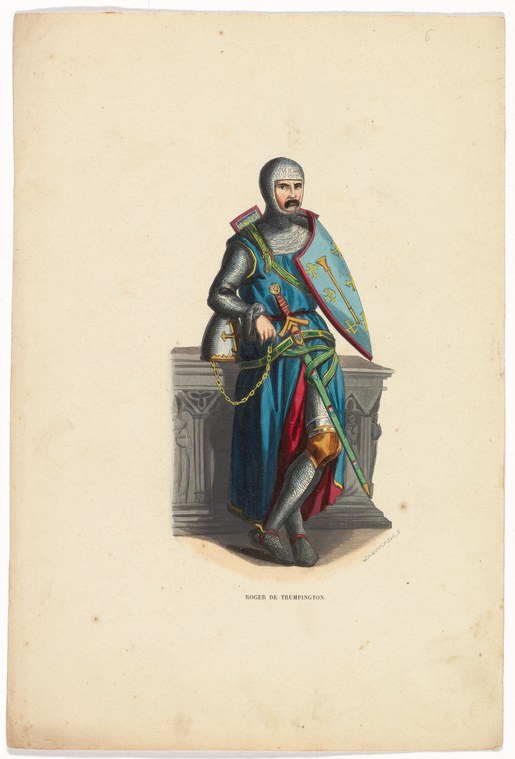
A solitary male figure in full medieval or Renaissance military dress stands in a three-quarter pose against a classical stone architectural backdrop. He wears articulated plate armor over a chainmail tunic, with a decorative blue surcoat embroidered in gold and trimmed in red—the garment drapes asymmetrically across his body and legs. A jeweled sword hangs at his side. His posture is formal and stationary, with one leg slightly advanced and his body angled toward the viewer's left. The figure gazes downward with a pensive or dignified expression, one hand resting near his hip. The setting is austere: a plain stone pedestal or plinth beneath him, against a beige background. The hand-coloring of the print is restrained and precise, with careful attention to the metallic surfaces and the richness of the textile ornament.
The dancing
The single figure maintains an upright, formally composed stance rather than an active dance posture. His weight is evenly distributed, with no indication of movement, turn, or momentum. His arms are relaxed at his sides; there is no arm frame, hold, or gesture characteristic of any dance vocabulary. The posture is heraldic and commemorative—more akin to a monument or portrait than to a depiction of movement. This is a stationary, formal presentation of a historical figure in costume.
The dance depicted
This image does not depict dance. While it shows a figure in historical military regalia, the pose, stance, and context are purely representational and commemorative. There is no movement, no partnering, no musical context, and no gesture language that belongs to any dance tradition. The figure is presented as a historical or legendary personage—likely Turenne, to whom the caption refers—rather than as a dancer or participant in a choreographed event.
How it was made
This is a hand-colored engraving or lithograph, executed with fine line work and careful tonal gradation typical of 19th-century costume history illustration. The technique permitted precise rendering of armor detail and textile pattern, and the hand-coloring—applied in watercolor or gouache—adds dimensionality to the metallic and fabric surfaces. This method of production indicates the work was intended as a page from a series or collection of historical costume studies, distributed to educated audiences interested in military and sartorial history rather than theatrical performance.
About this work
This is a costume study rather than a dance image: a formal, hand-colored engraving depicting a historical military figure in Renaissance or medieval armor and ceremonial dress. The catalogue assigns it to a collection of dance prints, but the image itself contains no choreography, movement, or dance context. It belongs in a costume and history archive rather than a dance gallery. The figure is presented as a commemorative portrait of a named historical personage, not as a performer.
How to look at it
Examine the precision of the armor rendering and the subtle gradations in the hand-coloring, which convey weight and metallic substance. Note the asymmetrical fall of the surcoat and the jeweled hilt of the sword—details that communicate status and historical specificity. Observe the stillness and formality of the stance, which is the entire point: this is a portrait and costume record, not a moment captured from movement. The downward gaze and static posture are intentional markers of commemoration rather than dance.
The artist
The artist is not recorded in the catalogue. The style, technique, and subject matter are consistent with 19th-century European historical costume publications—possibly French, given the French caption and the focus on a celebrated French military figure. Such works were often produced by teams of engravers and colorists rather than individual artists, and attribution has frequently been lost.
The period
This image belongs to the 19th-century vogue for historical costume documentation and military pageantry. During this period, lavish illustrated histories of dress, armor, and material culture were produced for the educated public. Simultaneously, historical dress and militaristic themes were entering theatrical spectacle and opera, but this particular image is a scholarly or antiquarian study rather than a theatrical design. The aesthetic of formal presentation and the heraldic stiffness of the pose reflect period conventions in portraiture and historical commemoration.
Where it lives
The work is held in the New York Public Library's collection of historical prints depicting dance and costume. Its presence in that collection may reflect 19th-century archival practices that grouped all historical dress imagery together, regardless of choreographic content.
Questions about this work
Is this person dancing?
No. This is a formal portrait study of a historical military figure in ceremonial dress. The pose is static and commemorative, with no movement, gesture, or choreographic intent. It is a costume record rather than a depiction of dance.
Who is Turenne, and why is he pictured?
The caption identifies the figure as a historical personage (likely Henri de la Tour d'Auvergne, Viscount of Turenne, a celebrated 17th-century French general), but the image functions as a costume study rather than a biographical narrative. It documents period armor and dress conventions.
Why is this in a dance collection?
The New York Public Library's cataloguing grouped historical dress and costume imagery together in the early-to-mid 20th century. Such organizational practices sometimes placed costume reference materials in dance collections, even when the images themselves do not depict choreography. This is an archival artifact of that decision.
More dance artwork





