49 works in this view — arrow keys or swipe to move between them.
Dance in Art
Historical and ethnic costumes
Unknown artist
- Collection:
- Prints depicting dance
- Source:
- New York Public Library
- Rights:
- Public domain — free to use, share and adapt.
- Recorded as:
- Public Domain
This work matters as evidence of how dance collections and archives sometimes contain non-dance material, and how catalogue errors can persist when works are catalogued remotely or by subject rather than by visual analysis. It serves as a reminder that 'costume' and 'figure' alone do not make an image a dance document; the absence of movement, the presence of stillness, and the devotional context all distinguish this decisively from dance imagery.
What you are looking at
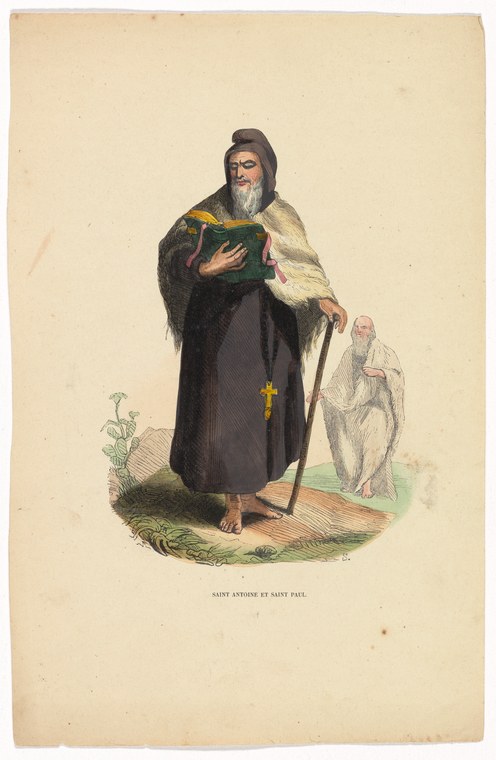
An elderly bearded man in monastic dress stands alone against a pale ground, his weight settled and his gaze directed toward the viewer with gentle authority. He wears a dark habit with a white fur-lined cloak draped across one shoulder, and a golden cross hangs at his chest. His right hand is raised in blessing or teaching gesture, fingers extended in a conventional ecclesiastical sign. To his right, slightly behind and in smaller scale, kneels a younger figure in white robes, head bowed in veneration or prayer. A small plant with delicate leaves grows from the ground at the elder's feet. The hand-colored print shows careful attention to the textures of fabric—the dense black of the habit contrasts with the luminous white of the fur lining and the younger figure's garments—and employs a warm cream ground typical of 19th-century religious prints.
The dancing
The standing figure occupies the central vertical axis of the composition, his posture upright and still, with no suggestion of movement or dance. His raised right hand employs the two-fingered blessing gesture conventional in Eastern Orthodox iconography. The kneeling figure is entirely static, positioned in an attitude of prostration or profound reverence. Neither figure is in motion; the composition presents two states of stillness—authority and supplication—arranged in hierarchical relationship rather than in any form of reciprocal bodily exchange.
The dance depicted
This image does not depict dance. It is a religious print presenting two holy figures in a devotional scene, likely representing a saint or monastic elder and a supplicant. The format, gesture, and spatial arrangement follow the conventions of Christian hagiography rather than dance documentation. The stillness of both figures is compositionally essential to the work's spiritual meaning.
How it was made
This is a hand-colored lithographic or engraved print, characteristic of 19th-century devotional imagery. The inscription at the base reads 'SAINT ANTOINE ET SAINT PAUL'—identifying the figures as Saint Anthony (or Antony) and Saint Paul the Hermit, two early Christian ascetics. The technique of hand-coloring allowed for subtle gradation in the flesh tones and the careful rendering of textural contrasts between the materials of dress. Such prints were produced in large numbers for popular religious instruction and domestic devotion, circulating widely in Catholic and Orthodox communities.
About this work
This is a 19th-century hand-colored print depicting two early Christian saints in a moment of spiritual encounter or veneration. Saint Anthony, the bearded elder, stands in blessing while Saint Paul kneels in prayer or homage. The work belongs to a vast tradition of devotional prints that served as tools for meditation and instruction in Christian households and monastic communities. Though the catalogue record labels it a dance print and describes it as 'Historical and ethnic costumes,' the image contains no movement, no performers, and no choreography—only the stillness and formal gesture of religious iconography. The confusion may arise from the print's historical costume elements and its figural composition, but these alone do not constitute dance.
How to look at it
Observe the formal geometry of the composition: the vertical line of Saint Anthony's body centered in the frame, the kneeling figure positioned in subsidiary space, the ground line anchoring both figures in a shallow stage. Note the hands—Anthony's raised fingers in the conventional blessing gesture, Paul's posture of submission. The print does not seek to capture a moment of action but rather to present a timeless spiritual relationship, frozen in a pose of eternal veneration. The costume—the habit, the fur cloak, the cross—carries historical and symbolic meaning, but serves devotion rather than documenting actual dress practice.
The artist
The print is unsigned and the catalogue records no artist attribution. The style and production method are consistent with mid-to-late 19th-century European devotional printing, likely French or German in origin, but without further documentation this cannot be confirmed. Such prints were often produced by commercial print houses rather than individual artists, and attribution was not always prioritized in their circulation.
The period
This print was made during the 19th century, a period of intense production of devotional imagery for popular consumption. The hand-coloring technique and the specific style of the engraving or lithography suggest manufacture between 1830 and 1890. During this period, prints depicting saints and Christian themes were mass-produced and widely distributed through religious organizations, bookshops, and peddlers. The revival of interest in early Christian asceticism—particularly the Desert Fathers tradition represented by Anthony and Paul—was part of the broader 19th-century Romantic engagement with spiritual authenticity and historical Christianity. These prints served both as devotional aids and as historical documents, meant to instruct viewers in Christian virtue and the lives of the saints.
Where it lives
The work is held in the New York Public Library's collection of prints depicting dance, catalogued in their research collection. It appears to have been acquired as part of a broader collection of historical and ethnic costume prints, a categorization that explains its presence in a dance archive despite its non-dance content.
Questions about this work
Is this a dance image?
No. This is a devotional religious print depicting two saints—Anthony and Paul the Hermit—in an attitude of prayer and blessing. Neither figure is in motion, and the composition follows the conventions of Christian hagiography rather than dance documentation. The presence of historical costume and figural imagery does not make an image a dance image.
Why is this in a dance collection?
The catalogue description labels it 'Historical and ethnic costumes,' which may have led archivists to classify it among dance-related materials. The error appears to be categorical rather than deliberate—the print does document historical dress and could be useful for costume historians, but that utility does not extend to dance history.
Who are these figures?
The inscription identifies them as Saint Anthony (or Antony) and Saint Paul the Hermit, two figures from early Christian monastic tradition, celebrated in the 4th century. Anthony is often depicted as the elder and founder of Christian monasticism, while Paul is remembered as one of the first hermits. The scene likely represents Paul's veneration of Anthony or their spiritual meeting.
More dance artwork





