49 works in this view — arrow keys or swipe to move between them.
Dance in Art
Historical and ethnic costumes
Unknown artist
- Collection:
- Prints depicting dance
- Source:
- New York Public Library
- Rights:
- Public domain — free to use, share and adapt.
- Recorded as:
- Public Domain
This plate preserves the material culture of regional or vernacular dance: the actual garments, accessories, and body presentation of people for whom dance was woven into daily or ceremonial life. As a printed series, it represents a moment when European institutions began systematizing and visualizing the world's peoples and practices, making it a key document of how non-European dance was recorded, categorized, and circulated in the 19th century.
What you are looking at
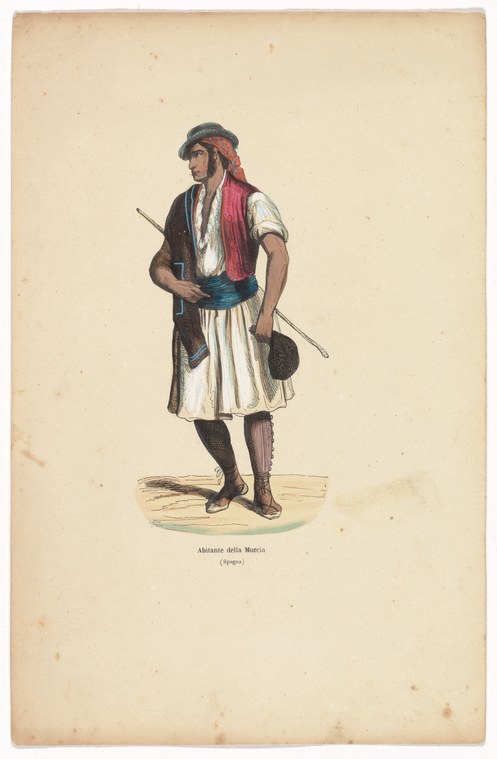
A single figure stands in three-quarter view against a plain cream ground, depicted in hand-colored engraving or lithograph. The person wears a white knee-length skirt gathered at the waist with a blue sash, paired with a sleeveless dark vest or jacket over a white shirt. A red fabric—possibly a headwrap or turban base—is wound around the head beneath a dark cap or hat. The figure holds a wooden staff or pole in the left hand and what appears to be a round shield or frame drum in the right. The stance is relaxed but alert, the weight distributed evenly on both feet shod in dark shoes or boots. The composition is formal and didactic, presenting the costume as a specimen for examination rather than capturing movement or dance in progress.
The dancing
The single standing figure adopts an upright, frontal pose with minimal suggestion of dynamic weight or active dancing. The arms are held low and slightly away from the body, one grasping the staff, the other the circular object. There is no closed hold, no partnering, no evidence of footwork or the off-axis tilt that characterizes active dance. The posture reads as a presentational stance—a costume model or ethnic type posed for documentation—rather than a captured moment of performance.
The dance depicted
This is not a depiction of dance in action but rather a costume plate or ethnographic illustration. The figure represents a regional or ethnic type, as indicated by the Italian inscription at the base (partially legible as "Abitante della Moscia" or similar—a person from a specific region). While the attributes—staff, circular object, regional dress—suggest this person may have danced, the image itself documents clothing and material culture, not dancing practice. The work belongs to the tradition of costume and type illustration common in 19th-century ethnographic prints rather than to dance documentation.
How it was made
This is a hand-colored engraving or possibly a lithograph, a reproductive print medium designed for distribution and study. The outline is finely incised or drawn, and watercolor or gouache has been applied by hand to render the garments, skin tone, and accessories. The technique allows for precise detail and repeatable circulation; the inscription suggests it was one of a series of costume plates, likely meant for a reference book or ethnographic collection. The formality and regularity of such prints made them a standard medium for documenting regional dress and "types" across Europe and colonial territories in the 18th and 19th centuries.
About this work
This is an ethnographic costume plate from the 19th century, part of a series documenting regional or ethnic dress. The figure represents a named type or inhabitant of a specific region, equipped with the staff and circular object (possibly a shield or drum) associated with local practice or status. While the dress and attributes may connect to vernacular dance traditions, the image itself is a still, formal documentation of costume rather than a depiction of dancing. It belongs in a dance gallery because the staff, drum, and regional dress are material evidence of dance practice in a particular culture, even though the image freezes the body in a presentational pose rather than capturing choreography or movement.
How to look at it
Look at the formal, frontal presentation: the figure is not mid-gesture or caught in motion, but posed for inventory. The staff and round object are held clearly visible, not in use. The costume—the wrapped head, the sash, the vest, the cut of the skirt—are rendered with precision so that every detail can be studied and distinguished. This is the visual language of ethnographic documentation, where the body becomes a display case for dress and material culture. A viewer should ask: who made this image, for whom, and on what authority? The beauty of the hand-coloring should not obscure that this is a classificatory tool, a way of rendering another person's culture as visible and knowable to a European viewer.
The artist
The artist is not recorded. The work belongs to the tradition of ethnographic illustration that flourished in the 19th century, produced by both professional engravers and natural history institutions. Such plates were often based on descriptions, earlier prints, or the observations of travelers and colonial administrators, rather than direct study of live dancers. The circulation through print collections (suggested by the NYPL holding) indicates this was one of many such works aimed at an educated European audience seeking visual knowledge of distant peoples and their cultures.
The period
The 19th century saw an explosion in ethnographic illustration and taxonomy, driven by colonial expansion and the rise of anthropology as a discipline. Costume plates became a standardized way of documenting human diversity, often organized by region, occupation, or "race." At the same time, theatrical and folk dance in Europe was gaining new cultural status; the Romantic ballet was emerging, and European artists were collecting and studying vernacular dances from rural and colonized populations as authentic sources. This plate sits between those impulses: it documents a real person's dress and equipment with scientific intent, yet also participates in the exoticization and display of non-European peoples that characterized the period.
Where it lives
The work is held in the NYPL's collection of prints depicting dance, catalogued as part of a series on historical and ethnic costumes. It arrived in the collection without a recorded artist or date, suggesting it was acquired as part of a larger series or donation of 19th-century prints. The inscription in Italian indicates it is likely from an Italian or Venetian source or edition.
Dance in this work
Questions about this work
Is this a dancer, and what dance is being shown?
The figure is a costumed person—likely from a specific region—documented in a pose that shows off the costume and accessories (staff, shield or drum) rather than capturing dance in action. While the staff and drum suggest this person participated in or performed dance, the image itself is an ethnographic costume plate, not a record of dancing.
What is the round object the figure is holding?
It is not entirely clear from the image alone. It could be a shield, a large round mirror, or a frame drum. Given the context of ethnographic documentation, it is likely an object of practical, ceremonial, or decorative significance associated with the regional costume or practice.
Who made this, and when?
The artist is not recorded. The style and technique suggest it is a 19th-century hand-colored engraving or lithograph, likely Italian or Venetian in origin, produced as part of a didactic series on world costume and regional types. The NYPL acquired it as part of a broader print collection.
Why is it in a dance collection if it is not showing a dance?
Because the costume, staff, and drum are material evidence of dance practice and performance in a specific culture. While the image freezes the body in a still pose, it documents the actual dress and equipment used by people for whom dance was part of their cultural life. It is a historical record of how dance was physically performed and equipped.
More dance artwork





