49 works in this view — arrow keys or swipe to move between them.
Dance in Art
Historical and ethnic costumes
Unknown artist
- Collection:
- Prints depicting dance
- Source:
- New York Public Library
- Rights:
- Public domain — free to use, share and adapt.
- Recorded as:
- Public Domain
Ethnographic costume studies like this shaped European and Western knowledge of non-Western dress and culture in the 19th century, often accompanying textual descriptions of music, ritual, and dance. Understanding how dancers and ceremonies were *visually* documented in this period—including through static costume plates—matters to historians of both dance and visual culture.
What you are looking at
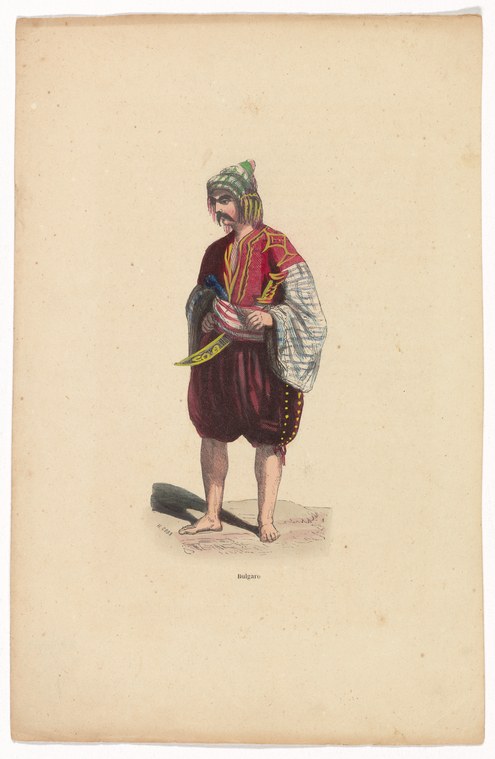
A single standing figure occupies the center of the composition against a plain cream background. The person wears a red knee-length tunic or dhoti with a checkered or patterned white wrap across one shoulder and arm, and a tall cylindrical headpiece in green and gold. The figure stands barefoot in a relaxed frontal pose, with one arm bent and the other at the side, gazing downward. The costume and headgear suggest South Asian or Middle Eastern dress from a historical period. The image is hand-colored, with careful attention to the patterns and textures of the garments. A single line of text appears below the figure.
The dancing
The body is upright and static rather than in motion, with weight distributed evenly on both feet. The arms are held low and relaxed rather than raised or extended—one arm bends slightly across the body, the other hangs naturally. The gaze is directed downward, creating a contemplative rather than dynamic impression. There is no sense of mid-movement or active stepping; the figure reads as a posed study of a person in ceremonial or formal dress.
The dance depicted
This does not appear to depict active dance. The figure is presented as a costume study or ethnographic illustration—a standing portrait in historical dress rather than a captured moment of movement. The pose and stillness suggest this is documentation of a garment, headdress, and cultural dress tradition rather than a record of choreography or a dancer in performance. Without visible motion, footwork, or gestural engagement, no specific dance style can be identified.
How it was made
This is a hand-colored engraving or lithograph, identifiable by the precision of the line work and the controlled application of pigment over a printed base. The technique allowed for fine detail in the headgear and woven patterns, and the hand coloring creates a sense of documentary specificity typical of ethnographic or historical costume illustration from the 19th century. The method suggests a work intended for circulation as a print, likely as part of a series or portfolio on historical dress.
About this work
This is a costume study rather than a dance documentation—a colored engraving of a figure in historical South Asian or Middle Eastern dress, presented as an ethnographic or antiquarian illustration. The work belongs in a dance archive because costume and cultural dress are inseparable from the contexts in which dance occurs, and because such prints often accompanied written descriptions of cultural practices including ceremonial and social dance. The absence of movement, however, places it at the margin of direct dance representation.
How to look at it
The viewer should attend to the specificity of the costume: the construction of the headdress, the pattern and drape of the wrap, the bare feet. These details tell us what was considered visually essential to the identity of this dress tradition. The downward gaze and static pose are conventions of the costume-study genre; the body is presented not as an agent but as a display surface for cloth, pattern, and form. The artist was documenting garment and headdress more than movement or dance.
The period
The 19th century saw an explosion of illustrated ethnographic and antiquarian publications documenting the dress, customs, and cultural practices of peoples across European colonial territories and trade routes. Such prints served multiple audiences: collectors of curiosities, scholars, costume designers, and those seeking visual evidence of cultural difference. Costume plates were often organized in series and sometimes accompanied dance notation, music transcription, or written accounts of ceremony and social practice. The hand-colored engraving was a standard medium for this work, balancing precision with the manual labor necessary to produce individual copies.
Where it lives
The work is held as part of the New York Public Library's prints collection on dance. It is catalogued as part of a series on historical and ethnic costumes, suggesting it was originally part of a larger illustrated publication or portfolio.
Questions about this work
Is this a dancer or just someone wearing a costume?
The image is a costume study—a static illustration of a person posed in formal or ceremonial dress. It documents garment and cultural tradition rather than capturing dance in motion. Many 19th-century ethnographic prints presented costumes this way, as visual reference for scholars, collectors, and costume makers.
What culture or region does this dress represent?
The cylindrical headdress, the knee-length tunic, the checked shoulder wrap, and the barefoot stance suggest South Asian or possibly Central Asian dress, though without text or clearer provenance it is difficult to specify a particular region or tradition with certainty. The hand coloring and style place it in 19th-century European ethnographic publication tradition.
Why is this in a dance collection if there is no visible dance?
Costume and cultural dress are integral to understanding dance in its original context. Such prints often appeared in publications that *did* describe dances, music, and ceremony alongside costume documentation. They help historians understand how dance traditions were visually represented and transmitted in European knowledge systems.
More dance artwork





