49 works in this view — arrow keys or swipe to move between them.
Dance in Art
Historical and ethnic costumes
Unknown artist
- Collection:
- Prints depicting dance
- Source:
- New York Public Library
- Rights:
- Public domain — free to use, share and adapt.
- Recorded as:
- Public Domain
This work demonstrates how costume, posture, and formal dress can evoke historical authority and identity—and how such images, though static, can be misclassified as dance documentation. It is a useful case study in the distinction between historical portraiture and choreographic representation, and in how institutional cataloguing can conflate costume history with dance history.
What you are looking at
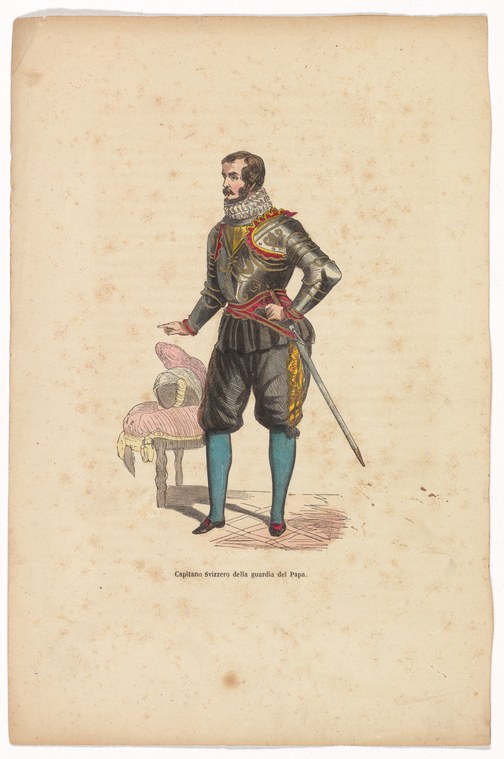
A single male figure stands in a three-quarter pose against a plain cream background, wearing ornate military dress of the Renaissance or early modern period. He wears a dark decorated breastplate with gold embroidery and trim, a high collar with a ruffled neckline characteristic of 16th-century Spanish dress, and blue-green stockings. His right arm rests on his hip in a commanding posture; his left arm hangs naturally at his side holding a rapier or sword. Behind him sits a cushioned stool or chair with pink/mauve upholstery and ornate fringe. The figure's stance is formal and static—an idealized portrait of authority rather than a moment of actual dance or movement. The inscription at the base reads "Capitano Speroni della guardia del Papa" (Captain Speroni of the Pope's Guard).
The dancing
A single standing figure in a formal, frontal three-quarter pose with weight equally distributed and no sense of movement or weight transfer. The right arm bent at the elbow rests on the hip in a characteristic Renaissance stance of nobility and command. The left arm hangs straight, holding a sword. There is no engagement of the torso, no indication of weight shift, and no partnering or interaction with space as a dancer would embody it. The posture is heraldic—designed to display status and costume rather than to capture movement.
The dance depicted
This is not a depiction of dance. It is a military or court portrait in the guise of a historical costume study. The figure is presented as a guard or official of the papal court, not as a performer. The stance, while formal and composed, carries no choreographic meaning. The work belongs to a tradition of historical costume documentation rather than dance documentation.
How it was made
Hand-colored engraving or lithograph, executed with fine line work for the face, costume details, and sword, and watercolor or hand tint for the flesh tones, fabrics, and background. The technique is characteristic of 19th-century historical costume illustration, allowing both precision in ornamental detail and the soft modeling of the figure. The colored paper ground and restrained palette suggest publication in a luxury folio or portfolio of historical dress studies, likely intended for a educated audience interested in historical authenticity.
About this work
This is a 19th-century hand-colored print documenting the dress of a papal guard or court official of the Renaissance period, presented as a single standing figure in formal costume. Although catalogued as part of a dance collection, it does not depict dancing, choreography, or any active movement. It is a historical costume study, part of a likely larger series on European military or court dress of earlier centuries. The work is valuable as evidence of 19th-century antiquarian interests and the visual reconstruction of Renaissance military identity, but not as a primary source for dance history or practice.
How to look at it
Note the formality of the stance—the weight settled, the arm placement rhetorical rather than kinetic. Compare this to depictions of actual dancers of the same period, where the body is caught in a moment of weight transfer, the limbs are engaged with space, and the composition suggests momentum or narrative interaction. Here there is none of that. The figure is an object of display, not an agent of movement.
The artist
The artist is unrecorded. The work is characteristic of 19th-century historical and ethnographic print publishing, a period when European interest in historical authenticity, military history, and costume documentation reached a peak. Such prints were often produced in series and distributed as educational or decorative portfolios.
The period
This print was created during the 19th century, an era of intense antiquarian scholarship and romantic fascination with Renaissance and early modern European history. The precision of costume detail and the emphasis on military rank reflect contemporary scholarly interest in reconstructing historical dress and ceremony. This was also the era in which dance, as a subject for serious historical study and illustration, was beginning to be documented more systematically, but this particular work remains outside that tradition—it is costume history, not dance history.
Where it lives
The work is held in the New York Public Library's collection of prints depicting dance. It was likely acquired or catalogued as part of a broader collection on performance, costume, and historical dress, though its classification as dance material appears to be an archival error rather than a curatorial judgment.
Questions about this work
Is this a dancer?
No. This is a military or court official of the Renaissance period, shown in formal dress. The figure is standing in an official pose, not executing any dance step or choreography. The work belongs to the history of military costume, not dance.
Why is it in a dance collection?
The work was likely acquired or catalogued as part of a broad institutional survey of performance-related imagery, or catalogued in error. It demonstrates how easily costume documentation can be conflated with dance documentation, and how important accurate cataloguing is to research.
What is a Capitano Speroni?
According to the inscription, Captain Speroni held the rank of Guard of the Pope—a position of authority in the papal military hierarchy. The print documents his official dress and insignia of rank, not his role as a performer or dancer.
More dance artwork





