49 works in this view — arrow keys or swipe to move between them.
Dance in Art
Nancy Dawson
Unknown artist
- Collection:
- Prints depicting dance
- Source:
- New York Public Library
- Rights:
- Public domain — free to use, share and adapt.
- Recorded as:
- Public Domain
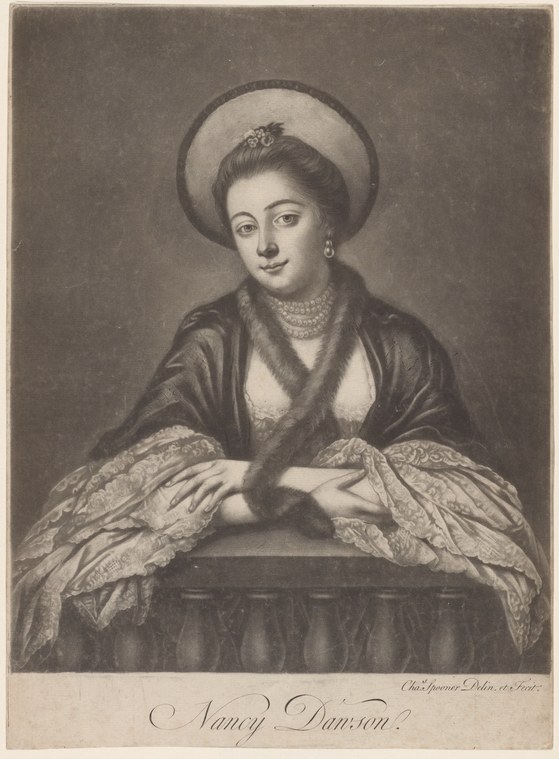
Nancy Dawson was a star of English pantomime and comic dance in the 1750s, and this portrait is a primary document of her celebrity and public image. The print shows how eighteenth-century theatrical dancers built fame through their presence and personality, not only through technical brilliance—a shift in how dance was valued and consumed. For historians of theatre, costume, and women's performance, the image is a rare record of how a celebrated dancer of the period was dressed, posed, and presented to the public.
What you are looking at
A three-quarter-length portrait of a woman wearing eighteenth-century dress, set against a plain grey background. She is seated at a table draped with elaborately patterned fabric in pale tones. Her dark hair is styled upswept with a small ornament, and a halo or circular frame surrounds her head—a conventional device in prints to mark the subject as notable. She wears a dark bodice with a deep neckline, pearl necklace, and multiple strands of jewels at the throat. Over this sits a dark shawl or wrap with gold embroidery or trim. Her expression is composed and frontal, her gaze meeting the viewer's directly. The inscription below reads "Nancy Dawson," identifying the subject. The print is executed in mezzotint or stipple engraving, creating soft tonal transitions and subtle modeling of the face and fabrics.
The dancing
A single seated female figure, posed statically and formally facing the viewer. Her torso is upright and squared; her arms rest on or near the table surface, hands relaxed and visible. There is no active bodily movement or dancer's frame; the pose is one of repose and dignified presentation rather than the seized moment of motion. The figure's bearing suggests performance presence—a quality of address to an audience—but no active footwork, turn, or traveling step is depicted.
The dance depicted
Nancy Dawson (1728–1767) was a celebrated English dancer and actress of the mid-eighteenth century, most famous for her comic performances in pantomime and for a signature step-dance to the tune 'Maggie Lauder' in John Gay's *The Beggar's Opera*. The image does not depict her dancing; instead, it is a portrait of her in street dress or performance attire, made for circulation as a commemorative print. Dawson danced in the English comic and pantomime tradition of the 1750s, a form that blended balletic convention with vernacular gesture and comic timing. The portrait registers her as a public figure and stage personality rather than capturing the movement that made her famous.
How it was made
This is a mezzotint or fine stipple engraving, a reproductive printmaking technique that allowed detailed tonal control and a velvet-like surface especially suited to portraiture. The inscription at lower right—'Cht Spooner Delin et Sculpt' (Charles Spooner, drawn and engraved)—attributes the work. The technique's capability for subtle flesh tones and fabric rendering made it the preferred medium for theatrical celebrity portraiture in the eighteenth century. Such prints were sold as single sheets to audiences and admirers, making them instruments of theatrical fame and commodities in their own right.
About this work
This is a mezzotint portrait of Nancy Dawson, one of the most celebrated English dancers of the mid-eighteenth century. The image does not show Dawson in performance; rather, it presents her as a public figure and theatrical personality at leisure or in formal dress. It belongs in a gallery of dance in art because it documents the culture of theatrical celebrity around dance, the importance of the dancer's face and presence to eighteenth-century fame, and the role of the printed portrait in making performers visible to audiences beyond the playhouse. The work is significant not as a record of dancing itself, but as evidence of how dancers were commodified, remembered, and circulated in popular culture.
How to look at it
Study the face and bearing first: Dawson meets the viewer's eye with a composed expression and an air of authority. Notice the formal dress and jewels, which signal both status and the artifice of theatrical presentation—this is not a private woman, but a public persona. The elaborate table drapery and the halo-like frame are conventions of the commemorative portrait, transforming Dawson into a monument. The absence of action or movement distinguishes this from prints of dancers in the moment of performance; instead, the print offers the dancer as object of contemplation, a figure to be remembered and admired rather than watched in motion.
The artist
Charles Spooner is recorded as the engraver of this plate ("Cht Spooner Delin et Sculpt"). Little is known of Spooner's biography or broader practice beyond attribution to individual works. He was one of many specialist mezzotint and stipple engravers working in London in the mid-eighteenth century, an era when theatrical portraiture was a robust commercial market. His technique here is competent and restrained, focused on clarity of facial likeness and rendering of fabrics rather than elaborate composition.
The period
This print was made in the 1750s–1760s, when English pantomime and comic dancing were flourishing as popular entertainment forms distinct from ballet proper. Nancy Dawson's fame rested on her skill in the comic and burlesque mode—rapid footwork, verbal wit translated into physical comedy, and a direct address to the audience. At the same time, Continental ballet was becoming more academically formalized; Dawson's fame thus marks a parallel, vernacular tradition rooted in older English theatrical dance. The mezzotint portrait itself was a new commodity form—theatrical celebrity distilled into a portable, affordable image for purchase and display in the homes of theater-goers.
Where it lives
The work is held in the Prints depicting dance collection at the New York Public Library. It is a mezzotint or stipple engraving, a single sheet intended for retail sale to the public and now catalogued within a larger collection of prints documenting dance imagery across periods and cultures.
Questions about this work
Why is Nancy Dawson famous and why is she in a dance collection?
Dawson (1728–1767) was the most celebrated comic dancer and actress of mid-eighteenth-century England, best known for her performances in pantomime and especially for a famous step-dance to 'Maggie Lauder' in The Beggar's Opera. She belongs to the history of English theatrical dance—a vernacular tradition parallel to ballet—and this portrait documents her as a public figure and cultural icon of the dance world.
This is a portrait, not a dance scene. Why isn't it just art history?
The print is a portrait of a dancer, not a depiction of dancing, which makes it art history with dance significance rather than a direct record of movement. But the image shows how dancers were presented, consumed, and remembered in their own time—as celebrities and commodities. For historians of dance culture, this shifts the focus from technique to fame, fashion, and the machinery of theatrical celebrity.
What was English pantomime and comic dance in this period?
English pantomime in the eighteenth century blended classical ballet technique with comic gesture, slapstick, and direct address to the audience. Dancers like Dawson were celebrated for speed, wit, and physical comedy rather than the ethereal grace valued in French or Italian ballet. This print documents a moment when English theatrical dance was distinct, popular, and largely vernacular—before it became absorbed into more codified forms.
How was this print made and circulated?
This is a mezzotint or stipple engraving, a reproductive technique that allowed for subtle tonal rendering and was ideal for portraiture. Such prints were sold individually as single sheets to theater audiences, fans, and collectors, making them instruments of celebrity marketing and affordable commodities. They transformed the dancer into a portable image for the home, extending the reach of theatrical fame beyond the playhouse.
More dance artwork





