49 works in this view — arrow keys or swipe to move between them.
Dance in Art
Historical and ethnic costumes
Unknown artist
- Collection:
- Prints depicting dance
- Source:
- New York Public Library
- Rights:
- Public domain — free to use, share and adapt.
- Recorded as:
- Public Domain
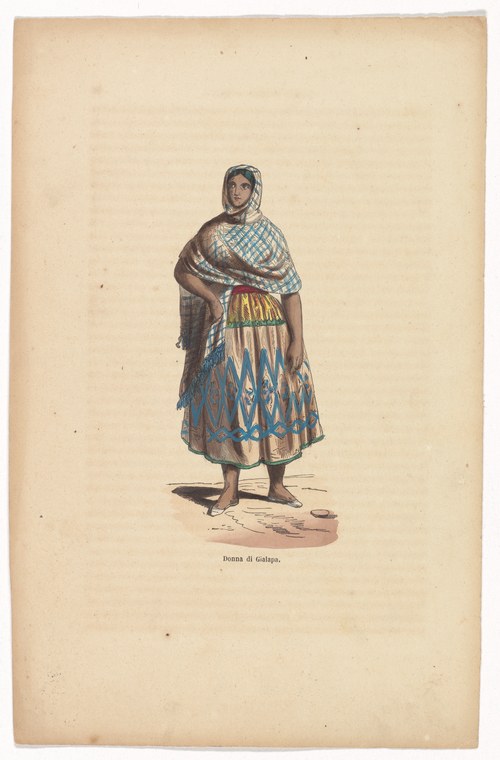
For dance historians, this image matters not as a record of movement or technique, but as material evidence of the vestments worn during celebrations and ceremonies in the documented community. The level of detail—the geometric patterning, the construction of the headscarf, the shape and embellishment of the skirt—tells us about the significance of textile and dress in festive contexts and about how dance traditions were materialised and understood through their visual markers.
What you are looking at
A single female figure stands barefoot against a plain background, her weight distributed evenly on both feet in a frontal stance. She wears a white and pale blue checkered headscarf or veil that drapes across her shoulders and upper torso, and a voluminous skirt with striking geometric patterning in deep blue, yellow, and red that falls to mid-calf. The skirt's decoration suggests embroidery or appliqué work in traditional motifs. A simple belt or sash marks the waist. The figure gazes downward with a composed, formal expression. At the bottom of the page, a caption identifies the subject in what appears to be French or Spanish. The standing pose and frontal presentation suggest this is an ethnographic or costume documentation illustration rather than a depiction of active dancing.
The dancing
The single figure stands in stillness with no suggestion of motion or dance engagement—weight evenly distributed, arms relaxed at the sides, gaze directed downward in a posed rather than performative manner. There is no indication of partnering, group formation, or the dynamic spatial relationships that characterise active dance. The posture and framing treat the body as a costume display object rather than a moving instrument.
The dance depicted
The image does not depict active dance or a dancer in motion. Instead, it appears to be a documentation of historical or ethnic costume, presenting a static figure in traditional dress. While the elaborate embroidered or appliquéd skirt and decorative headscarf suggest garments worn in celebratory, ceremonial, or festive contexts where dance may have occurred, this particular image captures a standing pose suitable for documentation rather than the movement vocabulary of any identifiable dance tradition.
How it was made
This is a hand-coloured engraving or lithograph, likely from the 19th century, judging by the printing technique and the style of ethnographic illustration prevalent in that era. The image shows the characteristic line work and tonal qualities of engraved or lithographed reproduction, with careful hand-application of watercolour or gouache for the costume details. The clean composition and neat border suggest this was one plate from a larger published series documenting regional or ethnic dress.
About this work
This is an ethnographic costume plate documenting traditional dress, likely from a European publication of the 19th century. The figure wears regalia suggesting a specific regional, ethnic, or ceremonial context—the elaborate embroidered skirt and decorative headscarf indicate a festive or formal garment tradition. While such dress would have been worn during celebration and dancing, this particular work does not document dance practice or movement; instead it presents a static, full-length view of costume for the purposes of documentation and education. It reflects the European scholarly and commercial interest in recording non-European dress practices that characterised the period.
How to look at it
Examine the costume itself rather than searching for dynamic movement: note the appliqué or embroidery technique visible on the skirt, the construction and draping of the headscarf, the use of colour and pattern. The artist has chosen a frontal standing pose that maximises the visibility of the garment's surface decoration—a curatorial choice designed for documentation rather than artistic drama. Consider what garments like this would signify in their actual social context, and why a European publisher would commission their illustration.
The period
This plate belongs to a long 19th-century tradition of European ethnographic illustration, influenced by Romantic-era interest in 'picturesque' and 'exotic' costume. Series like those of Cesare Vecellio, Johann Ramazzotti, and various 19th-century costume encyclopaedias sought to document and catalogue the dress of European regions and colonial territories. These publications served both scholarly and popular audiences and reflected contemporary collecting practices and museums' investment in material culture.
Where it lives
The work is held in the New York Public Library's collection of prints depicting dance, though the designation 'dance' in that collection reflects the broader 19th-century understanding of ethnographic costume documentation as related to performative traditions rather than this image's actual content. It is almost certainly one page from a larger published series.
Questions about this work
Is this a dancer?
No. The figure is a static model presenting costume for documentation. There is no indication of movement, performance, or dance engagement. The pose and presentation suggest this is an ethnographic or costume history plate designed to record garment construction and decoration rather than to depict dance practice.
What culture is this costume from?
The caption at the bottom of the page identifies the figure and likely the cultural or geographic source, but without a clear reading of the text, we cannot definitively say. The style of embroidery, the construction of the headscarf, and the geometric patterning of the skirt suggest a Mediterranean, Middle Eastern, or Central/Eastern European tradition, but identifying the specific origin would require reading the caption.
Why is this in a dance collection?
The work is likely catalogued as dance-related because ethnographic costume documentation was understood in the 19th and early 20th centuries as inseparable from the study of festive and performative traditions. While this particular image does not show active dance, it records the material culture of communities in which dance was practised.
More dance artwork





