49 works in this view — arrow keys or swipe to move between them.
Dance in Art
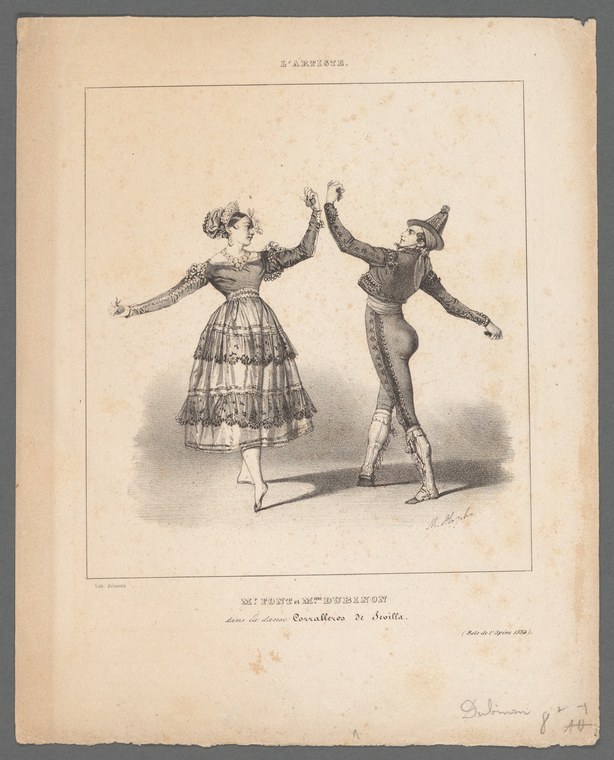
Mr. Font et Mme. Dubinon dans la danse Coralleros de Sevilla: (Bals de l'Opéra 1834)
Unknown artist
- Collection:
- Prints depicting dance
- Source:
- New York Public Library
- Rights:
- Public domain — free to use, share and adapt.
- Recorded as:
- Public Domain
This image provides rare documentary evidence of how Spanish regional dance was actually performed and dressed in 1830s Paris, capturing a moment when European ballrooms were incorporating regional and exotic dances into their entertainment. The specificity of the costume, the anatomical precision of the poses, and the named performers suggest this engraving served as a gazette of fashionable choreography—a kind of dance publication that helped circulate and standardize these performances across Europe.
What you are looking at
A man and woman perform a Spanish dance in what appears to be an opera ball setting. The woman wears an elegant white dress with gathered skirt and fitted bodice, her hair styled in the fashion of the 1830s with curls piled atop her head. The man wears a dark fitted jacket with light-colored tights and a jaunty cap, his posture athletic and sprightly. They face each other with raised arms, hands nearly touching in a gesture of greeting or courtship, their bodies animated and turned toward one another. The engraving is finely detailed, capturing the play of light and shadow across their garments and the subtle modeling of their forms. The composition is spare—the figures occupy the center of the frame against a plain background—allowing full attention to the dancers' poses and costumes.
The dancing
Both dancers are upright and energetic, with the woman's weight evenly distributed and the man caught in a moment of sprightly movement, perhaps a hop or step forward. Their arms are raised to shoulder height, hands approaching each other without contact, a gesture suggesting flirtation or the moment before a turn. The woman's left arm extends gently while her right reaches across her body; the man mirrors this with open, expansive gestures. Their faces are turned toward each other with animated expressions. The positioning suggests a moment of social interaction within the dance—the kind of interchange that would have been central to ballroom performance.
The dance depicted
The title identifies this as the Coralleros de Sevilla (Coral fishermen of Seville), a Spanish regional or character dance performed at the Opéra balls in Paris during the 1830s. This was likely a theatrical or ballroom adaptation of an Andalusian folk dance, presented as entertainment for the sophisticated Opera audience. The dance appears to emphasize upper-body gesture and facial expression, with the raised-arm poses suggesting both Spanish regional vocabulary and the flirtation typical of social dances of the period. The engraving documents how Spanish and Iberian dances were performed and received in elite Parisian settings, often stylized and adapted for ballroom contexts.
How it was made
This is a finely executed steel engraving, a technique that allowed for precise line work and fine tonal gradations through cross-hatching. The artist's signature appears at lower right. The medium was ideal for reproductive prints distributed widely to the opera-going public and dance enthusiasts, preserving a record of fashionable choreography and costume. The technical skill evident in the rendering of fabric folds, the musculature suggested beneath the tights, and the subtle facial expressions indicates this was a high-quality commercial product aimed at a cultured audience.
About this work
This engraving documents a performance of Spanish regional dance at the Paris Opéra in 1834, capturing both the choreography and the elaborate costume conventions of the period. The Coralleros de Sevilla was one of many European folk and regional dances adapted for ballroom and theatrical performance in the early 19th century, serving as entertainment for elite audiences and a vehicle for displaying refined technique and fashionable dress. The work is a valuable record of how non-European dance vocabularies were received, staged, and performed in European theatrical contexts—in this case, framed explicitly as a spectacle for the Opéra's winter balls.
How to look at it
Notice the moment the artist has chosen: not a leap or a turn, but the quiet moment of social interaction, with the dancers' hands raised and nearly touching. This reflects 1830s ballroom convention, where much of the meaning of a dance lay in the facial expression, the management of the skirt, and the delicate negotiation of space between partners. Look at how the woman's dress is rendered—the folds and pleats suggest motion even in stillness, while the man's athletic frame and lifted bearing show the gymnastic element ballroom dancing required. The formal framing and plain background were standard for theatrical prints of the period.
The artist
The artist is not recorded. The signature visible in the lower right of the engraving is difficult to read with certainty in reproduction. The work appears to be the product of a professional atelier producing theatrical and ballroom prints for the Paris market in the 1830s.
The period
The 1830s saw a European fascination with regional and exotic dance, particularly Spanish and Italian forms. These were often performed at elite ballroom events and adapted for theatrical presentation, creating a hybrid between folk vocabulary and ballroom convention. The Romantic era's interest in the picturesque and the foreign drove demand for such spectacles. Paris, as the capital of fashion and dance innovation, was the center of this circulation, and prints like this one served to codify and spread knowledge of fashionable choreography to other European ballrooms and theaters.
Where it lives
This engraving is held by the New York Public Library as part of its collection of prints depicting dance. It is one of many such prints produced in 1830s Paris documenting ballroom and theatrical performances.
Dance in this work
Questions about this work
What was the Coralleros de Sevilla?
It was a Spanish regional dance (named for Seville's coral fishermen) that became fashionable in elite Parisian ballrooms and theatrical settings in the early 19th century. Like many European regional dances of the period, it was adapted and stylized for performance at the Opéra's winter balls, blending folk vocabulary with refined ballroom technique.
Why are there so many 1830s prints of ballroom dances?
Ballroom dancing was the primary social entertainment for European elites, and prints served as both fashion magazines and dance manuals. They documented the latest steps, costumes, and pairings, allowing dances to spread across Europe and helping dancers learn new choreography without seeing it performed live.
How do you tell from the image alone that this is a 1830s ballroom dance?
The woman's dress—the specific cut of the bodice, the gathered skirt, the hairstyle—are diagnostic of the 1830s. The man's fitted jacket and tights are typical ballroom costume of the period. The engraving technique and style of the print also date clearly to this era, as does the framing and the conventions of the pose.
More dance artwork





