49 works in this view — arrow keys or swipe to move between them.
Dance in Art
Historical and ethnic costumes
Unknown artist
- Collection:
- Prints depicting dance
- Source:
- New York Public Library
- Rights:
- Public domain — free to use, share and adapt.
- Recorded as:
- Public Domain
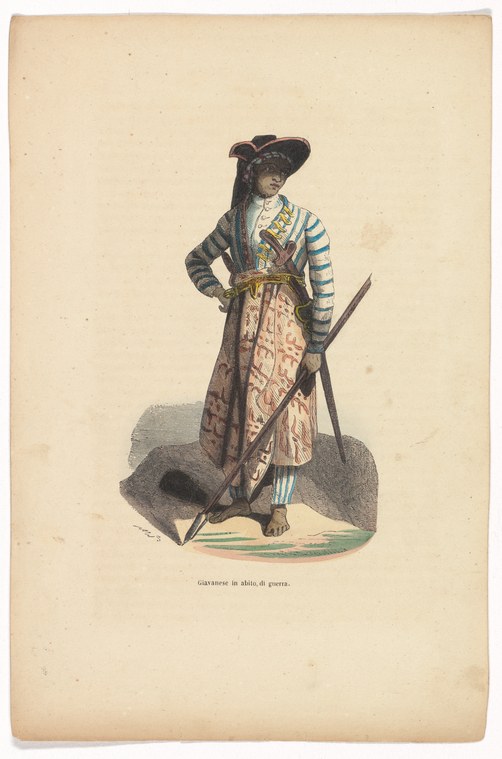
For dance historians, this work matters as evidence of how European audiences of the 18th or 19th century understood and represented non-European bodies and cultural practices through dress. The staff, the decorated costume, and the formal presentation suggest associations with ritual or performance that may connect to dance traditions, but the stilled, posed format shows how ethnographic illustration often evacuated movement and living practice in favor of typological display.
What you are looking at
A single female figure stands against a neutral cream background, dressed in historical or ethnic costume. She wears a striped blue and white jacket or bodice with long sleeves, a patterned skirt or lower garment in warm tones (rust, tan, cream), and a dark ornate headdress or turban. Her posture is upright and composed, with one hand resting on her hip and the other holding what appears to be a long stick or staff. She stands on a subtle ground suggested by minimal shading. The figure faces slightly toward the viewer in a three-quarter stance. The costume is rendered in hand-colored engraving or lithograph technique with careful attention to pattern and textile detail. An inscription in Latin script appears at the bottom of the print.
The dancing
The single figure is stationary rather than in motion, standing with weight evenly distributed. Her right hand rests on her hip in a poised, authoritative gesture; her left hand grasps a long rod or staff vertically. Her body is upright, shoulders squared. The stance is formal and presentational rather than mid-movement. There is no suggestion of footwork, partnering, or dynamic action—this is a posed figure study rather than a captured moment of dance.
The dance depicted
This does not appear to depict dance in motion. The figure is presented as a costume study or ethnographic type-portrait—a stock representation of a regional or ethnic identity through dress and bearing. The staff and posed stance suggest cultural identity (possibly related to warrior, dancer, or ceremonial roles in the original culture), but the static presentation, formal frontality, and didactic framing indicate this is a historical costume plate rather than a dance scene. The work belongs to the tradition of European costume books and ethnographic illustration rather than dance documentation.
How it was made
This is a hand-colored engraving or lithograph, evidenced by the fine line work, the uniform ground, and the subtle color application that respects the underlying line. The technique allows for mass reproduction and circulation as a print (part of a series of costume types). The careful rendering of textile patterns and the precise line work suggest a skilled printmaker, and the colored hand-application indicates either the original's value or the audience's willingness to invest in a finished version. This format was typical of 18th- and 19th-century ethnographic and costume documentation intended for educated collectors and scholars.
About this work
This is a single-figure costume plate from a historical series depicting regional or ethnic dress types. The figure is not engaged in dance but stands as a representative type, presented for study of costume, adornment, and cultural identity. The work exemplifies the European tradition of ethnographic illustration and costume documentation, where dress and bearing were recorded to capture cultural difference and historical variation. While the costume may have belonged to a dancing or ceremonial tradition in its original context, the image itself is not a representation of dance in practice.
How to look at it
Attend to the costume detail: the weave and pattern of the fabrics, the construction of the headdress, the function of the staff. Observe that the figure is entirely still and presented as a type rather than as an individual in a moment of action. The Latin inscription at the base would identify the specific region or people represented. This is a document of material culture and ethnic classification, not a snapshot of performance or movement.
The artist
The artist is not recorded. The work is part of a series titled 'Historical and ethnic costumes,' suggesting it was produced as one of many similar studies, likely by a professional printmaker or print shop specializing in costume documentation and ethnographic illustration. The quality of the engraving and the systematic approach to costume recording suggest a trained hand working within an established commercial or scholarly tradition.
The period
This print belongs to a tradition of European ethnographic and costume documentation that flourished from the 17th through 19th centuries, peaking in the late 18th and 19th centuries. Such series were created both as scholarly reference and as popular commodities for educated consumers interested in the world's peoples and their material culture. During this period, dance in non-European cultures was of great interest to European audiences, but it was typically represented through still costume plates (as here) rather than through motion studies. The formal, typological presentation reflects Enlightenment-era categorization of human diversity.
Where it lives
The work is held in the New York Public Library's collection of prints depicting dance. It is catalogued as part of a series of historical and ethnic costume illustrations, though neither the artist nor the precise date of publication is recorded in the catalogue.
Questions about this work
Is this figure actually dancing?
No. The figure is posed statically for the purpose of costume documentation. She is presented as a representative type of a particular region or ethnic group, standing in a formal, presentational stance. The staff and costume suggest that dancing or ritual performance may have been part of that culture's practice, but this image does not depict dance in action.
What is the staff she is holding?
The staff's function is not clear from the image alone, but it may have been a ceremonial or functional object associated with the culture represented. It is included here as part of the full costume type—a visual marker of cultural identity and status.
Why is this in a dance collection?
Costume plates and ethnographic prints were historically understood as related to dance because costume and adornment were central to performance and ritual. Dance historians often collect such materials as evidence of how bodies were dressed and how movement traditions were associated with specific garments and accessories. This image documents a costume tradition that may well have been danced in, even though it does not show dance occurring.
More dance artwork





