49 works in this view — arrow keys or swipe to move between them.
Dance in Art
Historical and ethnic costumes
Unknown artist
- Collection:
- Prints depicting dance
- Source:
- New York Public Library
- Rights:
- Public domain — free to use, share and adapt.
- Recorded as:
- Public Domain
For dance historians and costume scholars, this image is valuable as documentary evidence of how Greek or Balkan folk dress was understood and standardized in print culture during the 1800s. It shows the specific colour palette, silhouette, and ornamental detail that defined a regional dance identity before film or photography made direct recording common. Such images directly influenced stage representations of Greek and Mediterranean dance.
What you are looking at
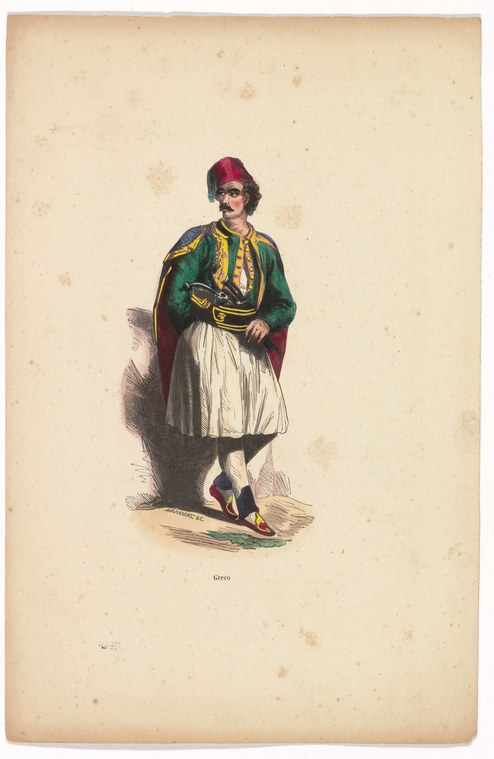
A single male figure stands in three-quarter pose against a neutral cream background, dressed in the costume of a Greek warrior or historical soldier. He wears a crimson fez or turban atop dark hair, a green cloth or cape with gold braid draped over one shoulder, and a white pleated skirt or fustanella that falls to mid-calf. A wide gold-trimmed sash cinches his waist. His left arm hangs naturally while his right hand rests on his hip or weapon. His legs are bare below the knee, ending in what appear to be dark boots or sandals. The figure is rendered in a hand-coloured engraving or lithograph with careful attention to fabric texture and colour. The pose is formal and statuary—a presentation of costume rather than action—and the figure's bearing is upright and dignified.
The dancing
A single standing figure in a formal, static pose. The body weight appears evenly distributed on both legs; the posture is erect and martial. The right arm is flexed at the elbow with the hand at hip level, a stance suggesting authority or readiness. There is no indication of movement, dance hold, or partnering. The figure is presented frontally and offers no clear evidence of active dance or physical engagement.
The dance depicted
This is not a depiction of dance in motion, but rather a costume study. The garment—a white fustanella with embroidered or pleated detail, paired with the crimson fez, green cape, and gold ornaments—is consistent with Greek or Balkan folk costume, possibly from the 19th century. If this figure is meant to represent a dancer, it documents the *dress* of Greek or Ottoman-influenced regional dance rather than the *action* of dancing. The static presentation and formal pose suggest this is a reference work or costume documentation rather than a scene of performance.
How it was made
This is a hand-coloured engraving or possibly a lithograph, a reproductive print technique common in the 19th century for costume books and historical compilations. The careful stippling and line-work visible in the background and folds of fabric, combined with selective hand-colouring in crimson, green, gold, and white, is typical of such publications. The technique allowed wide distribution of costume documentation to theatres, artists, and collectors, and suggests this work was part of a series on historical or ethnic dress.
About this work
This is a costume study from a 19th-century print series titled *Historical and Ethnic Costumes*, documenting the dress associated with Greek or Balkan regional tradition. It is not itself a dance representation, but rather a standing reference figure wearing garments historically connected to folk dancing in that region. The work belongs in a dance art gallery because it records the material culture and visual identity of a dance tradition—the costume as a key marker of regional and national identity. Such prints circulated widely among theatre designers, choreographers, and costume makers and shaped how dance was visualized and staged in the 19th and early 20th centuries.
How to look at it
Study the details of the garment: the pleating and weight of the white skirt, the precise placement and colour of the embroidered or woven gold trim, the drape of the green cape, the shape of the fez. Note the absence of any indication of movement—the feet are planted, the body is still. This is a technical reference image, not a narrative one. The figure's formal pose and centred placement are deliberate; the work is designed to be read as instruction, not entertainment.
The period
The 19th century saw an explosion of illustrated costume and ethnographic books, driven by Romantic interest in folk tradition, national identity, and exotic cultures. Theatrical companies commissioned or consulted such prints to ensure historical or regional authenticity in staging. This work fits within that movement—a moment when dance was increasingly understood as inseparable from costume, and when printed images became the primary way choreographers and designers accessed knowledge of regional styles.
Where it lives
This work is held in the New York Public Library's collection of prints depicting dance. It is catalogued as part of a series on historical and ethnic costumes, with no artist or date recorded in the current catalogue record.
Dance in this work
Questions about this work
Is this actually a dance image?
It depicts a figure in dance costume rather than in active dance. The pose is static and formal—a presentation stand rather than a captured moment of movement. It is valuable as a costume document and belongs in dance studies because dress is integral to how dance traditions are recognized, transmitted, and staged. The image serves choreographers and historians as a reference for authentic regional appearance.
What dance tradition is this costume from?
The fustanella (pleated white skirt), fez, and Balkan-style cape suggest Greek or Ottoman-influenced regional dance costume, likely documented in the 19th century. The specific identity of the dance is not recorded in the catalogue, but the costume elements are consistent with ceremonial or festival dance traditions of Greece and the Balkans.
Why is a standing figure in costume worth including in a dance gallery?
Dance scholarship and practice depend on visual reference. Costume prints like this one were essential tools for choreographers, costume makers, and theatre companies and shaped how dance was staged and understood across Europe. They are primary sources for the material culture of dance and for how regional identities were constructed through dress.
More dance artwork





