49 works in this view — arrow keys or swipe to move between them.
Dance in Art
Historical and ethnic costumes
Unknown artist
- Collection:
- Prints depicting dance
- Source:
- New York Public Library
- Rights:
- Public domain — free to use, share and adapt.
- Recorded as:
- Public Domain
This image documents a moment when European artists and publishers were beginning to systematically record non-European dance and martial movement, but through a lens that often conflated warrior practice, ceremony, and display. For dance historians, it raises questions about how movement was observed, frozen, and translated across cultural boundaries — and how the choice of pose (this dynamic lean rather than a standing rest) shapes what viewers understand about the practice.
What you are looking at
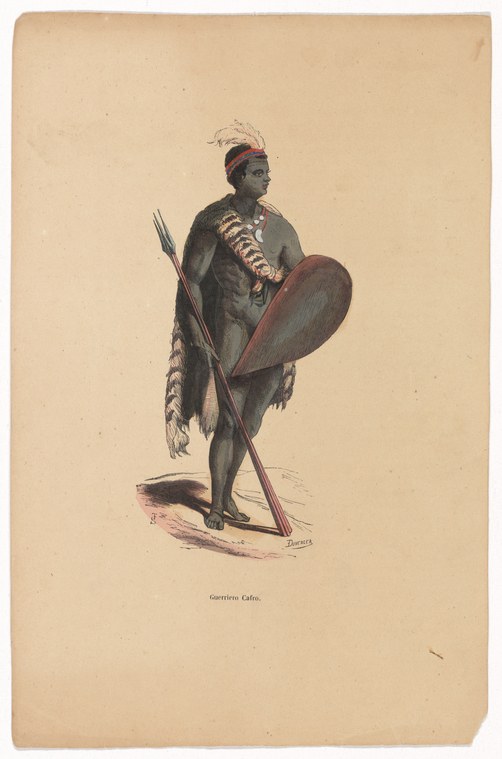
A single figure is depicted against a plain cream background, standing in a contrapposto pose that suggests both presentation and readiness. The figure has dark skin and is wearing minimal clothing — a dark wrap or loincloth — and an elaborate feathered headdress with what appears to be tall plumes rising from the crown. The figure holds a large shield or ceremonial implement in the right hand, positioned at a slight angle, and carries what looks like a spear or staff in the left hand. A beaded or woven band crosses the torso diagonally. The figure's weight is shifted onto the back leg, creating a dynamic stance that suggests movement or the moment before action. The artist has used hand-coloring — visible in the reddish tones of the shield's interior and the warm flesh tones — applied over what appears to be an engraved or lithographed base. The title at the bottom reads "Guerrier Cabre" (Cabre Warrior), indicating this is a representation of a specific cultural warrior or dance figure.
The dancing
The single standing figure occupies the full height of the composition and is rendered with anatomical clarity. The pose is not a static stance but a dynamic lean, with the torso angled and the weight thrown onto the rear leg in a way that suggests either a warrior's preparedness or the freeze-frame of a dynamic movement. The arms are extended but not symmetrically: the shield arm is lifted and forward, the spear arm is longer and angles downward. The legs are straight and powerful, the musculature clearly defined. This is not a dance position in the European ballroom sense, but the body language conveys controlled power and ceremonial presence.
The dance depicted
This appears to be a representation of a Cabre or Kabyle warrior from North Africa, shown in a pose that conflates warrior presentation with ceremonial or ritual movement. The stance — weight back, forward arm raised — is consistent with documentation of warrior dances and martial displays from North African and sub-Saharan cultures, where shield and spear work combine with body movement in displays of status and readiness. The work is likely 19th-century ethnographic representation, a genre that often captured indigenous dances and warrior practices through the lens of European visual culture. Without more specific documentation, it is difficult to assign this to a named dance form, but the image depicts a moment of ritualized movement rather than a static portrait.
How it was made
This is a hand-colored engraving or lithograph, a technique that allowed for mechanical reproduction of the base image followed by hand application of color — visible here in the inconsistencies and overlaps in the flesh tones and the shield. This hybrid method was standard for ethnographic illustration in the 19th century, allowing wide circulation while maintaining the appearance of careful observation. The technique implies a commercial or institutional context — likely a publication on world peoples, military practices, or ethnographic costume. The combination of print and color situates this within popular education and collecting traditions of the period.
About this work
This is an ethnographic illustration of a Cabre warrior from North African tradition, rendered in hand-colored engraving to present the figure's dress, weaponry, and bearing to a European audience. The work exemplifies 19th-century visual documentation of indigenous warrior practices and ceremonial display, a tradition that sat at the intersection of art, anthropology, and entertainment. The dynamic stance and careful attention to costume and equipment suggest the artist understood the figure as one engaged in movement and display — not merely as an exotic costume on a passive body, but as an active practitioner of martial and ceremonial forms.
How to look at it
Attend to the pose: this is not a standing rest, but a forward-leaning, weight-shifted stance that suggests either preparation for action or the captured moment of a movement. The shield and spear are not merely props but are held and positioned with intention — the shield forward and angled, the spear trailing — suggesting a grammar of movement rather than a static display. The headdress and beaded ornaments anchor this as ceremonial or ritualized presentation rather than ordinary dress. The artist's choice to show the figure mid-weight-shift is significant: it suggests an understanding of the practice as dynamic, not frozen.
The artist
The artist is not recorded. The style and technique are consistent with 19th-century European ethnographic publishing, likely French given the French-language title. Such works were often produced by commercial engravers and colorists working from descriptions, travelers' sketches, or earlier ethnographic sources, rather than from direct observation.
The period
This work dates to an era of intense European colonial expansion and ethnographic documentation. In the 1830s–1880s, illustrated books and portfolios on world peoples and cultures were major commercial products, fed by colonial administration, military campaigns, and emerging museums. Dance and warrior movement were key subjects because they were seen as revealing authentic cultural identity and military capacity. This particular work sits within a tradition of representing North African and sub-Saharan warriors to European audiences, often emphasizing the exotic and the martial.
Where it lives
This work is held by the New York Public Library as part of its Prints collection, catalogued under "Prints depicting dance." It is part of a broader collection of ethnographic and costume illustrations, likely extracted from a larger 19th-century publication on world peoples or military forces.
Dance in this work
Questions about this work
Is this a dance or a warrior stance?
Both. In many non-European traditions, warrior display, ceremonial movement, and dance are not separate categories. This image likely documents a practice that blended martial readiness with ritual and performative movement. The artist's choice to show the figure in a dynamic, weight-shifted pose suggests engagement with movement rather than static presentation.
What is a Cabre warrior?
Cabre (or Kabyle) refers to Berber peoples of North Africa, particularly the Kabylie region of Algeria. The title indicates this is meant to represent a Cabre warrior or warrior-dancer. The engraving is a European interpretation, not necessarily a direct record of an actual performance or individual.
How accurate is this representation?
That is unknowable from the work itself. This is a 19th-century European rendering, made through print-and-color technique, likely based on written description or earlier artistic sources rather than direct observation. It reflects what European publishers thought their audiences wanted to see — exotic, martial, and visually striking.
Why does the posture matter?
The artist chose to show the figure leaning forward, weight back, shield and spear positioned for action rather than rest. This choice suggests the artist understood the subject as engaged in movement or display, not as a passive model. It is a gesture toward documenting performance or martial practice, even if the medium constrains it to a single moment.
More dance artwork





