49 works in this view — arrow keys or swipe to move between them.
Dance in Art
Historical and ethnic costumes
Unknown artist
- Collection:
- Prints depicting dance
- Source:
- New York Public Library
- Rights:
- Public domain — free to use, share and adapt.
- Recorded as:
- Public Domain
This work is significant not as a dance image but as a historical artifact revealing 19th-century European ethnographic practice and the visual conventions used to represent colonized or distant peoples. For dance historians, it raises important questions: why are non-European figures documented as still, posed specimens rather than as dancers or musicians in motion? The absence of dance in an image labeled "ethnic costume" is itself a statement about which bodies were deemed worthy of representation in movement.
What you are looking at
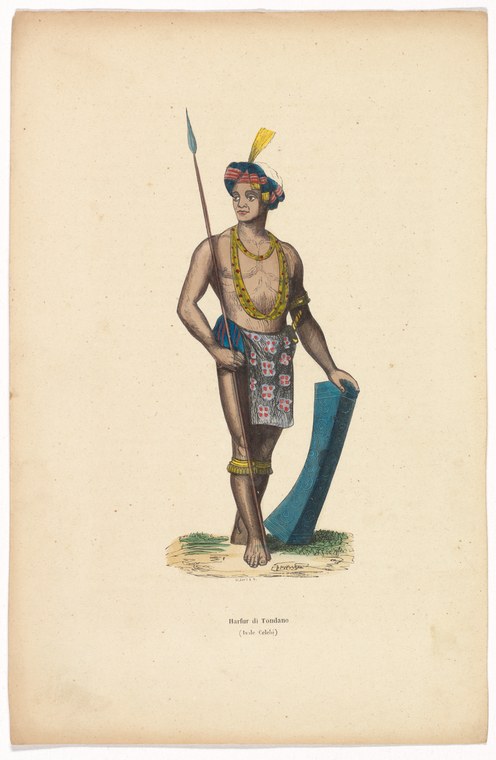
A single male figure stands in a relaxed contrapposto pose against a plain cream background. He wears a wrapped cloth around his hips—patterned with floral or geometric motifs in red and blue—and a gold beaded torso ornament or breastplate across his chest. A red and gold wrapped turban or headdress sits on his head with a single tall feather or plume rising from it. He holds a long spear or lance vertically in his left hand and a curved blue-green shield or curved object in his right, positioned at his side. His body is bare from the waist up, and he stands barefoot on a small grassy ground line. The figure appears to represent a warrior or dignitary from a non-European cultural tradition, rendered in hand-colored engraving with delicate attention to textile pattern and ornament.
The dancing
The figure's weight is settled evenly on both legs in a standing position with the hips slightly shifted—a neutral, presentational stance rather than one suggesting active movement. The shoulders are relaxed and squared. The left arm holds the spear at a vertical rest; the right arm hangs naturally, holding the shield at the hip. There is no dynamic tension in the frame or evidence of active dancing posture—the body is displayed rather than moving.
The dance depicted
This image does not appear to depict active dance. The figure is posed as a warrior or cultural representative in static display, holding weapons and regalia. While the dress and ornaments may be associated with ceremonial or martial contexts in which dance occurs, the image itself shows no movement, no music, no gathering of dancers, and no choreographic intent. The figure's bearing is that of a portrait or ethnographic documentation rather than a dance representation.
How it was made
This is a hand-colored engraving, likely 19th century, printed from a copper plate. The fineness of the line work in the textile patterns and the careful application of watercolor or gouache to define the ornaments and skin tones suggest a commercial or scientific publication aimed at a educated European audience. The plain background and isolated single figure are typical of natural history illustration and costume documentation of the period.
About this work
This work is a hand-colored engraving documenting the dress and regalia of a non-European warrior or dignitary, likely from a 19th-century ethnographic or costume album. The figure is presented in isolation with meticulous attention to textiles, ornaments, and weapons. While the image is catalogued in a dance collection and labeled as "Historical and ethnic costumes," it does not itself depict dance or dancers; rather, it is an artifact of the period's approach to documenting global cultures through dress and material culture. It belongs in a dance archive as evidence of how European audiences and scholars of the era viewed and represented non-European bodies and traditions—often outside the context of the movement and music that animate them.
How to look at it
Observe the precision of the textile pattern—the engraver has rendered every bead and thread of the costume with care, signaling that this is documentary illustration, not imaginative theater. Notice the static, neutral pose: the figure does not leap, gesture expressively, or suggest motion. The empty background isolates him as a specimen. Compare this visual strategy to images of European warriors or dancers from the same period, which often show action, context, and relationship to other figures. The stillness is itself a choice, and a colonial one.
The artist
The artist is not recorded in the catalogue. The work appears to be part of a larger costume series, common in 19th-century publishing. Such compilations were typically assembled by editors and publishers (such as Costumes of All Nations or similar atlases) rather than by single named artists, drawing on engravers, colorists, and researchers whose individual contributions are now difficult to trace.
The period
This engraving dates to an era of intense European ethnographic documentation and colonial expansion (likely 1830s–1870s). Dance was rarely the subject of such ethnographic imagery; instead, publishers and naturalists focused on dress, tools, and warrior poses as markers of cultural difference. Meanwhile, in Europe, Romantic ballet was at its height, and staged representations of non-European dancers (often performed by European women in blackface or "Oriental" costume) were popular. The absence of dance in this scientific illustration contrasts sharply with the exoticized, choreographed performances of non-European cultures happening on European stages.
Where it lives
The work is part of the New York Public Library's collection of prints depicting dance. It was likely part of a bound costume atlas or natural history volume, one of thousands circulated in 19th-century Europe to satisfy growing curiosity about colonial territories and distant peoples.
Questions about this work
Why is this in a dance collection if there is no dance in it?
It was likely catalogued as a dance work because it documents the dress and regalia of a cultural group, and because dance is often assumed to be central to the cultures depicted in such atlases. However, the image itself shows no movement, music, or dancers. Its presence here is instructive: it reflects historical assumptions about non-European cultures and reveals how 19th-century European documentation often sidelined or erased the actual performance traditions of colonized peoples in favor of static displays of material culture.
What culture does this figure represent?
The catalogue record does not identify the specific origin of the costume. The style of the turban, beaded ornament, shield, and spear suggest a warrior from Central Asia, East Africa, or South Asia, but without the original publication context or caption, precise attribution is not possible. Such atlases often mixed, mislabeled, or conflated cultural groups.
Is this figure a dancer?
No. The figure is posed as a warrior or dignitary in static display. While the regalia may be worn during ceremonial dances in the figure's culture of origin, this image does not depict dance or dancing. It is an ethnographic costume illustration.
More dance artwork





