49 works in this view — arrow keys or swipe to move between them.
Dance in Art
Historical and ethnic costumes
Unknown artist
- Collection:
- Prints depicting dance
- Source:
- New York Public Library
- Rights:
- Public domain — free to use, share and adapt.
- Recorded as:
- Public Domain
This print is significant as a historical record of indigenous Chilean material culture and as an example of 19th-century European ethnographic representation. For historians of dance, it serves as a document of the dress and social context of a culture with its own rich movement traditions, but it does not itself depict dance and should not be read as evidence of how Mapuche people danced.
What you are looking at
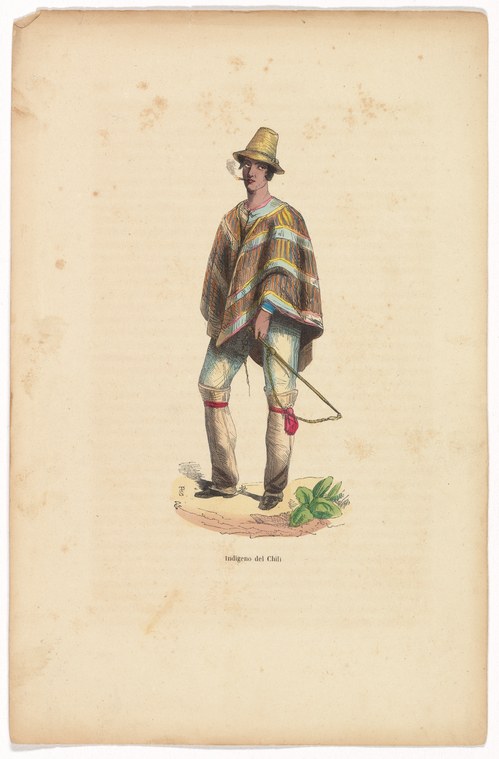
A single figure stands against a plain cream background, dressed in the costume of a Chilean indigenous person. He wears a broad-brimmed straw hat and a heavy woven poncho or cloak in earth tones — browns, creams, and stripes of colour — draped loosely over his shoulders and torso. Beneath it, light-coloured breeches or leggings are visible, and he wears dark shoes. In his right hand he holds a long wooden staff or walking stick, angled downward; in his left hand, near his hip, he carries what appears to be a small red or pink implement, possibly a musical instrument or ceremonial object. At the base of the composition, a small cluster of green leaves suggests botanical naturalism typical of ethnographic illustration. The figure is rendered in hand-coloured engraving or lithograph, with careful attention to the texture of the woven garments and the individual's dignified, frontal pose — a stance typical of 19th-century ethnographic portraiture rather than action or movement.
The dancing
A single standing figure in profile-frontal orientation, weight evenly distributed on both feet in a static pose. There is no visible dance posture, footwork, or kinetic energy; the body is presented as a still portrait. The arms hang naturally, one holding a staff. The overall frame is documentary and anthropological rather than choreographic.
The dance depicted
This image does not depict dance. It is an ethnographic costume study, presenting indigenous dress and material culture for documentation or educational purposes. The figure is posed as a standing model, not as a dancer or in a moment of movement. While the costume may belong to a culture with rich dance traditions, nothing in this image shows dancing, rhythm, or the body in motion.
How it was made
Hand-coloured engraving or lithograph, likely mid-to-late 19th century based on the printing technique and the style of ethnographic illustration. The careful rendering of fabric texture, the soft botanical detail at the base, and the plain background are all consistent with published ethnographic plate work, possibly from a travel narrative, natural history, or costume encyclopædia. The hand-colouring (visible in the poncho's stripes and the leaves) was typical of works intended for a educated, affluent audience interested in non-European cultures.
About this work
This is a 19th-century hand-coloured ethnographic print documenting the dress and appearance of a Chilean indigenous person, likely a Mapuche. The work belongs to a long tradition of European visual anthropology, in which non-European peoples were presented in costume studies for educational and curiosity-driven audiences. Although it is held in a collection described as prints relating to dance, it is itself a costume and cultural documentation rather than a representation of dance in action. It records material culture and social identity, not choreographic or kinetic practice.
How to look at it
Observe the care taken in rendering the poncho's weave and the hat's texture — this is not a generic 'indigenous' figure but an attempt at specific material documentation. Notice the small red object in the figure's hand: it may be a musical instrument or tool, hinting at the figure's social role or practice. The botanical detail at the base grounds the figure in a specific environment. However, do not read the static stance as representative of how the figure or culture moved in actual ceremonial or social contexts; this is portraiture, not choreography.
The artist
The artist is not recorded. The work is consistent with the anonymous hand-coloured ethnographic prints produced by European publishing houses in the 19th century, often accompanying travel narratives, scientific expeditions, or compilations of world costume and culture. Such works were frequently based on sketches by travellers, naturalists, or artists attached to expeditions, then engraved and hand-coloured by studio workshops.
The period
The 19th century saw an explosion of ethnographic imagery in Europe, driven by colonialism, scientific curiosity, and the growth of illustrated publishing. Works documenting indigenous peoples of the Americas, including Chile, were produced both as academic records and as entertainment for European audiences. This period coincides with the consolidation of European nation-states and the subordination or displacement of indigenous populations; such images often functioned as documentation of 'disappearing' cultures. In dance history, this era precedes the systematic study of non-European dance as art form; indigenous movement was rarely studied or valued by European scholars, though dance remained central to the cultures being documented.
Where it lives
Held by the New York Public Library in a collection titled 'Prints depicting dance,' though this work is a costume study rather than a dance depiction. The catalogue record lists it as 'Historical and ethnic costumes' with unknown date and artist, suggesting it may be one of many similar prints assembled together without detailed individual cataloguing.
Questions about this work
Is this a dance image?
No. This is a static ethnographic costume study, not a representation of dance or movement. While the figure wears the dress of a culture with dance traditions, the image documents clothing and material culture, not choreography or kinetic practice.
What culture does this represent?
The costume, poncho, and straw hat are consistent with Mapuche or other Andean indigenous dress. The catalogue record identifies it as Chilean indigenous. However, without additional documentation, the specific culture and individual origin cannot be confirmed with certainty.
When was this made?
The catalogue record lists the date as unknown. Based on the printing technique (hand-coloured engraving or lithograph) and the style of ethnographic illustration, it is likely mid-to-late 19th century, but this cannot be confirmed without additional research.
Why is it in a dance collection?
The New York Public Library holds it in a collection titled 'Prints depicting dance,' but this may reflect the collection's broad scope rather than a claim that every item depicts dance. It is probably included as documentation of a culture's dress and material context, even if the specific image does not show dancing.
More dance artwork





