49 works in this view — arrow keys or swipe to move between them.
Dance in Art
Historical and ethnic costumes
Unknown artist
- Collection:
- Prints depicting dance
- Source:
- New York Public Library
- Rights:
- Public domain — free to use, share and adapt.
- Recorded as:
- Public Domain
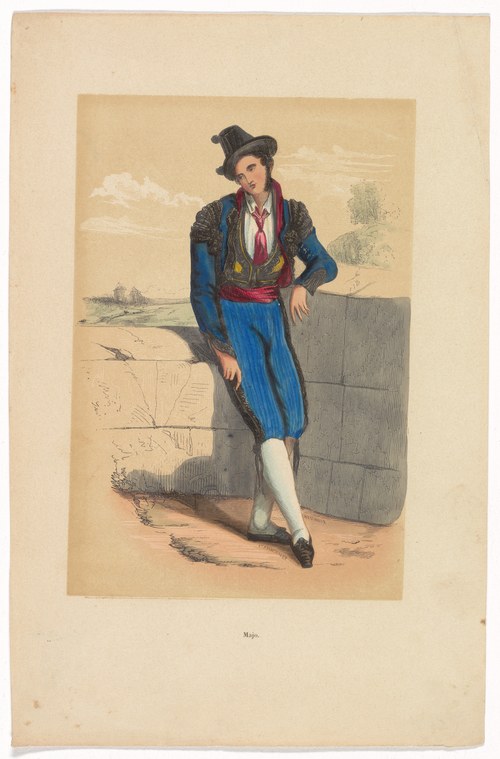
This image is valuable not for depicting a dance itself, but for documenting how non-Western and regional identities were coded, costumes in 19th-century European theatre and visual culture. The dress allows us to understand what European audiences would have recognized as 'Eastern' or 'exotic' male performance wear, and how such figures appeared in staged contexts. For dance historians, costume studies like this reveal the visual shorthand by which dancers could communicate character, origin, and social role to an audience—a technique fundamental to narrative ballet, pantomime, and theatrical spectacle.
What you are looking at
A single figure in fashionable dress stands in a three-quarter pose against a pale, sketchy landscape. The figure wears a deep blue jacket with red and gold trim, a burgundy vest with what appears to be gold or cream brocade, and blue trousers. A black bicorne or top hat sits at a jaunty angle on the head. The figure's posture is relaxed and elegant, with one arm resting on what appears to be a stone block or ledge; the other hangs naturally at the side. The weight is distributed lightly on the legs, with the feet in soft shoes or slippers—one foot bearing weight, the other raised slightly. The background is minimal: a distant landscape with a few trees sketched in watercolor, pale sky above. The hand-coloring is delicate and precise, applied over what appears to be a printed base. The overall effect is that of a fashion or theatrical costume study rather than a scene of active dancing, though the elegance of bearing and the theatrical dress suggest performance.
The dancing
A single figure is shown at ease rather than in motion or formal dance position. The frame is upright but not stiff; the shoulders are relaxed and one slightly forward. The arms hang naturally, one supported by the ledge; there is no closed hold, partner contact, or the formality of a ballroom frame. The legs appear capable of movement but are in a resting weight distribution. The feet suggest soft, flexible footwear suited to performance or social dance rather than specialized dance shoes. The overall impression is of a performer between moments or in a pose of social ease—the kind of 'ready but relaxed' posture that would precede or follow formal movement.
The dance depicted
This appears to be a costume study rather than a depiction of active dance. The title 'Historical and ethnic costumes' suggests a didactic or illustrative purpose—possibly from a costume reference work, a theatrical company's record, or an ethnographic study. The dress is clearly coded as 'foreign' or 'other': the jacket, vest, and trousers do not match any single recognizable European male formal costume of a single era, but rather combine elements (the red trim, the brocade) that suggest Eastern European, possibly Polish, Hungarian, or Balkan dress. If this is from a theatrical context, it may document a costume for a character role or an ethnic dance figure in a European theatrical production. The relaxed pose and the absence of a partner suggest this is a figure study for reference rather than a record of an actual performance moment.
How it was made
This is a hand-colored print, likely a lithograph or engraving based on the fine linear detail visible in the figure's outline and the delicate application of watercolor or gouache over the printed image. The technique allowed for reproducibility—a single stone or plate could produce multiple copies, which were then hand-tinted individually or in assembly-line fashion. This method was common in the 19th century for costume books, fashion plates, and theatrical reference works. The precision of the printing and the careful placement of color suggest a professional, possibly commercial production intended for an educated audience with an interest in costume, theatre, or ethnographic study.
About this work
This is a hand-colored costume study of a single figure in theatrical or ethnographic dress, likely from a 19th-century reference work or costume book. The figure wears what appears to be Eastern European or Balkan male dress—a deep blue jacket with ornate red and gold trim, a brocaded vest, and blue trousers—and stands in a relaxed, elegant pose that suggests performance tradition rather than active choreography. The image is not a record of a specific dance, but rather documentation of a costume type that would have been associated with a particular regional or theatrical character. It belongs in a dance gallery not because it shows dancing, but because costume is foundational to understanding how dance was performed, marketed, and understood in theatrical and ethnographic contexts of the period.
How to look at it
Observe the careful attention to the details of dress—the exact configuration of the jacket trim, the texture of the vest, the cut of the trousers—and understand that these details carry meaning. A 19th-century viewer would have read this figure's origin, social status, and performance type from such cues. Notice also the studied ease of the pose: this is not a dancing figure, but a figure *ready* to perform, or pausing between performances. The artist has chosen a moment of social ease and elegance, not action, suggesting that the purpose was documentation and reference rather than narrative. The minimal, almost abstract landscape background reinforces that this is a costume study, not a scene.
The period
The 19th century saw an explosion of both theatrical spectacle and ethnographic illustration in Europe. Following the Napoleonic Wars and increasing European contact with Ottoman and Central Asian regions, there was a sustained appetite for 'Eastern' costume and character types on stage and in popular prints. Romantic ballet frequently featured exotic locales and characters—*La Bayadère*, *Le Corsaire*, *Giselle*'s Wilis—and demanded authentic-seeming costumes to sell the fantasy. Simultaneously, ethnographic and costume reference books became commercial products, addressed to theatre practitioners, artists, and the educated public. This print sits at the intersection of these worlds: it may be from a theatrical costume book, an ethnographic study, or a general costume reference work.
Where it lives
The work is held in the New York Public Library's collection titled 'Prints depicting dance.' It was catalogued with minimal metadata, suggesting it may be part of a larger album or series of costume and dance studies.
Questions about this work
Is this figure actually dancing?
No. The pose is too relaxed and self-conscious to depict active dance. The figure is standing at ease in costume, likely as a reference study for theatrical or ethnographic documentation. Dance historians value such images not for showing how a dance is performed, but for showing what dancers wore and how they presented themselves to audiences.
What region or culture does this costume represent?
The dress appears to be Eastern European or Balkan in inspiration—the cut of the jacket, the red and gold trim, and the brocaded vest are consistent with 19th-century European understanding of Hungarian, Polish, or Ottoman dress. However, this may be a theatrical synthesis rather than a historically accurate representation of any single tradition.
Why is this in a dance gallery if there's no dancing?
Costume is integral to dance history. This print documents how regional and exotic identities were visually coded for 19th-century audiences, and how performers would have been dressed to communicate character and origin. For historians and dancers, such images are essential to understanding the visual language of theatrical performance.
Who is the artist?
The artist is not recorded in the catalogue. Based on the technique and style, this is likely a professional lithographer or engraver working in the mid-to-late 19th century, possibly as part of a publishing house specializing in theatrical or ethnographic prints.
More dance artwork





