49 works in this view — arrow keys or swipe to move between them.
Dance in Art
Historical and ethnic costumes
Unknown artist
- Collection:
- Prints depicting dance
- Source:
- New York Public Library
- Rights:
- Public domain — free to use, share and adapt.
- Recorded as:
- Public Domain
This work exemplifies the 19th-century European practice of collecting and categorising non-Western bodies and dress as exotic curiosities, a visual convention that intersected with (and often obscured) actual dance practice. For scholars of colonial representation and dance history, it shows how costume documentation and ethnographic illustration shaped European fantasies about 'Oriental' movement and performance, often in the absence of detailed knowledge of living tradition.
What you are looking at
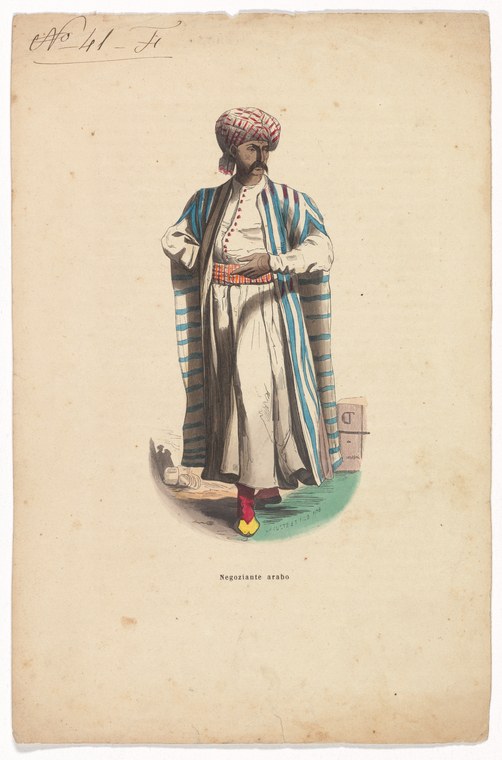
A single figure stands in three-quarter view against a cream background, dressed in Ottoman or Middle Eastern costume of the 19th century. He wears a striped robe of deep blue and cream with horizontal bands of colour, open to reveal a white linen garment beneath, cinched at the waist with a red and gold embroidered belt. A voluminous cream skirt falls to mid-calf; his feet rest on a green ground line, one foot stepping forward slightly. A wrapped turban in muted tones crowns his head. His posture is upright and dignified, one arm bent across his body, the other at his side, in a stance that suggests ceremonial bearing rather than active movement. The figure is rendered in hand-coloured engraving or lithograph, with careful attention to textile pattern and the volumetric fall of fabric.
The dancing
A solitary standing figure in a formal, static pose. The weight appears evenly distributed or slightly favoured on the back leg, with the front foot advanced in a measured step. Arms are held close to the torso in a gesture of repose or formal presentation rather than active dance gesture. The body is vertical and composed, with no indication of weight shift, turn, or travelling movement. The pose resembles a court presentation or processional position more than an active dance frame.
The dance depicted
The image is captioned 'Négotiate arabe' (Arab negotiator or merchant), and the figure's bearing and costume suggest this is a study of Ottoman or Levantine dress and social position rather than a depiction of dance proper. The stance is ceremonial and formal, consistent with 19th-century European ethnographic illustration. While Middle Eastern dance traditions (particularly raqs sharqi and dabke) existed and were performed in the period, nothing in this figure's posture, isolation, or presentation indicates active dance movement. The work appears to be documentary rather than choreographic in intent.
How it was made
Hand-coloured engraving or lithograph, likely mid-19th century. The technique allows fine linear detail in the face, costume patterns, and the volumetric rendering of draped fabric. The additive colour—applied in clear, flat tones—is typical of commercial illustrated costume books or travel documentation. This approach to colour suggests a work intended for a broad, literate audience: costume albums circulated widely in Europe as curiosities and educational materials.
About this work
This is a costume study from a 19th-century European ethnographic or travel illustration series, rendered in hand-coloured print. The figure represents Ottoman or Arab dress and bearing as understood by European artists of the period. While catalogued under dance, the image does not depict active dance movement; instead it documents dress, social position, and formal body posture. It belongs in a dance gallery as evidence of how dance and costume were conflated in colonial-era visual culture, and as an example of the 'ethnic type' illustration that shaped European understanding of non-Western movement practices.
How to look at it
Attend to the stillness and formality of the pose: this is not a body in motion, but a body on display. Notice the careful rendering of textile and pattern, which is the actual subject of the illustration. The figure's isolation against a neutral ground, the three-quarter stance, and the composed expression are all conventions of costume study and ethnographic portraiture rather than dance documentation. Compare this to any energetic dance image from the same period to see how different the visual language becomes when movement is the subject.
The period
The 19th century saw a boom in European illustrated travel narratives, costume albums, and ethnographic collections aimed at bourgeois readers hungry for images of 'otherness.' These works blended genuine observation with stereotype and fantasy. Ottoman dress and Middle Eastern culture held particular fascination in the post-Napoleonic era, especially after Orientalist painting became fashionable. Dance and costume were often conflated in these publications: European audiences consumed images of foreign dress as proxies for an exoticised, eroticised understanding of non-Western performance. The caption 'Négotiate arabe' suggests this figure may have been intended to represent a merchant or diplomat, yet the work's classification under dance indicates how porous these categories were.
Where it lives
The work is held in the New York Public Library's Prints collection, catalogued under 'Historical and ethnic costumes.' This classification, and its appearance in a dance collection, reflects the historical conflation of ethnographic costume documentation with dance imagery.
Questions about this work
Is this actually a dance image?
Not in the sense of depicting active movement. It is a costume study or ethnographic portrait that has been classified under dance, possibly because such images were often grouped with dance material in 19th-century collections. The figure's stillness, formal bearing, and focus on dress mark it as documentary portraiture rather than choreographic representation.
What does the caption 'Négotiate arabe' mean?
It labels the figure as an Arab negotiator or merchant—a person of some social standing in Ottoman society. This suggests the illustration was intended to document not just costume, but social role and status as understood by European observers.
Why is this in a dance collection if it does not show dance?
This reflects how 19th-century European collections mixed ethnographic, costume, and performance material together. Dance, dress, and 'ethnographic type' were not sharply distinguished in popular illustrated works of the period, and that conflation has persisted in some museum and library holdings.
More dance artwork





