49 works in this view — arrow keys or swipe to move between them.
Dance in Art
Historical and ethnic costumes
Unknown artist
- Collection:
- Prints depicting dance
- Source:
- New York Public Library
- Rights:
- Public domain — free to use, share and adapt.
- Recorded as:
- Public Domain
This work does not depict dance and should not appear in a dance gallery. Its inclusion suggests either a cataloguing error (a costume plate mistaken for a dance print) or a broad definition of dance that encompasses military drill or martial display. A curator should clarify the acquisition intent.
What you are looking at
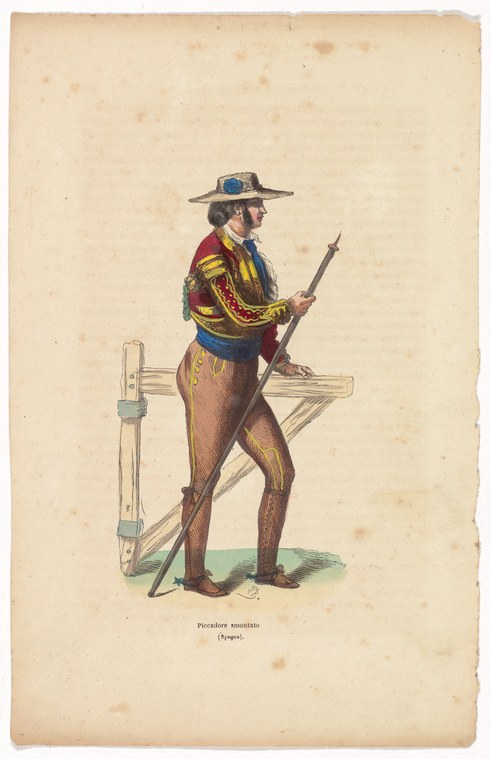
A single figure in military dress stands in profile against a plain background, holding a long rifle or musket at an angle across the body. The soldier wears a distinctive plumed hat, a red coat with yellow braiding and trim, a blue sash or belt, and brown breeches. The left side of the composition includes a wooden structure resembling a fence rail or fortification element. The figure's posture is upright and formal, with weight distributed evenly on both legs in a stance that suggests either a military position or, less clearly, a movement phrase from a dance tradition. The hand-colouring is applied to what appears to be an engraving or lithograph, with careful attention to the uniform's detail and a green ground line establishing the figure's placement.
The dancing
The body is presented in three-quarter stance without obvious weight shift or rise through the legs. Both arms are engaged with the rifle—one hand gripping the barrel, the other positioned near the middle section—in a way that could be read as either a military manual of arms position or a movement with an object. The torso is vertical and the neck long, with the head in profile. There is no evident flexion, no visible arm styling or extension typical of dance vocabulary, and no suggestion of momentum or the preparation/recovery phases that characterise movement.
The dance depicted
The image does not appear to depict dance in the conventional sense. Although the figure is presented in a formal, staged manner typical of instructional prints, and although some historical military drills incorporated dance-like elements (particularly in 18th-century European martial exercises and some folk traditions of armed dance like sword or stick dances), nothing in this image—the rigid posture, the emphasis on weapon handling, the absence of momentum or leg articulation—suggests a choreographed or performative movement tradition. The caption reads "Piqueur montado" or similar, indicating a mounted soldier or cavalry figure. This is an ethnographic or military costume plate, not a dance image.
How it was made
The work is a hand-coloured engraving or lithograph, a reproductive technique common in 19th-century ethnographic and military documentation. The process allowed for serial production of instructional images and costume records, circulating among military academies, historical societies, and collectors. The hand-colouring—applied after printing—gives it the character of a careful documentary record rather than an original artwork. Such prints were often gathered into costume or military manuals and served educational, historical, and reference purposes.
About this work
This is a military or ethnographic costume plate depicting a soldier in formal dress with weapon, not a representation of dance. The figure's formal presentation, the emphasis on accurate uniform detail, and the instructional framing are consistent with 19th-century costume documentation and military manuals. While the image has visual formality and the kind of staged frontality associated with some dance prints, the content—weapon handling, rigid posture, absence of movement articulation—places it squarely in the domain of military or ethnic costume record rather than dance history.
How to look at it
Attend to the rigid verticality of the figure and the absence of any suggestion of movement or weight shift. The rifle is held as a weapon or emblem, not as a dance prop. The formal frontality and clear detail indicate an instructional or documentary intent rather than the captured motion or expressive gesture typical of dance imagery.
The period
The print belongs to a 19th-century tradition of ethnographic and military costume documentation, when European institutions were systematizing visual records of uniforms, regional dress, and martial practices. Such prints often appeared in costume albums, military histories, and illustrated ethnographies. The hand-colouring technique and style are consistent with mid-to-late 19th-century production.
Where it lives
The work is held in the NYPL Prints collection under the broad subject heading 'Prints depicting dance,' suggesting it was catalogued as part of a wider historical survey of figure representation rather than a focused dance archive. The catalogue record lacks attribution, date, and medium specification, indicating limited curatorial detail.
Questions about this work
Is this actually a dance image?
No. While it is catalogued under 'dance,' the image depicts a soldier or mounted officer in military dress holding a weapon. There is no visible dance movement, choreography, or performance context. The figure's posture is formal and static, lacking the articulation, momentum, or weight transfer characteristic of dance.
Could this represent a military drill or armed dance tradition?
While some historical military exercises and folk traditions (such as sword or stick dances) incorporate movement and formality, nothing in this image suggests performance or choreography. The emphasis is on accurate costume and weapon depiction, not movement documentation. The caption appears to identify it as a military or ethnic costume record.
Why is it in a dance collection?
The work was likely catalogued broadly as part of a general historical record of figure representation or costume. Without detailed provenance or curatorial notes, it may have been included because of its formal presentation and staged quality, which resemble some dance prints, rather than because it actually documents dance.
More dance artwork





