49 works in this view — arrow keys or swipe to move between them.
Dance in Art
Historical and ethnic costumes
Unknown artist
- Collection:
- Prints depicting dance
- Source:
- New York Public Library
- Rights:
- Public domain — free to use, share and adapt.
- Recorded as:
- Public Domain
Character prints like this document the theatrical vocabulary of gesture, pose, and costume that shaped how bodies moved and were understood in performance traditions. For historians of dance and theater, such prints are evidence of the character types and physical stereotypes that actors embodied, and of the conventions of address and display that audiences recognized and expected. The confidence and immediacy of this woman's pose shows how gesture and costume worked together to communicate identity and status instantly to a viewer.
What you are looking at
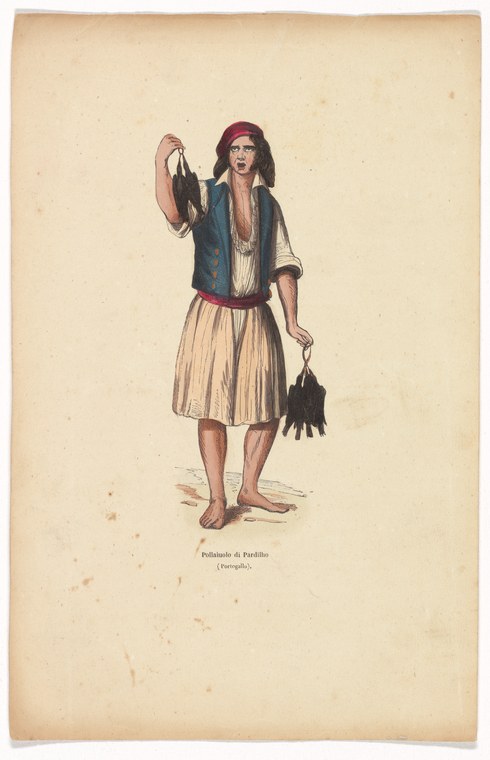
A young woman stands barefoot in three-quarter view, facing left and upward with an animated expression. She wears a burgundy or maroon cap, a blue jacket or bodice, and a pale cream or beige skirt that falls to mid-calf. In her raised right hand she holds what appears to be a dead bird or game—possibly a duck or wild fowl—and in her lowered left hand she carries a bundle of dark objects, likely more game or provisions. The figure is posed against a plain buff-colored background with minimal setting detail. The inscription below reads 'Pescatore di Perugia' (Fisherman of Perugia) in italics, with the word 'Scampigliato' or similar in parentheses beneath. The work is printed in hand-colored technique, with tones applied to define the figure's anatomy, clothing, and the objects she carries.
The dancing
The woman's posture is active and alert, with weight slightly forward on her feet and her torso twisted to display the catch to the viewer. Her right arm is raised and extended, holding the bird aloft in a gesture of display or pride; her left arm hangs naturally but purposefully, cradling a bundle. The stance suggests movement paused mid-stride—a moment of momentary halt rather than a static pose. Her facial expression is direct and engaging, turning toward the viewer as if announcing or presenting her catch.
The dance depicted
This is not a dance image but rather an ethnographic or occupational costume study. The figure appears to represent a working-class or rural character type from the Perugia region, documented in the tradition of regional character prints that were popular in 18th- and 19th-century European prints. The animated pose and direct address to the viewer use conventions found in theatrical or commedia dell'arte traditions, where character types were displayed in recognizable costume and attitude, but there is no evidence of choreographed dance movement, formation, or the partnering, frame, or footwork that would define any dance style.
How it was made
This is a hand-colored engraving or lithograph, a printing medium that was standard for producing reproducible images of theatrical characters and regional types from the mid-18th through 19th centuries. The technique allowed multiple copies to be circulated widely to theater audiences and print collectors; the hand-coloring in watercolor or gouache distinguishes each copy slightly and suggests this was a relatively modest production aimed at a popular market rather than collectors' fine art. The printing technique and hand-finishing are consistent with prints made for theatrical documentation or costume reference.
About this work
This is a character study from a series of regional or occupational types, likely connected to theatrical traditions and the documentation of regional Italian dress. The figure represents a type—the Perugia fisherman—rather than a narrative scene, and was distributed as a hand-colored print for theater-goers and the general public. The work belongs in a dance archive not because the figure herself is dancing but because such character prints were intimately bound up with theatrical performance, commedia dell'arte traditions, and the visual circulation of recognizable character types on the stage. The directness of the pose and the animated expression use conventions of performance and presentation that connect to the broader culture of gesture and physical embodiment in theater.
How to look at it
Look at the pose itself: the raised arm, the forward lean, the direct gaze. These are not the poses of passive display but of active presentation and assertion. The artist has chosen the moment of the turn toward the viewer, catching the figure mid-gesture as if she has just paused to show off her catch. Notice how the costume—the cap, the jacket, the skirt—is rendered in clear, bright color to make the figure legible and memorable from a distance; this was designed to be seen and recognized quickly, as it would have been on a crowded print-seller's stall or in the gallery of a theater. The bare feet are significant too: they anchor the figure to the real, working body rather than to any refined or decorative tradition.
The period
Character and costume prints were a staple of European printmaking from the 17th century onward, with particular intensity in the 18th and 19th centuries. They served multiple audiences: theatrical practitioners needed visual reference for costume and characterization; audiences wanted mementos of performances and actors they had seen; and the broader public collected them as affordable art and as ethnographic curiosities. The tradition of documenting regional or occupational 'types' was especially strong in Italian and French prints, and often drew on or fed back into commedia dell'arte and other popular theatrical forms where a repertoire of recognizable characters was essential to the entertainment. The inscription in Italian and the reference to Perugia suggest this print was part of a series documenting Italian regional dress and character.
Where it lives
This print is held by the New York Public Library in a collection of prints depicting dance. It is catalogued as part of a series of historical and ethnic costume prints, though the title and artist remain unrecorded in the library's current record. The work is a hand-colored engraving or lithograph, a form of serial production typical of 18th- and 19th-century theatrical and ethnographic printing.
Questions about this work
Is this a dancer?
No. The figure is a character type—the fisherman of Perugia—documented in her occupational dress and pose. However, such character prints were closely connected to theatrical tradition and the visual language of performance, which is why it appears in a dance archive. The pose uses conventions of theatrical presentation and gesture that actors and dancers would have recognized and used.
What is she holding?
In her right hand she holds what appears to be a dead duck or other game bird, raised as if to display her catch. In her left hand she carries a bundle of dark objects, likely additional game or provisions associated with fishing or hunting. These objects identify her occupation and status.
Why is this in a collection about dance?
Character and costume prints like this document the theatrical vocabulary of gesture, pose, and physical embodiment that shaped performance traditions, including dance. They are evidence of how bodies were understood, displayed, and made legible in the context of theater and public performance.
What does 'Pescatore di Perugia' mean?
Pescatore di Perugia means 'Fisherman of Perugia.' The print documents a regional character type from the Perugia region of Italy, likely part of a series showing different occupational or ethnic types in their traditional dress.
More dance artwork





