49 works in this view — arrow keys or swipe to move between them.
Dance in Art
Folk and ethnic dancing in wood engravings
Unknown artist
- Collection:
- Prints depicting dance
- Source:
- New York Public Library
- Rights:
- Public domain — free to use, share and adapt.
- Recorded as:
- Public Domain
This work is crucial for understanding how dance terminology was applied to indigenous peoples during the colonial period, and how European printmaking traditions shaped global perception of non-Western movement practices. It reveals the gap between the label 'dancing' and the actual content of the image, demonstrating how ethnographic imagery was captioned and consumed by audiences with limited knowledge of the cultures depicted.
What you are looking at
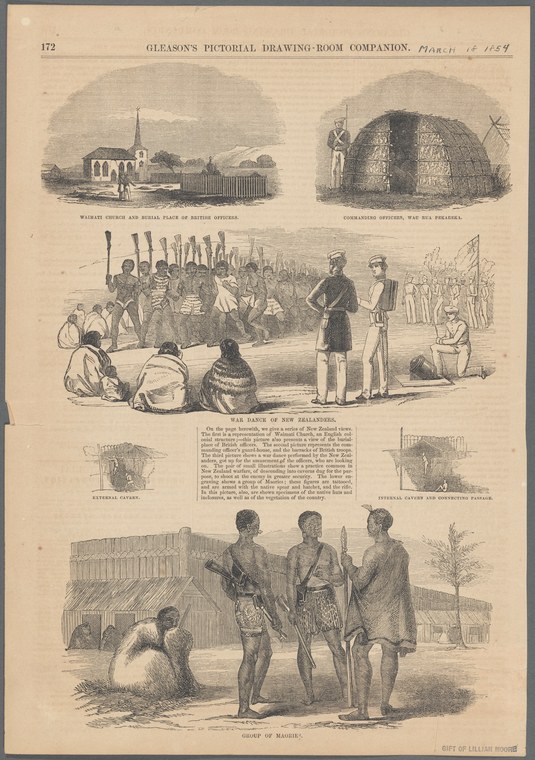
This is a page of wood engravings documenting indigenous peoples and their practices, arranged in five distinct scenes. The top row shows two small architectural or structural scenes: on the left, a European-style church or chapel with a spire beside a fortified structure; on the right, a large dome-shaped structure identified as a 'Conical Building, West Bay, Penguins.' The central and dominant scene depicts a large gathering of indigenous people arranged in a circle or semicircle, with figures standing and sitting on the ground. Some carry long poles or spears held upright. Europeans in dark clothing and hats stand among or observing the group, suggesting a moment of contact or ceremonial observation. The lower section shows two more scenes: on the left, what appears to be a dwelling or shelter interior with a figure, and on the right, three standing male figures in minimal dress with implements. The engravings are rendered in fine cross-hatching typical of wood-engraving technique, creating tonal depth and texture throughout.
The dancing
The indigenous figures are depicted with minimal clothing and are positioned in varied stances: some standing upright with spears or implements held vertically, others crouched or seated on the ground in relaxed postures. The figures show no unified formation or synchronized movement, instead occupying space in loose grouping. The European figures stand apart, clothed formally, observing or participating in the gathering. Body language and positioning suggest a documentary or ethnographic moment rather than choreographed dance—the standing figures hold their implements as tools or status symbols rather than as dance implements, and no bodies show the alignment, tension, or spatial relationship that would indicate partnering or synchronized movement.
The dance depicted
While this page is captioned as 'Folk and ethnic dancing,' the central gathering does not depict recognizable dance forms. The scene appears to be an ethnographic document showing indigenous peoples at a gathering or ceremony, with European observers present. The standing figures with vertical implements suggest a ceremonial or martial gathering rather than a dance event. Without clear evidence of rhythmic movement, musical instruments, or the body positions that characterize dance, this image functions more as a record of indigenous social or ceremonial practice than as a depiction of actual dancing. The caption may reflect 19th-century conflation of indigenous ceremonial or social gatherings with 'dancing' as an exotic or primitive practice.
How it was made
These are wood engravings, a relief printing technique in which an image is carved into the end-grain surface of a hardwood block. The fine cross-hatching, precise linear detail, and tonal gradation are characteristic of wood engraving at its height in the 19th century. Wood engraving permitted mass reproduction and circulation as part of illustrated periodicals or books, making ethnographic and travel imagery accessible to a broad audience. The technique's capacity for fine detail and narrative clarity made it the dominant medium for illustrated journalism and natural history documentation during this period.
About this work
This page comprises five wood-engraved scenes presented as documentation of indigenous peoples, with the largest scene showing a gathering of indigenous figures and European observers. The work is framed as 'Folk and ethnic dancing,' yet the imagery suggests ethnographic or ceremonial documentation rather than choreographed dance performance. The composition mixes architectural views, group scenes, and figure studies, typical of the illustrated natural history and travel literature that circulated widely in 19th-century Britain and America. The page belongs in a dance collection as evidence of how dance—or practices labeled as dance—was imagined, documented, and circulated in colonial-era visual culture, and how European observers constructed narratives around indigenous social and ceremonial life.
How to look at it
Examine the spatial arrangement of the figures and the absence of synchronized or mirrored body positions. Note the vertical orientation of the spears and implements, which suggests ceremonial or martial significance rather than dance equipment. Observe the contrast between the informally grouped indigenous figures and the formally dressed, standing European observers. The composition is documentary and observational—capturing what the artist understood as a moment of indigenous gathering—rather than capturing the dynamic, rhythmic, or partnered qualities that characterize dance imagery. The viewer should question the relationship between the label 'dancing' and the visual evidence presented.
The artist
The artist is not recorded. The page is part of 'Gleason's Pictorial Drawing-Room Companion,' a Boston-based illustrated periodical published from 1851–1859, known for its wood-engraved scenes of travel, natural history, and exotic peoples. The periodical employed multiple engravers and artists, and images were often credited to the publication rather than individual creators. The aesthetic and documentary purpose are consistent with mid-19th-century illustrated journalism.
The period
This engraving dates to the height of illustrated periodical culture and the expansion of European colonialism and ethnographic representation. The 1850s saw widespread publication of travel narratives and ethnographic imagery in illustrated periodicals, which shaped metropolitan European and American understanding of indigenous peoples. During this period, 'dancing' was frequently invoked as a marker of primitiveness or exoticism in indigenous cultures, often without precise documentation of actual dance practices. The image reflects both the appetite for travel imagery and the interpretive frameworks through which indigenous peoples were understood and represented.
Where it lives
This page is part of the New York Public Library's holdings of 'Gleason's Pictorial Drawing-Room Companion,' a Boston-based illustrated periodical. The work is catalogued as part of the broader 'Prints depicting dance' collection, though its classification as dance imagery is questionable given the content.
Questions about this work
Is this actually depicting dance?
The image is labeled as 'Folk and ethnic dancing,' but the visual evidence does not clearly show choreographed or rhythmic movement. The figures are grouped informally, hold implements vertically, and display no synchronized positioning or body relationship characteristic of dance. The caption likely reflects 19th-century conventions of labeling indigenous ceremonial or social gatherings as 'dancing,' a practice that conflated exotic otherness with dance without precise documentation.
Who are the European figures in the center scene?
The formally dressed figures appear to be observers or participants in the gathering—possibly colonial officials, merchants, missionaries, or naturalists. Their formal dress and positioning apart from the indigenous figures suggests a hierarchical or documentary relationship. Their presence indicates this is a scene of colonial contact or ethnographic observation rather than an indigenous ceremony captured in isolation.
What is the 'Conical Building' shown in the upper right?
The caption identifies it as 'Conical Building, West Bay, Penguins.' This suggests the page may document a specific location, possibly in the Southern Hemisphere or a colonial region where penguins are native. Without additional context from the periodical, the specific location and purpose of the building cannot be determined.
More dance artwork





