49 works in this view — arrow keys or swipe to move between them.
Dance in Art
Tarantelle pour le piano
Unknown artist
- Collection:
- Prints depicting dance
- Source:
- New York Public Library
- Rights:
- Public domain — free to use, share and adapt.
- Recorded as:
- Public Domain
This work documents the 19th-century fascination with Italian folk culture as material for European concert music and domestic performance, and shows how dances traveled and were transformed in that journey. The engraved image reveals contemporary assumptions about folk authenticity and rural life—the picturesque, convivial gathering under trees—that shaped how non-European or subaltern dance forms were seen and consumed by urban, educated audiences.
What you are looking at
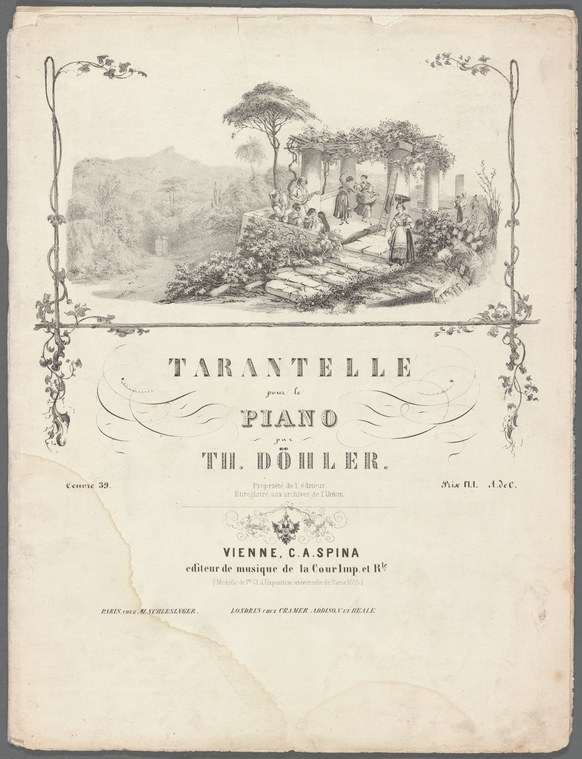
This is the cover or title page of a published piano score for a tarantelle, a traditional Italian folk dance. The composition features a framed vignette at the top center showing an outdoor Italianate scene: figures gather beneath spreading trees on rising ground, with mountains visible in the distance. The women wear long dresses and bonnets typical of the 19th century; the men are in period dress. The figures are arranged in animated groups, suggesting the sociable character of the dance. Below the vignette, ornamental flourishes frame the title in elegant typography: "TARANTELLE pour le PIANO" by "TH. DÖHLER." The publisher information identifies this as published by Vienne. C. A Spina, éditeur de musique de la Cour et de l'Empereur, with offices in Paris and London. The overall design is characteristic of mid-19th-century European sheet music covers—carefully engraved, with decorative vine borders flanking the central image and typography suggesting both gentility and market appeal to amateur pianists.
The dancing
The figures in the vignette are rendered in outline engraving and are relatively small, but their postures convey the energetic and social character of tarantelle dancing. Several women are visible in billowing skirts; the men wear dark coats. The grouping suggests interaction and movement across the landscape rather than a formal line or closed couples' hold. The composition emphasizes the outdoor, convivial setting of folk celebration rather than the technical precision of a formal dance step.
The dance depicted
The tarantelle is a rapid, whirling Southern Italian folk dance traditionally associated with popular celebration and courtship. Named for the city of Taranto and historically attributed to the bite of the tarantula spider (the "tarantism" phenomenon), by the 19th century it had become a fashionable subject for European concert music and salon performance. This score by Théodore Döhler, a respected pianist and composer of the mid-19th century, packages the tarantelle for amateur pianists—a work of musical rather than choreographic documentation. The engraved vignette captures the social context of the dance as a village gathering rather than showing the specific footwork or technical sequence.
How it was made
This is a professional music publication, executed in intaglio engraving—the finest and most expensive method of reproducing sheet music for mid-19th-century publishers. The vignette is engraved in fine lines and cross-hatching, creating the subtle tonal gradations visible in the foliage and distant landscape. The title and text are set in decorative typography. The decorative vine borders are also engraved. This technique, along with the publication by a court publisher with international offices, indicates a work aimed at educated amateur musicians and professional performers across Europe—a product of commercial music publishing at its height.
About this work
This is the cover of a published piano score for a tarantelle, one of many European salon arrangements of Italian folk material that circulated among 19th-century amateur musicians. The work sits at the intersection of ethnographic curiosity, Romantic nationalism, and commercial music publishing: the tarantelle represented "authentic" Southern Italian culture to Northern European audiences, yet it reached them through the genteel medium of the piano sonata and the drawing room. The engraved vignette is not a record of actual dance practice but a romantic imagining of the dance's social context—a visualization calculated to appeal to middle-class sheet music buyers who would never witness an actual tarantella in a Southern Italian village.
For students of dance history, the image reveals how folk dances entered European metropolitan consciousness in the 19th century not through direct observation but through music publishing, visual art, and the written word—mediated through commercial and imperial networks. The tarantelle's presence in a Viennese court publisher's catalog also charts the dance's journey from regional celebration to cosmopolitan salon music.
How to look at it
Attend to the contrast between the romantic pastoral scene depicted in the vignette and the abstract, notational world of the sheet music below. The engraver has chosen to show the dance in its social and geographical context—an outdoor village gathering in sunlit landscape—rather than to visualize steps or technical technique. This choice tells us that for the 19th-century sheet music buyer, the appeal of the tarantelle lay in its association with Italian rural life and celebration, not in any documentary record of how it was actually danced. The ornamental borders and careful typography also signal the work's position in the hierarchy of published music—respectable enough for educated consumption, but still labeled as a "folk" subject rather than original composition.
The artist
Théodore Döhler (1814–1856) was a German pianist, teacher, and composer of salon music who spent much of his career in Europe's musical capitals. He was known for virtuoso piano works and arrangements of popular dances and operatic melodies aimed at the amateur market. His compositions reflect the 19th-century fashion for brilliant, technically approachable keyboard works based on folk material and national themes.
The period
The mid-19th century saw an explosion of European interest in folk culture, particularly Southern European and Mediterranean material, as both an expression of Romantic nationalism and as exotic subject matter for urban audiences. The tarantelle in particular became a standard item in the European salon repertoire after Liszt and other virtuosi performed and published their own concert versions. At the same time, sheet music publishing was democratizing music—works that professional musicians had monopolized were now available to educated amateurs, usually in simplified arrangements. Viennese and Parisian publishers led this market, packaging folk material, operatic excerpts, and national dances as portable, performable, and profitable commodities.
Where it lives
This object is held in the New York Public Library's collection of prints depicting dance. It is a published music score, a commercial product of the mid-19th-century music publishing industry rather than a unique work of art.
Dance in this work
Questions about this work
What is a tarantelle?
A tarantelle is a rapid, energetic folk dance from Southern Italy, particularly the Taranto region. It is traditionally performed at celebrations and courtship gatherings. In the 19th century it became fashionable in European concert music and salon performance, though the versions published for pianists were often simplified arrangements rather than transcriptions of actual practice. The dance's name and mythology derive from the tarantula spider; Renaissance and Baroque physicians believed its bite caused a condition (tarantism) that could only be cured by dancing.
Who was Théodore Döhler?
Döhler (1814–1856) was a German pianist and composer known for virtuoso salon pieces and arrangements. He worked in Europe's major musical centers and published extensively with leading publishers. His output consisted mainly of brilliant keyboard works based on popular melodies, national dances, and operatic material—music designed for amateur performance and commercial appeal.
What does the picture on the cover actually show?
The engraved vignette shows a romantic, idealized scene of Southern Italian rural life: figures in 19th-century dress gathered beneath trees in a sunlit landscape, suggesting festivity and social gathering. It is not a documentary image of how the tarantelle was actually danced, but rather a visual marketing device—a picturesque representation of "authentic" folk culture designed to appeal to Romantic-era sensibilities and to sell sheet music to educated amateurs.
Why was Italian folk music so popular in 19th-century Europe?
The 19th century saw intense European interest in folk culture as an expression of national identity and as exotic subject matter. Italy—especially Southern Italy—held particular romantic appeal as an imagined site of authentic rural life, passionate emotion, and unmediated nature. Publishers, composers, and audiences consumed Italian folk material as objects of consumption that represented an idealized "other" to modern urban society.
More dance artwork





