49 works in this view — arrow keys or swipe to move between them.
Dance in Art
Historical and ethnic costumes
Unknown artist
- Collection:
- Prints depicting dance
- Source:
- New York Public Library
- Rights:
- Public domain — free to use, share and adapt.
- Recorded as:
- Public Domain
For dance historians and costume specialists, this image is valuable evidence of how folk costume was understood and presented in the 19th century—what colors, cuts, and textiles defined a particular regional identity. The inclusion of textile samples shows how contemporaries thought about costume construction and material authenticity, concerns that remained central to folk dance revival and stage presentation for the next century.
What you are looking at
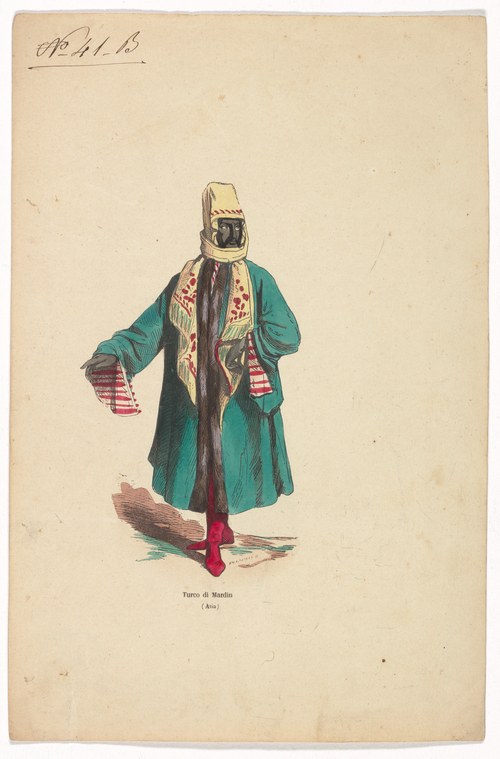
A single figure stands against a plain cream background, dressed in what appears to be a Scandinavian or Northern European folk costume from the 19th century. The figure wears a deep teal-green wool coat or sarafan (sleeveless dress) worn open over a long burgundy underdress, with a white linen headdress that covers the hair and frames the face. The headdress is embroidered or trimmed, with a dark rectangular panel across the forehead. The figure holds up fabric swatches in each hand—the right hand displays a striped textile in red and white, the left a plain burgundy piece. The costume is completed with dark red or burgundy stockings and simple dark shoes. At the base of the composition, faint marks suggest the figure is standing on or near additional textile samples. The figure's posture is frontal and upright, presenting the costume as a complete ensemble for inspection.
The dancing
The single figure stands in a formal, stationary pose with arms extended sideways at approximately shoulder height, holding textile samples. The body is centered and symmetrical, with weight evenly distributed. There is no indication of movement or dance position—the arms are raised for display rather than in any recognizable dance hold or frame. The figure is alone, facing the viewer directly.
The dance depicted
This is not a dance image. The figure is posed for costume documentation rather than performing any choreography. The upright, symmetrical stance and the deliberate display of textiles indicate this is a reference work or ethnographic illustration intended to record folk costume details. While folk dance traditions are strongly associated with such regional dress, the image itself depicts costume study, not dancing.
How it was made
This is a hand-colored engraving or lithograph, likely from the mid-19th century, based on the technique and printing conventions visible. The image shows fine line work characteristic of engraving, with hand-applied watercolor or gouache to add the greens, reds, and flesh tones. The plain background and frontal framing are typical of costume documentation prints produced for ethnographic or commercial reference purposes, suggesting this was meant for circulation among costume historians, theater practitioners, or as part of a larger ethnographic series.
About this work
This is a costume documentation print showing a Scandinavian or Northern European folk dress from approximately the mid-19th century. It belongs in an archive of dance-related imagery not because it depicts movement, but because folk costume and dance are inseparable subjects: this dress records the material context in which regional dances were performed and lived. The work is part of a systematic effort to document European regional culture during a period when nationalist movements and Romantic aesthetics made folk traditions subjects of serious artistic and scholarly attention. Such reference works informed stage costume design, ethnographic study, and the emerging field of folk dance documentation.
How to look at it
Examine the details of construction: the cut of the coat, the structure of the headdress, the pattern and weave of the fabrics shown in hand. Note that the artist chose to show the costume completely assembled and also in its component textiles—a choice that reveals how 19th-century costume study worked, moving between the garment as a whole and the material evidence of its making. The formal, frontal presentation and the neutral background strip away context; this is a record, not a narrative.
The artist
The artist is not recorded. The style and execution suggest this is the work of a professional engraver or lithographer, likely European, trained in the conventions of ethnographic illustration. The notation 'Part di Marino (Asia)' or similar text visible in the upper left may indicate this is part of a larger series documenting European regional costume, though the inscription is unclear in the current image.
The period
The mid-19th century was a period of intense European interest in folk culture, driven by Romanticism, nationalism, and the emergence of comparative ethnography. Dance was understood as an integral expression of national and regional identity. Costume documentation served both scholarly and theatrical purposes: ethnographers used such prints to record 'authentic' dress as modernization threatened traditional practices, while theater makers consulted them when staging historical or folk-inspired works. The practice of publishing hand-colored costume prints was well-established by this period, with such images circulating in reference collections, published series, and costume libraries.
Where it lives
The work is held in the New York Public Library's Prints collection, identified as part of a series on historical and ethnic costumes. The catalogue record provides no artist, date, or publication details. The inscription visible in the upper left may yield more information if it can be deciphered.
Questions about this work
Is this a dance image?
Not directly. The figure is posed for costume documentation, not performing. However, folk dance historians use such prints as primary sources for understanding how dancers dressed, what textiles were available, and how regional identity was expressed through costume. This is a document of the material context of folk dance rather than a representation of the dance itself.
What region is this costume from?
The style suggests Scandinavia or possibly another part of Northern Europe, based on the headdress design, the color palette, and the sarafan-like outer garment. The inscription in the upper left may specify the region, but it is not clearly legible in the current image. NYPL records would clarify this.
Why are textile samples being held up?
This documents the materials used in the costume and allows viewers to see both color and weave. For costume historians and theater practitioners, understanding the actual fabrics was essential for accurate recreation. The print thus functions as both a visual record and a reference for material procurement.
When was this made?
The catalogue record gives no date, but the engraving technique, hand coloring, and style suggest the mid-19th century, when such ethnographic costume prints were widely produced. The condition and medium are consistent with this period.
More dance artwork





