49 works in this view — arrow keys or swipe to move between them.
Dance in Art
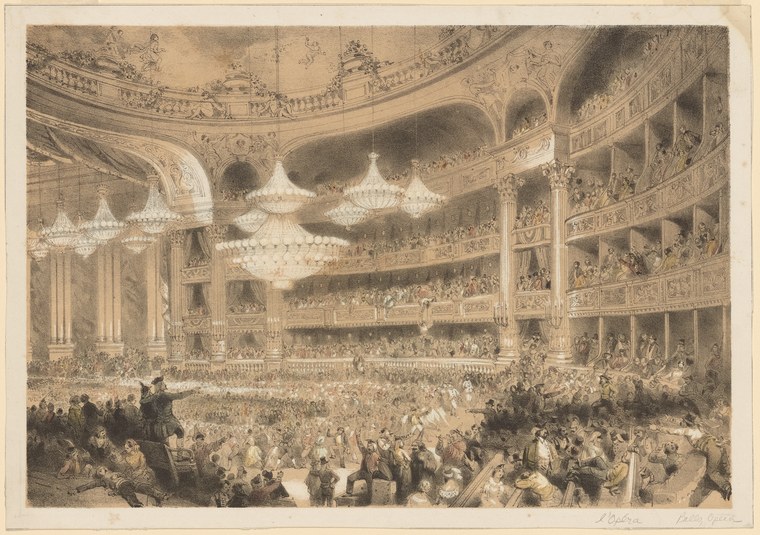
Opera ball
Unknown artist
- Collection:
- Prints depicting dance
- Source:
- New York Public Library
- Rights:
- Public domain — free to use, share and adapt.
- Recorded as:
- Public Domain
For historians of dance and society, this image is invaluable evidence of how ballroom dance was embedded in spectatorial culture and architectural grandeur. It shows that the operatic ball was a public event, a display of wealth and taste, and a space in which dance was one thread in a much larger social fabric. The work reminds us that dance history cannot be separated from the history of buildings, audiences, and the economics of spectacle.
What you are looking at
A grand theatrical opera house at full capacity, viewed from stage left during a ball or social dance. The tiered interior with multiple levels of boxes and galleries frames hundreds of spectators lining the balconies and filling the floor. The perspective emphasizes the vast audience rather than the dancers themselves; figures on the main floor are rendered small and distributed across the space, some standing, some seated at tables, in animated conversation and movement. The architecture is neoclassical and ornate, with columns, detailed moldings, and hanging chandeliers or gasoliers providing light. The composition conveys spectacle, social occasion, and the architecture as protagonist—a statement about the scale and prestige of operatic culture and ballroom society rather than dance technique itself.
The dancing
Individual dancers are difficult to isolate in this composition; the work emphasizes crowd and architecture over bodies in motion. Where figures are distinguishable on the floor, they appear to be standing or moving in the casual promenade and social grouping typical of ballroom venues rather than partnered dancing in closed or standard holds. Figures wear formal dress (men in dark coats and tails, women in light-colored gowns) consistent with 19th-century evening wear. The overall impression is of socializing and circulation rather than choreographed ensemble or couple work.
The dance depicted
This is not primarily a work depicting a specific dance style or technique. It records the social practice of the operatic ball—an upper-class ballroom event held in or adjacent to an opera house, where elite audiences gathered for conversation, dining, and informal dancing. The work documents the event as a social institution and a space of class performance rather than the dance itself. Waltzes, quadrilles, and polkas would have been the likely dances of the period, but the artist shows almost no interest in the specifics of movement or partnering.
How it was made
This is a print—most likely an engraving or lithograph, from the character of the line work, tonal gradation, and the sepia or gray-brown wash visible throughout. The technique allows for wide distribution and serial reproduction, suggesting this was a popular image of a well-known or fashionable venue. The detail is finest in the architecture and public boxes; the crowd is rendered more summarily, as texture. The scale and complexity of the composition required considerable planning and technical skill, and the finished work was likely a commercial print for collectors interested in contemporary social life and urban spectacle.
About this work
This is a record of an operatic ball—a social and architectural event rather than a choreographic one. It shows the interior of a grand 19th-century ballroom, likely French or European, packed with formally dressed spectators and participants arranged across multiple tiers and the main floor. The work is a document of elite leisure, public spectacle, and the built environment of dance rather than an analysis of dance itself; it belongs in a gallery of dance in art because the ball was a central institution of social dance in the Romantic era, and because the image shows us how that dance was framed, witnessed, and valued—as one element of a vast and architecturally defined social performance.
How to look at it
Step back to see the whole composition: the work is organized as a vertical and horizontal grid of boxes, balconies, and crowds, emphasizing the architectural frame and the social hierarchy of seating. Notice that the dancers on the main floor are small and often obscured by furniture and spectators; the artist chose to minimize the dance in favor of the event and the space. Look at the play of light from the chandeliers and the careful rendering of the boxes and galleries—the real subject is the building and the crowd it contains, not the steps or holds of the dancers.
The period
The operatic ball was a characteristic institution of European high society from the late 18th century onwards, reaching particular prominence during the 19th century. In the Romantic era, the ball became a featured subject in literature, music, and visual culture—a symbol of elegance, social hierarchy, and the glamor of urban life. Opera houses themselves expanded and became increasingly ornate as symbols of civic pride and imperial wealth. This print documents the convergence of opera, dance, architecture, and social performance that defined the cultural moment. Waltzes and quadrilles were the dominant social dances of this period, danced by guests in the spaces surrounding the operatic stage.
Where it lives
Held in the New York Public Library's Prints collection. The work is catalogued as depicting dance but lacks attribution, precise title confirmation, and date.
Dance in this work
Questions about this work
What is an operatic ball?
An operatic ball was a grand ballroom social event held in or near an opera house, typically attended by wealthy and aristocratic guests. It combined elements of theater, music, dining, and social dancing in a single evening, and was understood as a display of elegance and social status. The events were particularly fashionable in European cities during the 19th century.
What dances would have been performed at such an event?
The waltz was the dominant social dance of the 19th century and would certainly have been prominent. Quadrilles, polkas, and country dances were also common. However, this print does not show enough detail to confirm the specific dances or the technique used.
Why is the dance so small in this picture?
The artist prioritized the architectural grandeur and the social spectacle of the event over the choreographic detail. The work is as much a portrait of the building and the crowd as of the dance itself, reflecting how 19th-century society understood the operatic ball—as a space of social performance, not as an occasion to admire technique.
Is this a real ballroom or imaginary?
Unknown. The architectural style and the reference to 'Opera ball' in the title suggest a real or recognizable venue, but without artist attribution and date, confirmation is not possible. The print may be a documentary record, a composite ideal, or a fanciful interpretation of a famous location.
More dance artwork





