49 works in this view — arrow keys or swipe to move between them.
Dance in Art
Historical and ethnic costumes
Unknown artist
- Collection:
- Prints depicting dance
- Source:
- New York Public Library
- Rights:
- Public domain — free to use, share and adapt.
- Recorded as:
- Public Domain
Costume documentation from this period reveals the forms and patterns of dress worn in dances still performed today, making it a historical record of material culture. Such prints also expose the 19th-century practice of isolating and aestheticizing non-Western dress as 'ethnic costume'—a framework that shaped how dance and cultural practice from the Americas, Asia, and Africa were collected and presented to Western audiences.
What you are looking at
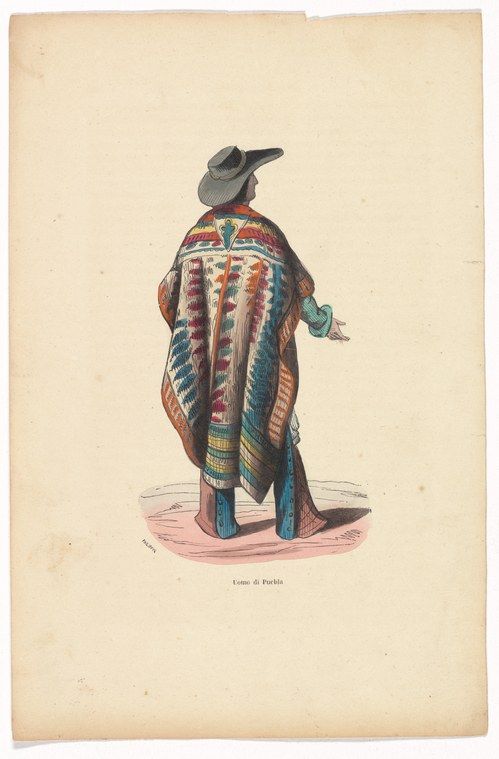
A figure stands alone against a pale background, viewed from behind. They wear a dramatic and voluminous garment that dominates the composition—a woven cloth or shawl of striking geometric patterning in warm tones (rust, cream, and earth colors) arranged in vertical stripes and triangular motifs. The fabric is draped and wrapped around the body in the manner of a Peruvian or Andean aqlliku or manta, falling nearly to the ankles. Beneath it, fitted stockings or leg wrappings in teal or turquoise are visible. The figure wears a dark, rounded hat or chullu on their head. The stance is still and frontal, with no evident movement; the emphasis is entirely on the dress. The patterned textile dominates the visual field, suggesting this is a study of costume rather than captured dance. A thin ground line in pale rose tones indicates minimal setting.
The dancing
A single figure is presented in a stable, standing posture viewed from behind, with weight evenly distributed and no visible tilt or shift in the body. The arms hang at the sides or are obscured by the enveloping textile. The garment is the active compositional element rather than the body; the figure serves as a stand for the display of the woven cloth and its pattern. There is no indication of motion, turning, or the dynamic alignment that would suggest an active dance posture.
The dance depicted
This work does not depict dance in action. It is a costume study, presenting the formal dress of what appears to be Peruvian or Andean highland culture. While such textiles and dress are worn during ceremonial and social dances in Andean regions—and the geometric patterns and colors do reflect regional aesthetic traditions—the figure here is static and posed as a garment documentation rather than performing. The catalogue title 'Historical and ethnic costumes' confirms this intent. No specific dance style can be identified from the image, as none is being performed.
How it was made
This is a hand-colored engraving or lithograph, likely from the 19th century, printed on laid paper. The fine line work and stippled shading in the textile pattern are consistent with engraving, while the systematic hand-coloring—applied in flat, clear tones to define the stripes and geometric forms—is typical of colored prints intended for ethnographic or costume documentation. The technique allowed accurate reproduction and wide distribution of costume references, important for scholars, performers, and collectors interested in world dress.
About this work
This is a 19th-century ethnographic costume print, part of a broader tradition of documenting 'folk' and 'native' dress through colored engraving. It presents Peruvian or Andean highland garments—particularly the distinctive patterned manta or wrap, the fitted leg bindings, and the knitted hat—in careful documentary style. The work belongs in a dance archive not because it shows dance in motion, but because such costumes are integral to the material culture of Andean ceremonial and social dance traditions, and because costume studies like this one shaped how European and North American audiences understood non-Western performance. The image records what a participant would wear rather than how a participant would move.
How to look at it
Observe the precision of the geometric patterning in the textile—the careful repetition and symmetry of the stripe and triangle motifs—which demonstrates the complexity of Andean weaving. Note the contrast between the warm-toned manta and the vivid teal leg coverings, which suggests intentional color coordination in the original dress. The figure's posture is deliberately neutral, allowing the viewer to read the garment as a flat, complete pattern rather than as clothing on a moving body. This is the visual language of costume documentation rather than performance art.
The artist
The artist is not recorded. The work belongs to a large 19th-century publishing tradition of ethnographic and costume prints, often issued in series and colored by hand in workshops. Such prints were distributed to natural history museums, costume collections, and wealthy collectors, and were frequently used as reference material for theatrical and operatic costume design.
The period
The 19th century saw an explosion of ethnographic publishing in Europe and North America, driven by colonial expansion and Romantic-era fascination with 'exotic' cultures. Costume and dress were primary subjects, as they could be documented, collected, and displayed without requiring the presence of the people who wore them. At the same time, Andean textiles and weaving traditions were being suppressed in Peru and Bolivia under colonial and nationalist regimes; these prints sometimes preserved images of patterns and techniques that were being erased in their regions of origin.
Where it lives
The work is held in the New York Public Library's collection of prints depicting dance. It is catalogued under the general heading 'Historical and ethnic costumes' with no artist, date, or medium attribution recorded. It appears to be one item within a larger published series of similar costume studies.
Questions about this work
Why is a still costume image in a dance archive?
Costume and dress are part of dance history and practice. Andean communities dance in these garments; understanding the material form—the weight, pattern, and construction of the textile, the fit of the leg wrappings—is part of understanding those dances. Prints like this also document what was worn at a specific historical moment, providing evidence for reconstructing or contextualizing dances that may not have been recorded in movement notation.
When was this made?
The style of the engraving and hand-coloring, and the aesthetic choices about what to document, suggest the mid-to-late 19th century. However, the catalogue record provides no date, and the print may have been issued as part of a bound series that could have been published over a span of decades. More research would be needed to establish a precise date.
Is this Peruvian or more broadly Andean?
The style of the manta (woven wrap), the geometric patterns, and the knitted hat are consistent with Peruvian and Bolivian highland dress traditions. However, without a specific inscription or label on the print, the precise regional origin cannot be stated with certainty. The patterns and construction are recognizable to researchers familiar with Andean textiles, but a general Andean attribution is safest.
More dance artwork





