49 works in this view — arrow keys or swipe to move between them.
Dance in Art
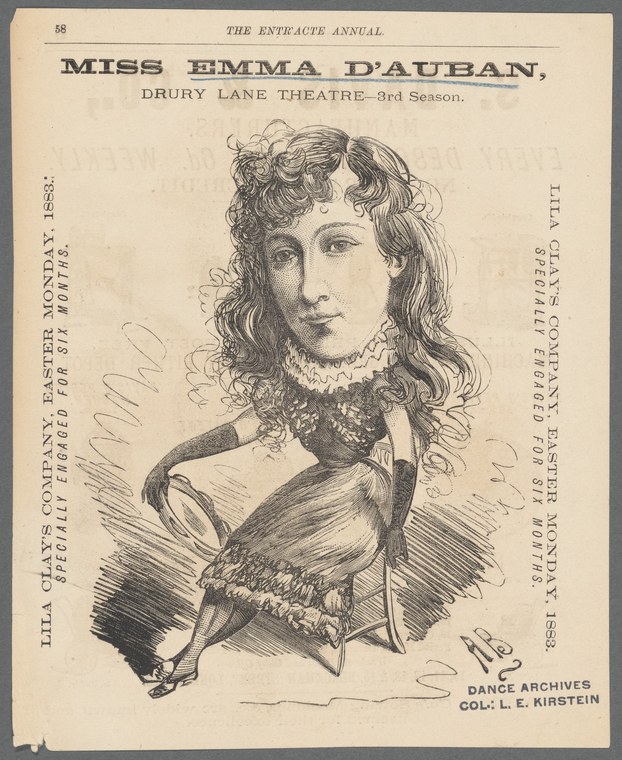
Miss Emma D'Auban, Drury Lane Theatre, 3rd season
Unknown artist
- Collection:
- Prints depicting dance
- Source:
- New York Public Library
- Rights:
- Public domain — free to use, share and adapt.
- Recorded as:
- Public Domain
As part of The Entracte Annual's collection of theatrical performers, this engraving is documentary evidence of late Victorian theatre practice, costume design, and the public image carefully cultivated by professional dancers and actors. It contributes to our understanding of how theatrical performance was commercialized and circulated through print culture, and how women performers negotiated professional identity in this period.
What you are looking at
A three-quarter-length portrait of a young woman, shown from approximately waist up, facing toward the left side of the frame. She wears an elaborately styled costume with a white lace collar and what appears to be a richly decorated bodice with ornate embroidery or jeweled detail. Her dark, voluminous hair is arranged in ringlets and waves characteristic of late Victorian theatrical styling. She holds a fan in her right hand, and wears what appears to be a draped garment or shawl across her body. The background is plain, keeping focus on the figure. This is rendered as an engraved or etched portrait in black and white, with fine cross-hatching to create tonal depth, particularly in the hair and fabric textures.
The dancing
The figure stands in a formal, composed pose typical of theatrical portraiture—shoulders relaxed, one arm raised slightly to display the fan, the other resting. The posture conveys poise and grace rather than captured mid-movement. The elaborate costume and deliberate presentation suggest this is a costume portrait rather than a depiction of active dancing. The delicate handling of the hands and the elegant tilt of the head emphasize refinement and professional presentation.
The dance depicted
This appears to be a costume portrait of an actress or dancer rather than a representation of dance itself. The inscription identifies the subject as Miss Emma D'Auban from the Drury Lane Theatre's third season, and the theatrical costume—with its rich embroidery, lace collar, and fan—suggests a role in dramatic or comedic theatre rather than ballet proper. Without seeing her in motion, the specific dance style cannot be determined from the image alone. The costume indicates she was a performer in late Victorian musical theatre or pantomime.
How it was made
This is a fine engraving or etching, executed with considerable skill in cross-hatching and linear technique to model form and create texture. The controlled line work suggests professional reproductive engraving, likely made for circulation as a theatrical print or as part of a published collection of performers. The technique allowed for wide distribution and relatively affordable reproduction, making such prints popular souvenirs and promotional materials for theatre-goers of the period. The quality of execution indicates this was a significant theatrical figure.
About this work
This is a formal engraved portrait of Emma D'Auban, a performer at the Drury Lane Theatre in London during the late 19th century. The print documents a specific moment in theatrical history through costume portraiture, capturing the visual splendor of late Victorian stage dress. Rather than depicting dance in motion, it preserves the appearance of a performer in costume, serving as both theatrical documentation and historical record of how dancers and actors presented themselves to audiences.
How to look at it
Attend to the costume itself—the lace collar, the embroidered bodice, the jeweled ornament—which tells us more about late Victorian theatrical aesthetics than the figure's pose does. Notice the deliberate theatricality of presentation: the fan, the arrangement of the hair, the three-quarter pose. The engraver has used varying densities of cross-hatching to emphasize the texture of rich fabrics and the softness of hair, creating depth and materiality. This is a publicity portrait designed to create glamour and appeal, not a study of dance technique.
The artist
The engraver is not recorded in the available catalogue data. The work appears in The Entracte Annual, a publication dedicated to theatrical portraiture, which employed skilled reproductive engravers to capture and circulate likenesses of popular performers. Such engravers were often uncredited craftspeople working within a commercial publishing apparatus.
The period
This portrait dates to the era of Victorian and Edwardian theatre, a period of great popularity for musical theatre, pantomime, and variety performance in London. The Drury Lane Theatre was one of London's most prestigious venues, and performers were celebrities whose likenesses were widely sought and reproduced. The late 19th century saw theatrical portraiture become a major publishing category, with specialized annuals and journals devoted entirely to actors and dancers. The costume visible here reflects contemporary trends in stage dress, where elaborate decoration and historical or exotic styling were central to theatrical spectacle.
Where it lives
The work comes from The Entracte Annual, a periodical devoted to theatrical portraiture and performance history, held at the New York Public Library in the Dance Archives collection. It was part of a systematic effort to document theatrical performers of the period through engraved portraiture.
Questions about this work
Was Emma D'Auban a ballet dancer?
The costume and theatrical context suggest she was a performer in musical theatre or pantomime at the Drury Lane Theatre, not a ballet dancer. The fan and richly decorated bodice are more consistent with dramatic or comedic theatre of the Victorian period than with ballet costume. Without additional biographical information, her specific theatrical specialty cannot be determined from the portrait alone.
What is The Entracte Annual?
The Entracte Annual was a periodical dedicated to theatrical portraiture and coverage of London theatre, particularly popular during the late 19th century. It provided theatre-goers with engraved portraits of performers, serving as both souvenir and advertisement. Collections of these annuals are held in theatre archives and libraries as primary sources for theatrical history.
Why is she holding a fan?
The fan was both a costume prop and a symbol of elegance and refinement in Victorian theatre portraiture. Its presence indicates a formal or romantic role and contributes to the overall impression of cultivated femininity that theatrical publicity sought to project.
More dance artwork





