49 works in this view — arrow keys or swipe to move between them.
Dance in Art
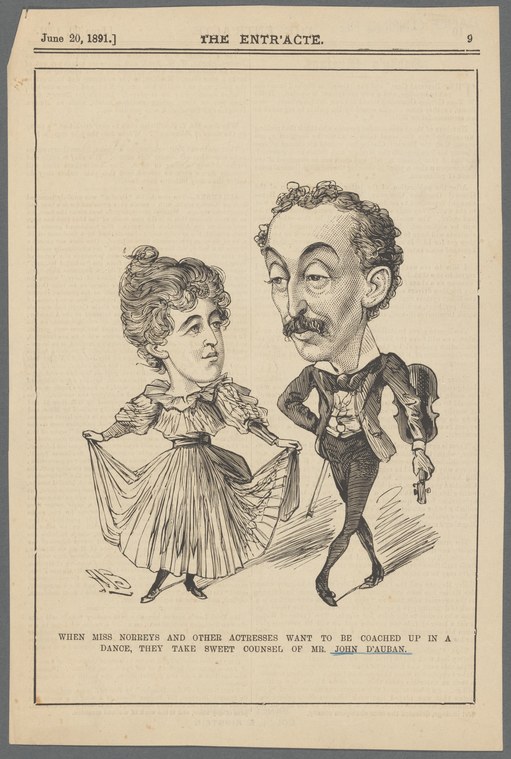
When Miss Norreys and other actresses want to be coached up in a dance, they take sweet counsel of Mr. John D'Auban
Unknown artist
- Collection:
- Prints depicting dance
- Source:
- New York Public Library
- Rights:
- Public domain — free to use, share and adapt.
- Recorded as:
- Public Domain
John D'Auban was central to the development of musical theatre and pantomime choreography in Britain during a formative period; his coaching of professional actresses shows that dance training was integral to theatrical practice at the highest level. This image is evidence of the professionalization of dance instruction in the theatre and the celebrity status of dance masters in the fin-de-siècle entertainment world.
What you are looking at
This is a caricature in the style of theatrical magazine illustration, likely from the 1890s. Two figures are shown in exaggerated proportions typical of the period's satirical art. On the left stands a woman in fashionable dress of the era: she wears a high-necked blouse with elaborate ruffled collar detail and puffed sleeves, and a skirt with prominent pleating that extends to her ankles. Her hair is styled in the upswept fashion of the 1890s. On the right is a man in formal evening dress—tailcoat, waistcoat, and bow tie—depicted with a distinctly elongated, caricatured face and exaggerated posture. His body leans forward in an attitude of instruction or demonstration. The inscription at the bottom identifies the figures and explains the scene: he is John D'Auban, a dance coach, and she represents actresses seeking his tutelage. The composition is spare—just the two figures against a plain background—and the line work is precise and confident, characteristic of skilled theatrical illustration.
The dancing
The woman stands with weight evenly distributed, her posture upright and formal, her arms at her sides—a static, observational stance. The man leans forward from the hips in an attitude of active instruction, his body angled toward his student. Neither figure is captured in actual dance movement; instead, the image freezes a moment of coaching or consultation. The caricature style emphasizes D'Auban's distinctive facial features and elongated frame, while the woman is rendered with fashionable grace befitting an actress of status.
The dance depicted
This is not a depiction of dance itself but of dance instruction—specifically, a satirical commentary on the coaching of actresses in choreography. John D'Auban (1842–1904) was a real figure: a prominent choreographer and dance master in the Victorian and Edwardian theatre, known for his work on musical theatre, pantomime, and ballet in London. The caption suggests that actresses of the period sought his expertise to learn or refine their dancing for stage performance. This image documents the social practice of private coaching rather than capturing a dance style in execution.
How it was made
This is a wood engraving or line engraving, evidenced by the precise hatching, the confident linear work, and the characteristic black-and-white tonal range. The technique allowed for fine detail in features and fabric texture while maintaining the bold graphic clarity needed for reproduction in a magazine. The signature visible in the lower left corner (though not fully legible in this image) is typical of professional theatrical illustrators of the period. This was a work made for publication in a periodical, aimed at a literate, theatre-going audience.
About this work
This is a satirical theatrical illustration documenting a real historical figure—John D'Auban, one of the most influential dance masters of late-Victorian London—and the practice of coaching actresses in choreography. Rather than depicting a finished dance performance, it captures the pedagogical moment: a student and her celebrated teacher in consultation. The image belongs in a dance gallery because it documents both a significant figure in theatre dance history and the social infrastructure of dance training in the professional theatre of the 1890s. It reveals that dance instruction was a valued commodity for actresses, and that expertise in choreography and movement was associated with named individuals whose celebrity extended into the popular press.
How to look at it
Observe how the artist has rendered the moment not as active dancing but as consultation: the woman is still and attentive, while the man leans forward in the attitude of an instructor. This captures a less visible but crucial aspect of theatrical dance—the pedagogical relationship. The exaggeration of D'Auban's features and frame is not mockery but the standard language of theatrical caricature; it serves to make him instantly recognizable to readers of the magazine and to emphasize his professional identity. The contrast between the fashionable formality of the woman's dress and the caricatured malleability of D'Auban's body defines their relationship: she is the client, he is the expert.
The artist
The artist is not recorded in the catalogue, but the style and execution are consistent with the work of theatrical illustrators employed by London periodicals in the 1890s. The confident line, the satirical approach, and the stage-trade knowledge suggest a professional illustrator with close connections to the theatre world. Such illustrators were often anonymous contributors to magazines like The Entr'acte, the publication in which this image appeared.
The period
In the 1880s and 1890s, British musical theatre was experiencing rapid growth and increasing sophistication. Choreography was moving from the realm of improvisation toward more formal training and documented choreographic systems. D'Auban was at the forefront of this professionalization, working on major productions and training performers in an era when dance was becoming a codified discipline within theatrical practice. The theatrical press of the period regularly satirized and celebrated the personalities of the stage world, making figure caricatures a standard feature of entertainment magazines.
Where it lives
This engraving appeared in The Entr'acte, a London theatrical periodical, on 20 June 1891. The Entr'acte was a weekly magazine covering theatre, music-hall, and entertainment news, illustrated with theatrical caricatures and topical commentary. This image is part of the New York Public Library's collection of prints depicting dance and entertainment.
Questions about this work
Who was John D'Auban?
John D'Auban (1842–1904) was a highly influential British choreographer and dance master who worked extensively in Victorian and Edwardian musical theatre, pantomime, and ballet. He was famous for his ability to train actors and actresses in movement and choreography, and his name became synonymous with theatrical polish and professional dance training in London. He choreographed for major West End productions and was a celebrated figure in the entertainment world.
What does 'coaching in a dance' mean in this context?
In the theatre of the 1890s, 'coaching' meant receiving private instruction in choreography and movement from a specialist. Professional actresses often needed to learn dances for their roles—in musical theatre, pantomime, or spectacular productions—and would engage a dance master to teach them. This was a commercial transaction and a sign of professional status, not different in principle from a modern actor working with a choreographer.
Why is this image satirical?
The caricature style—the exaggerated proportions of D'Auban's body and face, the theatrical positioning—is typical of magazine satire of the period. However, satire here does not necessarily mean mockery; it means a heightened, recognizable rendering designed to amuse and entertain readers familiar with stage personalities. The image celebrates D'Auban's prominence even as it makes him the subject of witty visual commentary.
What can this image tell us about dance in the 1890s?
It shows that choreography and dance training had become professionalized and specialized disciplines in the theatre; that dancers and choreographers were celebrity figures whose names were known to the theatre-going public; and that actresses, even of high status, required training from expert dance masters to perform choreography on stage. It also shows that the theatrical press took dance seriously enough to satirize it regularly.
More dance artwork





