49 works in this view — arrow keys or swipe to move between them.
Dance in Art
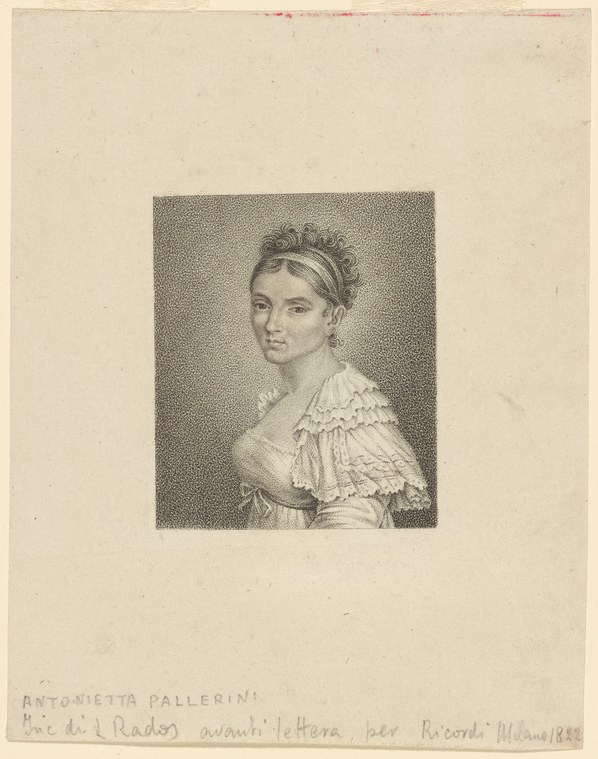
Antonietta Pallerini
Unknown artist
- Collection:
- Prints depicting dance
- Source:
- New York Public Library
- Rights:
- Public domain — free to use, share and adapt.
- Recorded as:
- Public Domain
This engraving is evidence of the professional standing of women dancers in early 19th-century Europe: Pallerini was celebrated enough to merit a formal printed portrait in an expensive technique, circulated to a paying public. The work shows how theatrical dancers were memorialized—through the careful rendering of their faces and fashionable dress—in the visual culture of the period.
What you are looking at
A three-quarter-length portrait of a young woman set against a neutral background, rendered in fine dotted engraving technique. She is shown from the waist up, turned slightly to her left, with her gaze directed toward the viewer. Her hair is styled in the fashion of the early 19th century, gathered up and adorned with a simple headband or fillet. She wears a high-waisted white dress with a low, broad neckline and short sleeves finished with deep ruffles or flounces that fall off the shoulders in the Regency fashion. The dress fabric appears delicate and the gathering at the waist emphasizes the silhouette typical of the 1810s–1820s. Her pose is poised and dignified, with her body relaxed but her posture upright, suggesting a moment of repose or formal presentation rather than active movement.
The dancing
A single standing figure occupies the composition. The woman's frame is vertical and composed, with her shoulders relaxed and her arms at rest, one arm partially visible at her side. Her weight appears evenly distributed, suggesting a moment of stillness. The artist has captured her at a moment of calm elegance rather than in the midst of any choreographed movement. There is no indication of dance posture—no lifted line, turned-out legs, or dynamic weight transfer. The gesture is one of formal presentation, conventional for portraiture of a named individual.
The dance depicted
This is a commemorative portrait, not a depiction of dance. The inscription at the base identifies the subject as Antonietta Pallerini and includes a handwritten note in Italian. Pallerini was a noted dancer of the early 19th century, celebrated particularly in European theatres, but this engraving captures her in formal dress as a named individual—a standard convention of the period for artists and performers of standing. The image documents her identity and status rather than illustrating her art.
How it was made
This is an engraving executed in fine dotted stipple technique, which creates tone and modeling through the controlled density of small dots rather than linear hatching. The technique allows for precise facial modeling and luminous effects, especially in the rendering of skin and delicate fabrics. Stipple engraving was labor-intensive and expensive, suggesting this was produced for a cultivated audience and likely circulated as a standalone print or in collected editions of portraits of notable performers. The technique was favored for formal portraiture and popular theatrical prints in the early 19th century.
About this work
This is a formal commemorative engraving of Antonietta Pallerini, a notable dancer of the early 19th century, rendered in the refined stipple-engraving technique. The work documents her as a named individual of artistic significance rather than depicting her in performance or teaching. Pallerini would have been recognized by contemporary audiences as a prestigious theatric figure, and this print served as a record of her identity and as merchandise for collectors of theatrical imagery. The work belongs in a gallery of dance in art because it represents how the profession of dance was documented and celebrated in print—as portraiture of named artists rather than only as depictions of the choreography or movement itself.
How to look at it
Look at the careful attention to the texture of the dress—the stippled technique creates a luminous quality in the white fabric that suggests expensive muslin and skilled tailoring. The artist has rendered Pallerini with a direct, engaging gaze and has positioned her at a moment of repose that conveys poise and refinement rather than spectacle. This is a portrait of a woman of professional standing and fashionable taste, not a record of a specific choreographic moment. The formal presentation and refined technique indicate that Pallerini's value lay not only in her movement but in her status as a recognized public figure.
The artist
The engraver is not identified in the catalogue record. The inscription on the plate suggests the work was made in Italian or by an Italian workshop, but without further documentation, attribution remains uncertain. The technique and finish are consistent with professional European engraving of the 1810s–1820s.
The period
The early 19th century saw the rise of the star system in European theatre, where individual dancers (especially women) became famous public figures whose likenesses were engraved and sold as prints. Theatrical portraiture in stipple engraving was at its height during this period, competing with and complementing the work of painters. The fashions visible in the dress—the high waistline, the short sleeve with ruffled edge, the delicate white muslin—are consistent with Regency and early Romantic-era aesthetics, suggesting a date somewhere between 1810 and 1825. This was the era of the rise of Romantic ballet, when the image of the ethereal, elegant female dancer was becoming a dominant cultural ideal.
Where it lives
The work is held in the New York Public Library's collection of prints depicting dance. The handwritten inscription in Italian on the plate suggests the work was accessioned or annotated by a collector with knowledge of Italian language and the subject.
Questions about this work
Was Antonietta Pallerini a famous dancer?
The fact that she was commemorated in a formal engraving suggests she held significant professional standing in early 19th-century European theatre. Dancers celebrated enough to merit prints in expensive stipple-engraving technique were typically stars of major theatres. Without additional documentation in the record, we cannot specify her particular repertoire or theatres, but the quality and care of this portrait indicate she was a figure of recognized importance.
Why is she not shown dancing?
This is a portrait, not a genre scene or performance image. Formal prints of theatrical performers typically presented them as named individuals in fashionable dress rather than in the midst of choreography. This convention served both to document the person and to display current fashion and artistic refinement. Dance was celebrated through both performance images and portraiture, and this belongs to the latter tradition.
How was this print made and distributed?
This is a hand-engraved print made using stipple technique, in which tone is built from small dots. Such prints were expensive to produce and were sold individually or in collected sets to theatre-goers, collectors, and aficionados. They served as souvenirs, collectibles, and records of notable performers, circulating within a cultured urban market.
More dance artwork





