49 works in this view — arrow keys or swipe to move between them.
Dance in Art
La Esmeralda
Unknown artist
- Collection:
- Prints depicting dance
- Source:
- New York Public Library
- Rights:
- Public domain — free to use, share and adapt.
- Recorded as:
- Public Domain
This work documents a form of physical performance—street contortion or acrobatic display—that left few other traces in art history. It connects literary Romanticism (Hugo's sympathetic portrayal of marginalized performers) to the actual bodily practices of non-elite performers in 19th-century cities. For dancers and historians, it is evidence of what bodies were trained to do, what audiences gathered to see, and what kinds of movement existed outside the ballet theater.
What you are looking at
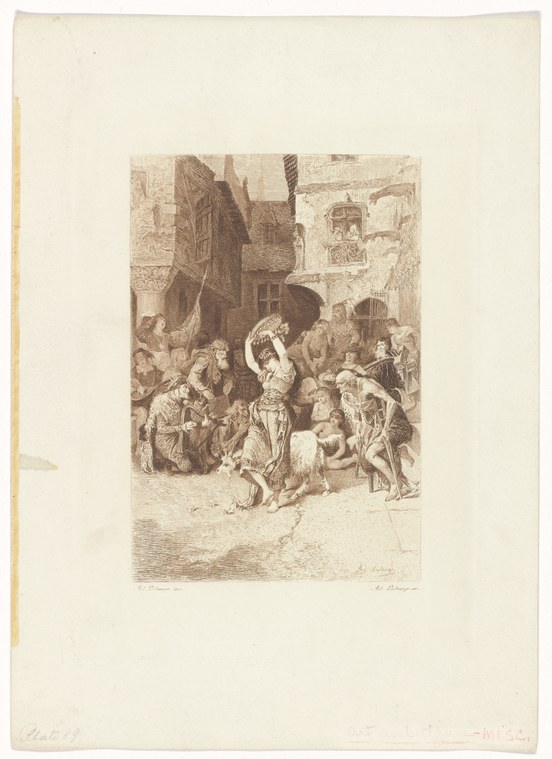
A crowded street scene in what appears to be a medieval or early modern European setting, with tall buildings framing a narrow urban space. A woman in a long white dress stands prominently in the center, her body twisted in an exaggerated pose with one arm raised above her head, her torso arched backward in a striking, acrobatic curve. She is surrounded by onlookers—men, women, and children—who cluster around her in various attitudes of attention and response. Some figures gesture toward her; others converse among themselves. The composition is dense and animated, with figures at multiple depths receding into the shadowed background. The woman's pose dominates the scene visually and spatially; her contorted posture and the gathered crowd suggest she is performing or displaying her body for public view. The light is warm and diffuse, characteristic of the period's aesthetic, and the entire scene carries a sense of street theater or public spectacle.
The dancing
The central female figure is the focus of all compositional energy. She stands with her weight apparently on one leg, her torso dramatically arched backward in an extreme backbend, her free arm extended upward in a flourish. Her posture is that of a contortionist or acrobat rather than a ballroom dancer—the degree of spinal extension goes far beyond any classical dance vocabulary. The surrounding figures are arranged as observers: some stand with arms crossed or at their sides, some gesture toward the performer, and children sit or stand at ground level. None of the surrounding figures are in closed hold with partners or arranged in a formal dance formation; they are witnesses to a solo performance or display.
The dance depicted
This appears to depict street performance or circus-like spectacle rather than formal theatrical or social dance. The extreme backbend and acrobatic posture suggest a contortionist performer, which aligns with the title 'La Esmeralda'—Victor Hugo's novel features a Romani street performer and dancer. The gathering of onlookers and the public setting indicate this is street entertainment. However, the specific choreography or dance style cannot be confidently identified from the pose alone; the emphasis is on bodily flexibility and public display rather than any recognizable dance steps or partnered form. The work documents a moment of sensational physical performance in a public urban space.
How it was made
This is a sepia-toned etching or engraving on paper, executed with fine linear hatching and cross-hatching to build tone and shadow. The technique allows for precise detail in the architecture and the play of light across the crowded composition, while the warm tone creates atmospheric depth and age. The medium is characteristic of 19th-century reproductive printmaking, which suggests wide circulation and an educated, urban audience familiar with both Hugo's literary work and European artistic traditions. The inscription at lower left appears to be the artist's signature or publisher's mark, though it is not clearly legible in this reproduction.
About this work
A print titled La Esmeralda, showing a woman in a white dress in a deep backward arch with one arm raised, performing before a crowd in a narrow street. La Esmeralda is the title of the Romantic ballet by Jules Perrot, first given at Her Majesty Theatre in London on 9 March 1844 to music by Cesare Pugni, with the title role created by Carlotta Grisi, and it is also the name of the Romani street dancer in Victor Hugo 1831 novel Notre-Dame de Paris, on which the ballet is based. Which of the two this print depicts, and whether it records a particular staging or dancer, is NOT established by anything we hold. The NYPL catalogue record gives no artist, no date and no medium, and it refused automated retrieval when archives tried to re-read it on 2026-10-07, so every statement about artist, date, technique and subject on this page awaits a sourced pass.
How to look at it
The woman carries her weight on one leg with the torso arched backward and the free arm raised. In Romantic-era theatrical prints a deep cambre en arriere with a raised arm is ordinary classical vocabulary and is routinely exaggerated by the printmaker, so the depth of the arch on its own does not tell you whether the subject is a ballerina, a street performer or an acrobat. The crowd may be onlookers in a street or the staged crowd of a ballet scene, and the print does not settle that either.
The period
This print was created in the 19th century, during the height of Romanticism and the popularity of Hugo's *Notre-Dame de Paris* (published 1831). The novel's protagonist Esmeralda is a Romani street dancer and performer, and the character captured the imagination of visual artists across media. In the 1830s–1850s, street performance was being rapidly displaced by industrialization and the rise of enclosed theaters, making such scenes subjects of nostalgia and documentary interest. Simultaneously, circus arts and acrobatics were developing as professionalized entertainment, creating a shared vocabulary of physical display. The print's style and technique suggest it was made for middle-class consumption—an affordable way to own an image of exotic, dangerous, or morally ambiguous performance.
Where it lives
The print is held in the New York Public Library's Prints collection, a major repository of 19th-century reproductive prints and popular imagery. It is catalogued under the general heading 'Prints depicting dance,' suggesting the library's broad curatorial understanding of what constitutes dance documentation.
More dance artwork





