49 works in this view — arrow keys or swipe to move between them.
Dance in Art
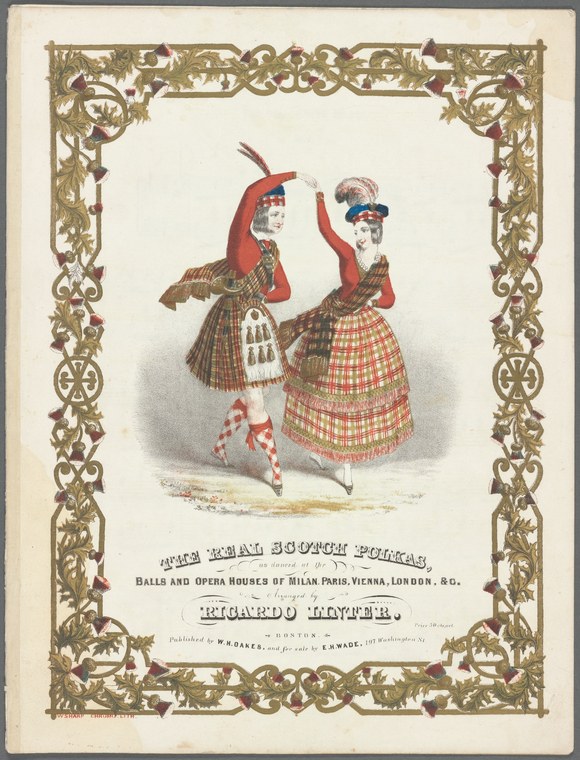
The real Scotch polkas [with score]: as danced at the balls and opera houses of Milan, Paris, Vienna, London, &c
Unknown artist
- Collection:
- Prints depicting dance
- Source:
- New York Public Library
- Rights:
- Public domain — free to use, share and adapt.
- Recorded as:
- Public Domain
This image documents the critical moment when traditional Scottish dance was being commercialized and standardized for the European ballroom market. For dance historians, it is evidence of how specific regional variants acquired fixed steps, standardized music, and correct costume—and how that standardization was circulated via print. For anyone interested in the polka or in nineteenth-century social dance practice, it shows authentic contemporary instruction material in the moment of actual use.
What you are looking at
Two women in vibrant tartan skirts and matching red jackets with white fur trim perform a lively Scottish polka. Both wear feathered bonnets tied with ribbon and decorative ankle gaiters in red and white check. The figure on the left leans forward dynamically, one leg extended behind her in a striking arabesque, arms raised expressively. Her companion stands more upright, also with raised arms in an animated pose. Both women's skirts billow outward, capturing the rapid spinning motion of the dance. The composition is set against a plain cream background, framed by an ornate gold and burgundy decorative border typical of mid-nineteenth-century sheet music or dance instruction materials. The border features intricate scrollwork, tassels, and classical ornamental details that suggest this is a formal publication for ballrooms and opera houses across Europe.
The dancing
Both dancers adopt a bouncy, animated upper-body carriage with high arm positions and forward-tilted torsos characteristic of lively social dancing. The left dancer's extended leg and arched back suggest the turning, spinning action of the polka, with her body rotating through space. The right dancer faces front, mirroring the energy and height of port de bras. Neither figure shows a closed ballroom frame; instead both dance with open, individually expressive arm work and substantial vertical lift. The dynamic asymmetry between them—one leaning, one more vertical—captures the quick, rhythmic pulse and constant turning inherent to the dance.
The dance depicted
This is a Scottish polka, a social partner dance that was enormously popular in mid-nineteenth-century ballrooms across Europe. The polka itself originated in Bohemia but was rapidly adopted and regionalized—Scottish, Irish, French, German, and Scandinavian variants each developed distinctive footwork and costume. The dancers' tartan skirts, bonnets, and ankle gaiters identify this specifically as a Scottish regional variant. The image documents a moment of rapid turning and elevation, with both dancers in an active state of motion. The sheet music notation below (visible in the original) would have provided the musical tempo and structure for dancers learning the steps. This publication format—a hand-colored engraving of dances 'as danced at the balls and opera houses' of major European cities—was a standard way of circulating and standardizing dance steps across cities and social classes in the 1840s–1860s.
How it was made
This is a hand-colored lithograph or engraved print with applied color, typical of mid-nineteenth-century dance instruction and sheet music covers. The decorative border, the inclusion of musical staff notation below, and the mass-production format indicate this was a commercial publication printed in quantity for sale to middle-class households and dance schools. The technique allowed rapid circulation of standardized choreography and costume instruction across Europe, making specific dances reproducible in London, Paris, Vienna, and Milan simultaneously. The hand-coloring gives it immediacy and visual appeal; the border and typography mark it as a luxury item within affordable reach of the aspiring genteel public.
About this work
This is a contemporary record of the Scottish polka as performed in European ballrooms and opera houses during the mid-nineteenth century. The print serves simultaneously as sheet music, choreographic instruction, and fashion plate—capturing not only how the dance was executed but how dancers were expected to look. The image preserves a specific moment in the history of social dance, when regional folk variants were being absorbed into urban ballroom culture and commercial print media was standardizing and circulating them across the continent. The ornate border and elaborate costume detail suggest that dancing a regional polka correctly—in historically accurate tartan, bonnet, and gaiters—was a matter of pride and social competence for the middle-class ballroom public.
How to look at it
Notice the moment the artist chose to freeze: both dancers mid-turn, with weight distributed dynamically and limbs extended. The left dancer's arabesque and forward lean shows understanding of how the body orients itself during rapid rotation. Look at the costume detail—the feathered bonnet, the tartan pattern, the ankle gaiters—each element is specific to Scottish regional identity and would have been essential to performing the dance 'correctly' in a fashionable ballroom. The ornate border frames the dance as a precious, valuable piece of knowledge worth preserving and circulating. The print is both intimate instruction and status symbol.
The period
The polka emerged in Bohemia in the 1830s and spread across Europe with extraordinary speed, becoming the dominant social dance of the 1840s–1860s. As it traveled, it acquired local variants—Scottish, Irish, French, German polkas each claimed distinct footwork and costume. This print belongs to the era when urban, middle-class ballroom culture was at its peak and when commercial publishers were racing to codify, illustrate, and sell choreography to an eager public. Sheet music with engraved or lithographed dance figures was a standard product: it taught steps, offered fashion guidance, and signaled sophistication and cosmopolitan knowledge to the buyer. The geographical scope of the publication—'as danced at the balls and opera houses of Milan, Paris, Vienna, London, &c'—reflects the genuine international exchange of dances across European capitals during this period.
Where it lives
The work is held in the New York Public Library's Prints collection. It is a commercial publication, likely from the 1850s–1860s, and exists in multiple copies across institutions. The title page information identifies it as a sheet music cover with choreographic instruction, printed in London and sold through music publishers and dance instructors.
Dance in this work
Questions about this work
What is a Scottish polka?
The polka was a Bohemian dance that spread across Europe in the 1840s. The Scottish variant incorporated Scottish regional dress—tartan skirts, bonnets, ankle gaiters—and may have integrated Scottish folk movement qualities, though the basic polka step and rhythm remained consistent. Scottish polkas appear in ballroom dance instruction from the 1850s onward and were distinct from English or German polkas partly through costume and partly through subtle variations in the styling and energy of the movement.
How do we know what the steps were?
The notation below the illustration (visible in the original) provides the musical structure. Beyond that, written dance instruction manuals from the same period—particularly by French, German, and English dance masters—give detailed step-by-step descriptions of the polka and its regional variants. By comparing this image with contemporaneous instruction books, we can reconstruct the intended footwork and weight transfer.
Who danced the polka?
The polka was a social dance for the urban middle class and aspiring genteel public throughout Europe. It was danced at balls, subscription dances, opera house social events, and in private homes. The costume and setting here suggest this was aimed at a respectable, fashion-conscious audience—people who could afford to buy sheet music and instruction prints and who cared about dancing in correct costume.
Why is costume shown so precisely?
In nineteenth-century ballroom culture, dancing a regional dance correctly meant wearing authentic regional costume. The detail here—the specific tartan pattern, the bonnet style, the ankle gaiters—was instructional. A purchaser of this print would use it as a fashion guide as much as a choreographic one. Correct costume was a form of cultural knowledge and social competence.
More dance artwork





