49 works in this view — arrow keys or swipe to move between them.
Dance in Art
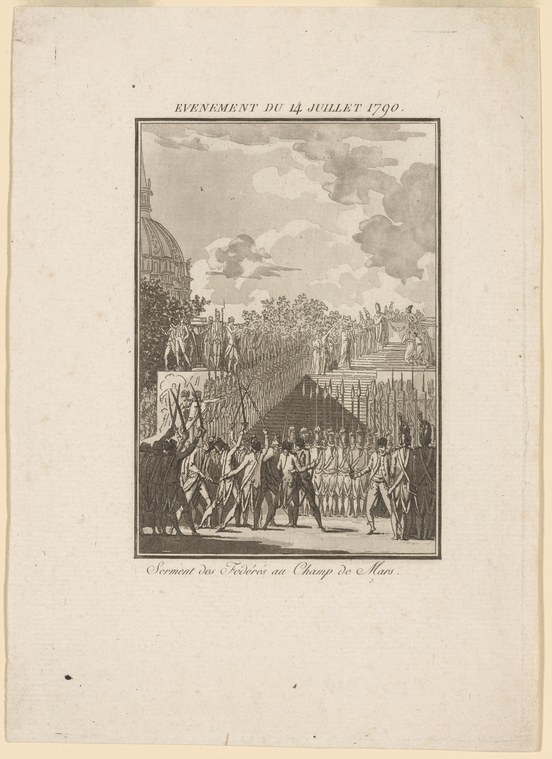
Serment des Fédérés au Champ de Mars
Unknown artist
- Collection:
- Prints depicting dance
- Source:
- New York Public Library
- Rights:
- Public domain — free to use, share and adapt.
- Recorded as:
- Public Domain
This print is evidence of how civic ritual and ceremonial assembly were visualized and circulated in the Revolutionary period. Its presence in a dance collection raises important questions about how historians have categorized 'movement'—whether the archive includes only choreographed dance or also ceremonial and processional action.
What you are looking at
A large gathering of military or civic figures assembled in formal procession at the Champ de Mars in Paris, depicted in this 18th-century engraving. The composition is dominated by densely packed rows of uniformed or formally dressed men arranged in strict linear formation, stretching into the deep background toward a classical building with a dome (likely representing a civic or military structure). In the foreground, a smaller group of prominent figures stands elevated or separated from the main body, suggesting leadership or ceremonial prominence. The sky is rendered with dramatic clouds typical of the period's engraving style. The scene captures a moment of collective civic or military action—a solemn assembly rather than a joyful gathering, with the figures' postures suggesting oath-taking or formal declaration rather than celebration.
The dancing
The figures stand in rigid, vertical postures characteristic of formal military or civic ceremony rather than dance. Bodies are arranged in parallel lines perpendicular to the picture plane, with minimal variation in stance or arm position—a visual convention for depicting mass assembly rather than movement. The foreground figures show more articulation and gesture, with some arms raised or extended as if in address or salute, suggesting speakers or leaders directing the gathering. No couples, no holds, no rhythmic spacing or weight shift visible; the arrangement is administrative and hierarchical rather than kinetic.
The dance depicted
This is not a dance scene, despite appearing in a collection labeled 'Prints depicting dance.' The engraving documents a civic or military assembly—most likely the Serment des Fédérés (Oath of the Federates), a ceremonial gathering during the French Revolutionary period. The 'dance' category may reflect the print's archival history or a cataloguer's assumption about crowd scenes. The formal procession and massed figures belong to civic ritual, not choreographed movement. No musical instruments, no couples, no rhythm, and no bodily formations typical of dance are evident.
How it was made
This is a line engraving, characteristic of 18th-century French prints made for broad circulation and documentation of current events. The technique—fine parallel lines (hatching) to create tone and depth—was the standard for news graphics and historical records of the period. Engraving allowed multiple impressions and wide distribution, making this the kind of image that would have reached educated Parisians as contemporary record. The style is documentary rather than artistic, prioritizing legibility of the assembly's scale and structure over compositional subtlety.
About this work
This engraving documents the Serment des Fédérés (Oath of the Federates), a major civic ceremony during the early French Revolutionary period, likely from 1790. The work records a moment of mass collective action and declaration rather than dance, though it has been preserved in dance collections, possibly due to the archival confusion around 'movement' and 'procession.' The print exemplifies how 18th-century engraving was used to circulate images of significant public events to a literate audience.
As a historical artifact, the engraving matters not for dance but for its documentation of Revolutionary-era civic ceremony and the public's appetite for images of political gathering. It belongs in a dance archive only if the collection aims to trace the boundary between choreographed movement and ceremonial assembly, or if it documents the visual culture surrounding public festivals of the period.
How to look at it
Attend to the rigid, parallel arrangement of figures and the emphasis on vertical posture and frontal orientation—markers of formal assembly rather than dance. Notice how the foreground figures are individualized and elevated, suggesting they are speaking or leading, while the masses behind them are depicted as undifferentiated and uniform. The engraver has chosen to freeze a moment of collective stillness and attention, not motion. The composition's depth—the receding rows and the building in the distance—emphasizes the gathering's scale and civic significance rather than any aesthetic or rhythmic qualities.
The period
The Serment des Fédérés events took place in the early 1790s as celebrations of Revolutionary unity, with the most famous gathering at the Champ de Mars in Paris on July 14, 1790. These ceremonies combined civic ritual, military display, and public spectacle, often incorporating music and formal processions that blurred the line between ceremony and performance. The period saw a proliferation of prints documenting Revolutionary events, making engraving a crucial medium for circulating images of political transformation to a broad audience. Many Revolutionary-era public festivals included organized movement and choreographed group actions, though this particular engraving emphasizes the oath-taking and declaration rather than any rhythmic or aesthetic movement.
Where it lives
The print is held in the New York Public Library's collection of prints depicting dance. Its presence there may reflect cataloguing decisions about crowd scenes, processional imagery, or Revolutionary-era public spectacle rather than evidence that it depicts dance in any technical sense.
Questions about this work
Is this actually a dance?
No. This engraving documents the Serment des Fédérés, a civic and military ceremony where participants took an oath of unity. While the event involved public spectacle, procession, and possibly music, the scene itself depicts a formal assembly and declaration, not choreographed dance. The rigid postures, parallel formations, and hierarchical arrangement are those of ceremony, not movement.
Why is this in a dance collection?
Likely due to archival categorization practices that grouped 'movement' or 'spectacle' broadly. The print may have been filed under dance because Revolutionary-era public festivals sometimes included organized group movement, or because it was misfiled as a crowd scene. It serves as a useful boundary case—an image of collective human action that is performative and public but not choreographed.
What was the Serment des Fédérés?
A series of civic ceremonies during the French Revolution, most famously on July 14, 1790, when National Guard units and civic leaders gathered at the Champ de Mars to take an oath of loyalty to the nation and the constitution. The events were spectacular public gatherings intended to demonstrate Revolutionary unity, and were documented in engravings for wide circulation.
More dance artwork





