49 works in this view — arrow keys or swipe to move between them.
Dance in Art
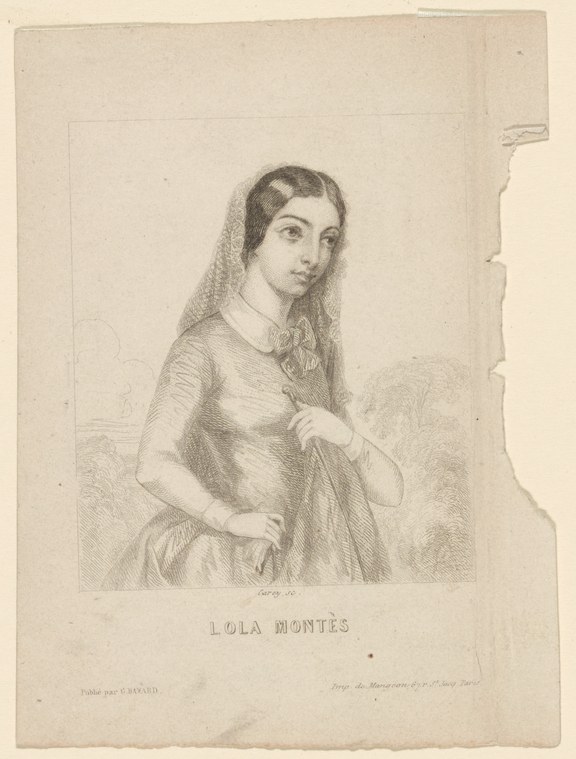
Lola Montès
Unknown artist
- Collection:
- Prints depicting dance
- Source:
- New York Public Library
- Rights:
- Public domain — free to use, share and adapt.
- Recorded as:
- Public Domain
Lola Montès was one of the most talked-about performers of her age, but her reputation rested as much on her personal scandals and her relationships with European royalty as on her dancing. This portrait illustrates the collision between the world of theatrical performance and high society that defined her career. For historians of 19th-century dance and celebrity culture, such images reveal how a dancer's public persona was constructed and circulated in the pre-photographic era.
What you are looking at
A three-quarter-length portrait of a young woman in a neoclassical style, rendered as an engraving or lithograph. She is shown from the waist up, turned slightly to her left, gazing away from the viewer with a pensive expression. She wears a high-waisted, draped garment in the Empire silhouette fashionable in the early 19th century, with delicate short sleeves and what appears to be a shawl or stole wrapped loosely around her shoulders. A fine veil or head covering falls from her hair to her back. The background is minimal and neutral, rendered with subtle shading. The line work is precise and controlled, creating volume through parallel hatching rather than broad tonal areas. The composition emphasizes dignity and restraint rather than theatrical gesture.
The dancing
The figure is poised rather than actively dancing. The torso is upright and centered, the shoulders relaxed. One arm rests naturally at her side while the other hand grasps or adjusts the fabric of her shawl—a gesture of modest restraint rather than movement. The pose suggests standing stillness. There is no indication of dance technique in the body alignment, foot position, or momentum.
The dance depicted
This is a portrait of the dancer Lola Montès rather than a representation of her dancing. The image does not depict her in motion or in the act of performance. Lola Montès (1821–1861) was a Spanish-born dancer famous across Europe for her Spider Dance and other theatrical works in the mid-19th century, and was known as much for her scandals and love affairs as for her artistry. This print captures her as a fashionable society figure at a moment of repose, not as a performer on stage.
How it was made
This is an engraving or lithograph, likely hand-colored or printed in a tonal technique, identifiable by the fine parallel line work and the delicate gradation of gray tones. The technique allowed for wide circulation and inexpensive reproduction compared to paintings, making it the standard medium for celebrity portraiture and theatrical publicity in the 19th century. The print is published 'par D. Maynard' with a publication mark visible at bottom, indicating it was a commercial product intended for collectors and admirers of the theater.
About this work
This is a portrait engraving of the celebrated 19th-century dancer Lola Montès, one of the most famous and controversial performers of her era. The image presents her not as a dancer in motion but as a fashionable woman of her time, in the neoclassical portrait mode that dominated celebrity imagery of the period. She appears in the dress and bearing of polite society rather than the costume and energy of the stage. The work is significant as a document of how a famous dancer was marketed and consumed—as a society celebrity and object of fascination—and how printmaking served the machinery of theatrical fame in the mid-19th century.
How to look at it
This is not a dance image but a celebrity portrait. The viewer should attend to the contrast between the restraint and dignity of the pose and the turbulent public persona Lola Montès enjoyed. The fashionable dress and careful composition suggest respectability and high status, qualities that her actual life and career—marked by scandal, expulsion from various courts, and bohemian living—constantly threatened to undermine. The portrait shows how the theater industry presented its stars to a respectable public audience.
The artist
The print is credited only to 'D. Maynard' as publisher. The engraver's name is not recorded. Such prints were commercial products made for a mass market; they often preserved the name of the publisher but not the artist who cut the plate or drew the image. This anonymity was typical of theatrical publicity work in this period.
The period
The 1830s and 1840s saw the rise of the theatrical celebrity and the machinery of publicity that surrounded famous performers. Lola Montès danced during the Romantic era of ballet, when ethereal, otherworldly subject matter dominated high art dance; her work, however, was in popular theater and cabaret. The fashion visible here—the high waist, the veil, the neoclassical silhouette—remained current from the Napoleonic era through the 1840s. Engraved and lithographed portraits of stage celebrities were eagerly collected and displayed, making them among the most accessible visual art in middle-class homes.
Where it lives
The work is held as part of the New York Public Library's collection of prints depicting dance. It is a commercial engraving or lithograph, likely dating to the 1840s, and would have been sold singly or in serialized collections of theatrical celebrities.
Questions about this work
Was Lola Montès a famous dancer?
Yes. She was one of the most celebrated—and scandalous—performers of the 1830s and 1840s, known for works including the Spider Dance, which she performed across Europe. She was also famous for her affairs with European nobility, which caused her to be expelled from several courts and made her as much a figure of public gossip as of artistic respect.
Why doesn't this image show her dancing?
This is a portrait for public circulation, not a documentation of performance. In the 19th century, celebrity portraits were sold as souvenirs and collectibles; they presented the star as a fashionable, respectable person rather than in the theatrical moment. Photography would later change this, but in the era of engraving, portraits of performers were usually posed and formal.
Who was D. Maynard?
The record lists Maynard as the publisher of this print, but does not identify the artist or engraver. It was common practice in commercial printmaking to credit the publisher but not the maker of the image. Without further research, the engraver's identity remains unknown.
More dance artwork





