49 works in this view — arrow keys or swipe to move between them.
Dance in Art
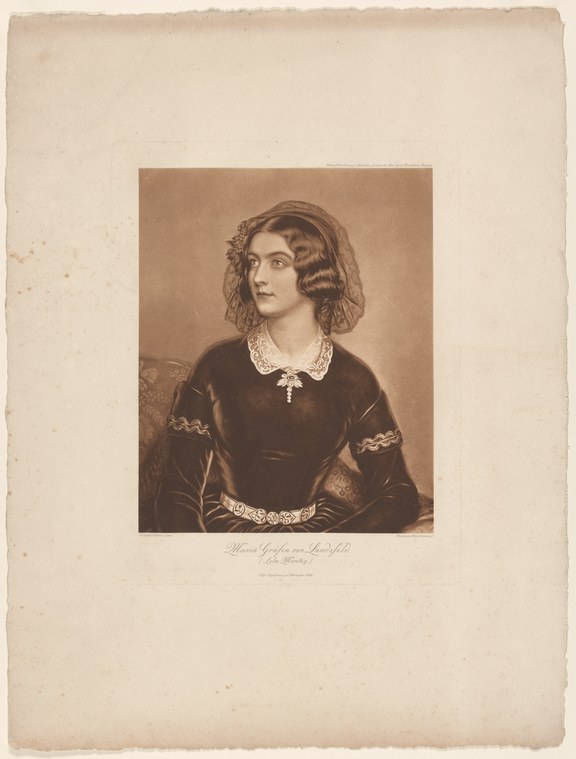
Maria, Gräfin von Landsfeld (Lola Montez)
Unknown artist
- Collection:
- Prints depicting dance
- Source:
- New York Public Library
- Rights:
- Public domain — free to use, share and adapt.
- Recorded as:
- Public Domain
Lola Montez was a globally famous performer whose influence on dance, scandal, and the commodification of women performers shaped mid-nineteenth-century culture. This portrait—one of many circulated commercially—demonstrates how theatrical celebrities were marketed and consumed as visual commodities, and how a dancer's image and persona could be detached from performance and sold as society portraiture. For historians of dance and celebrity, it illustrates the machinery of fame in the period before photography became dominant.
What you are looking at
A three-quarter-length portrait of a young woman in a dark velvet dress, shown against a warm sepia background. She is positioned in an elegant seated or standing pose, facing left of frame with her head turned slightly toward the viewer. Her dark hair is styled in fashionable waves and partially covered by a delicate lace veil or headdress secured with what appears to be a jeweled ornament. The dress is striking: a high-necked dark velvet garment trimmed with elaborate white lace at the collar and cuffs, and decorated with ornamental embroidery or beadwork at the waist and along the sleeves. The woman's bearing is aristocratic and composed; her gaze is direct and confident. The print is rendered in sepia tones with fine tonal gradation, the background warm and atmospherically soft, which throws the figure into sharp relief.
The dancing
The woman's posture is upright and dignified, her body angled in a three-quarter pose that was conventional for formal portraiture of the period. Her arms are positioned with one visible at her side or resting naturally; her hands are delicate and well-rendered. The overall frame is static and posed rather than captured in motion—this is portrait convention, not dance action. No weight shift, no open extended limbs, no footwork is visible or implied.
The dance depicted
This work does not depict dance action. It is a formal portrait, likely a commemorative print of a named individual (identified in the inscription as Maria, Countess of Landsfeld, known as Lola Montez). Lola Montez (1821–1861) was a celebrated dancer and courtesan who performed as a Spanish dancer across Europe and the Americas in the 1840s–1850s; however, this image is a formal society portrait made to circulate her likeness, not documentation of her performance. The dress and styling are consistent with fashionable aristocratic women's wear of the 1840s–1850s, the period of her greatest fame.
How it was made
This is a hand-colored or tinted engraving or possibly a lithograph, recognizable from the fine linear hatching, the characteristic warm sepia tone of period color printing, and the quality of detail in the lace and embroidery. The technique allowed for mass production and wide circulation of celebrity likenesses during the early-to-mid-nineteenth century. The print is mounted on larger paper stock, typical of gift prints or collectible portraiture of the era. The fine definition and formal presentation suggest this was a professional commercial product, marketed to admirers and society audiences.
About this work
This is a formal portrait engraving of Lola Montez, the renowned dancer and public figure of the 1840s–1850s. Although Montez built her fame as a performer—she claimed to dance the Spanish *cachucha* and marketed herself as an exotic Spanish dancer—this particular work documents not her on stage but her as a society celebrity, dressed in fashionable aristocratic costume. The image participates in the mass production of celebrity portraiture that characterized the period, allowing admirers and the curious to own a likeness of one of the era's most notorious personalities. It belongs in a dance archive not because it shows dance, but because it preserves the image and social status of a major theatrical performer and because it reveals how dancers of this period were consumed and circulated in popular culture beyond the theatre.
How to look at it
Notice the careful attention to the lace, embroidery, and jewels that mark this as a woman of wealth and status—these details would have signaled her celebrity and desirability to viewers. The composed, direct gaze and elegant pose follow portraiture convention but also assert her confidence and agency in controlling her own image. The sepia tone and fine engraving technique were state-of-the-art for celebrity reproduction and would have made this print affordable and collectible for admirers. The inscription at the base anchors the image to her name and, implicitly, her fame.
The artist
The artist is not recorded. The work is a commercial portrait engraving of the type produced by professional print houses across Europe and America during the 1840s–1850s. Multiple versions and variants of Lola Montez portraits were in circulation, suggesting she was a subject of sustained commercial interest and that her image was produced, distributed, and consumed across multiple venues and publishers.
The period
Lola Montez emerged as a major theatrical figure in the 1840s, at a moment when Romantic ballet was at its height and when non-classical dances—especially those marketed as exotic, Spanish, or oriental—attracted enormous popularity and fascination. She claimed to perform a Spanish *cachucha*, which she promoted as authentic folk dance; this claim was contested even in her lifetime, and she was eventually revealed to have been born Eliza Gilbert in Limerick, Ireland, not Spain. The circulation of her portrait in numerous commercial formats reflects both her theatrical fame and the broader Victorian appetite for images of celebrated actresses and dancers. The portrait's refined, aristocratic presentation—formal dress, jewels, refined styling—shows how dancers of this period, despite (or because of) their ambiguous social status, were packaged as objects of desire and admiration for middle-class collectors.
Where it lives
The work is held in the New York Public Library's collection of prints depicting dance. It is a commercial engraving, likely printed in multiple impressions and distributed for sale or gift, rather than a unique artwork.
Questions about this work
Did Lola Montez actually dance the cachucha?
Montez claimed to perform the *cachucha*, a Spanish folk dance, and this was central to her marketing as an exotic performer. However, historians have long questioned the authenticity of her performance and her Spanish identity. She was of Irish birth and likely learned a theatrical version of Spanish dance in London. The *cachucha* was itself a fashionable theatrical dance in Romantic ballet, not necessarily performed in its original folk form.
Why is a portrait in a dance collection?
While this image does not depict dance action, it preserves the likeness of one of the nineteenth century's most famous dancers and illustrates how dancers were commodified and celebrated as public figures. It documents the visual culture and celebrity apparatus surrounding theatrical dance in this period.
What does the inscription say?
The inscription identifies her as Maria, Countess of Landsfeld, Lola Montez. 'Maria' was part of her stage persona; her real name was Eliza Gilbert. 'Countess of Landsfeld' was a title granted to her by King Ludwig I of Bavaria, whose mistress she became in 1846, a relationship that caused a political scandal.
More dance artwork





